
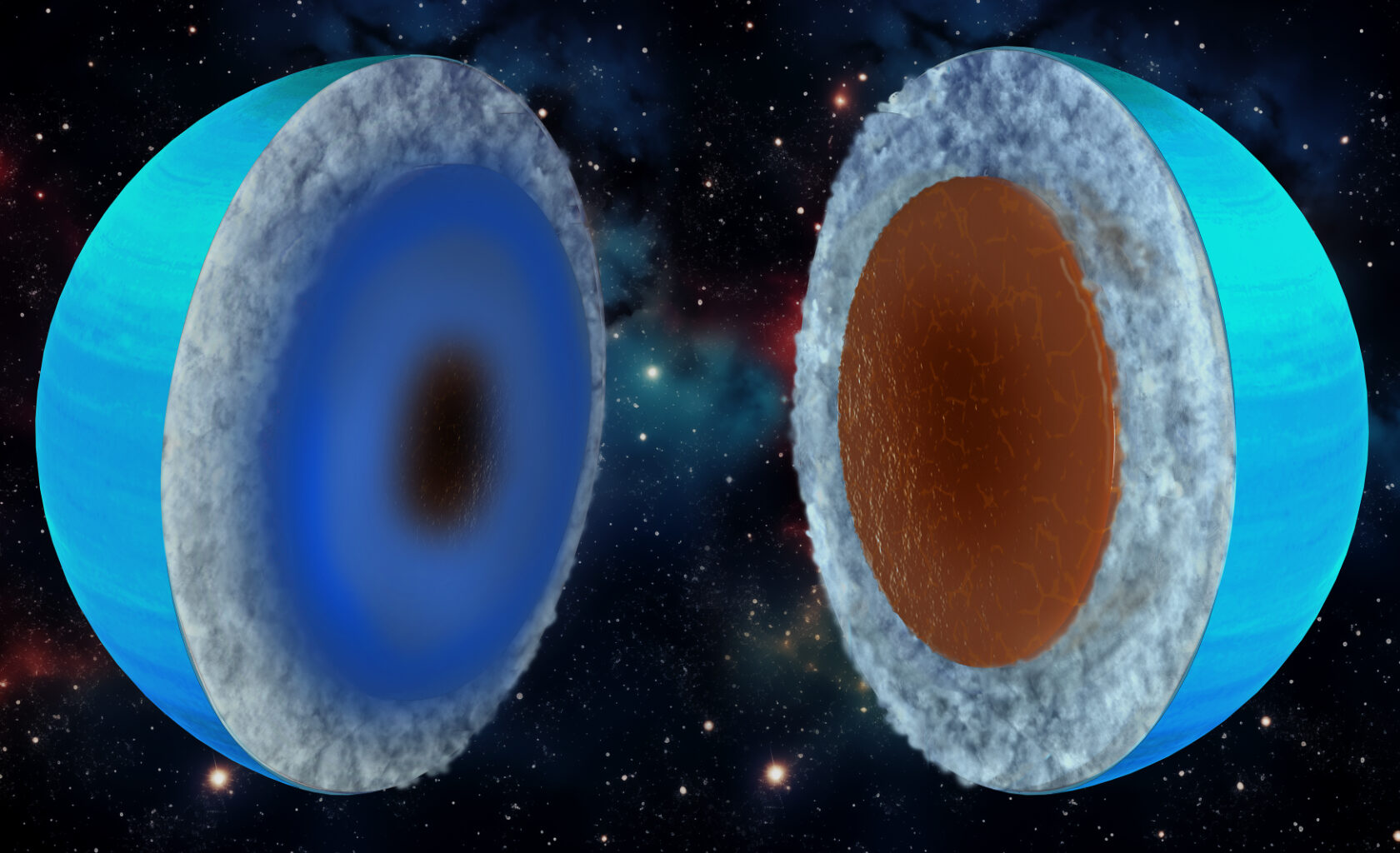
It seems that we know the planets in our solar system relatively well, but a recent study rethinks our two beautifully blue ice giants. Instead of being composed of gassy, icy materials, like immense orbiting slushies made of methane and ammonia, Uranus and Neptune could be rock giants, hiding a huge mass of rock in their enigmatic interiors.
The study, courtesy of the University of Zurich and the Swiss planetary research institute NCCR PlanetS, lays down a theoretical framework for reexamining conventional wisdom in the outer solar system.
This framework simulates the interiors of Uranus and Neptune, using random density profiles and then calculating the resultant gravitational field, until these models match up with observational data of the two ice giant planets.
“Models based on physics were too assumption-heavy, while empirical models are too simplistic. We combined both approaches to get interior models that are both “agnostic” or unbiased and yet, are physically consistent,” says Luca Morf, the study’s lead author.
In other words, the researchers found a middle ground between “rigid assumptions” and “simplified empirical profiles,” to develop a new, middle-way of thinking.
Solving Solar System Mysteries with New Models of Uranus and Neptune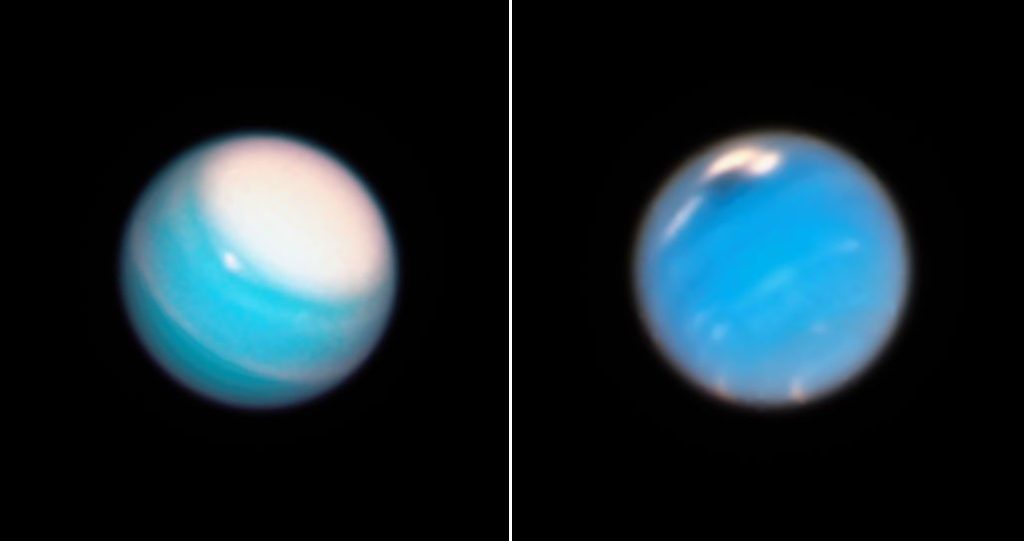 Another rethink: the Hubble Space Telescope shows that Uranus and Neptune are more similar in color than some may think.
In addition to the possibility of Uranus and Neptune being surprisingly rocky, the researchers also suggest that the ice giants have convective interiors that swirl wildly with ionic water, which exists in the insanely hot, high-pressure conditions inside immense planets.
The swirling, conductive nature of this alien fluid may help explain why Uranus and Neptune have such weird, multipolar magnetic fields — ones that are more disordered than Earth’s generally dipolar magnetic field.
Overall, this innovative way of re-examining the ice giants is “something that we first suggested nearly 15 years ago, and now we have the numerical framework to demonstrate it,” explains astrophysicist and study initiator Ravit Helled in the official press release. There are still uncertainties, of course, as are often caused by cosmic conditions. As such, the researchers aren’t making any decisive statement as to whether our solar system’s outer planets are icy or rocky.
The study was published in Astronomy & Astrophysics.