
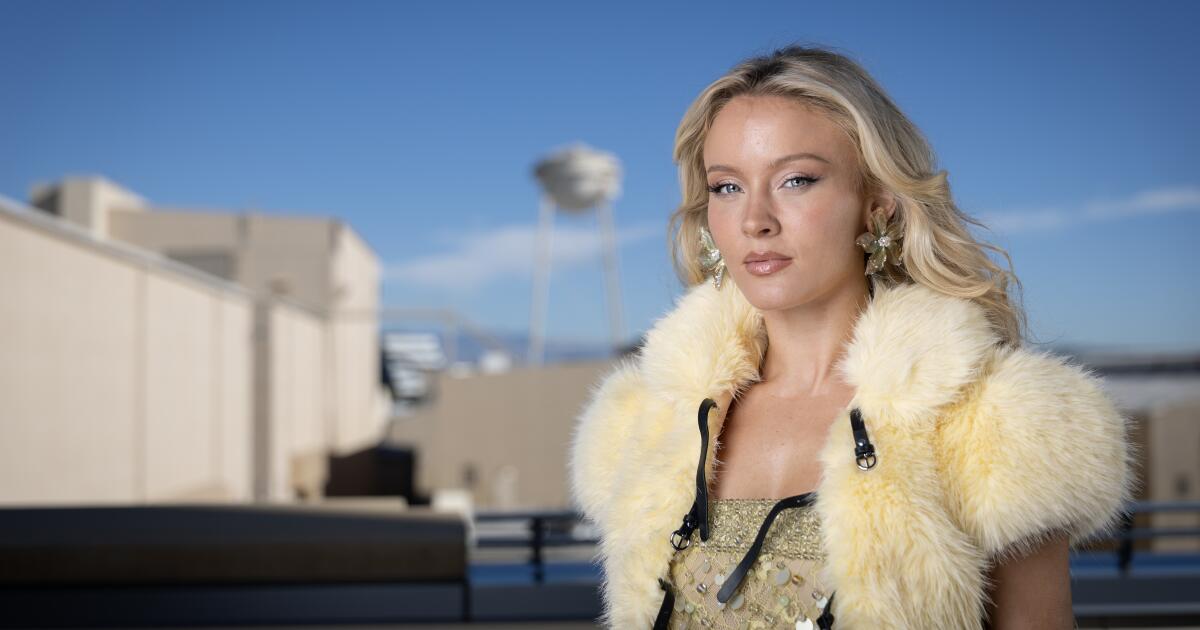
A chauffeured black SUV pulls up to the curb outside Destroyer in Culver City and out jumps Zara Larsson like somebody riding a float in the Rose Parade.
The 28-year-old Swedish singer has been a steady presence in pop music for about a decade, with a string of catchy singles — “Lush Life,” “Never Forget You,” “Ruin My Life” — that have racked up hundreds of millions of streams without ever quite establishing a place for her among music’s glitterati.
Yet that’s finally what happened this year with the title track from Larsson’s fifth studio album, “Midnight Sun.” A euphoric electro-pop jam about “skinny-dipping with your heart out,” it was called one of the songs of the summer by Pitchfork, which described it as “‘Ray of Light’ via Jersey club by way of Lisa Frank” and said it was “seemingly designed in a lab to short-circuit gay guys’ critical thinking.” Now “Midnight Sun” is nominated for a Grammy Award — Larsson’s first — in the dance pop recording category alongside tracks by Lady Gaga and Tate McRae.

Wearing a sparkly mini-dress and a brightly colored shrug, Larsson — who’s also made headlines lately with her vocal support of the Palestinian people — spoke about her career upswing over breakfast on a warm December morning ahead of an appearance at iHeartRadio’s annual Jingle Ball concert.
“It’s so much nicer to be here right now than back home,” she says, her blond hair shining in the sun. “In Sweden, it’s snowy and cold, and it gets dark so early. You’ll be like, ‘Guys, it’s really late — we should go to sleep.’ Then you realize it’s 3:30.”
You said in a recent interview that the American propaganda machine worked on you. I wondered which parts specifically.
The entertainment of it all: the Hollywood sign, the Walk of Fame, Universal Studios, just L.A. as a whole. That’s also why I like coming here — it’s like I’m still living in a childhood fantasy. There’s something motivating about coming to the land of trying for success versus being at home, where we’re just happy with our insurance and our healthcare. There’s no grind.
The grind is good?
In doses. I like to come here for a few months, feel inspired, then go back home.
You started spending time in L.A. for work when you were young.
Sixteen or 17. I always came with my mom — she used to take me everywhere. I didn’t really have any friends here but then I wrote some people on Instagram around my age and was just like, “You wanna grab lunch?”
Kind of bold.
Why not? Having friends here changes everything. If I have a weekend, I can drive somewhere and see somebody. The car is a big reason why I like L.A. I love to be in the car — I get to listen to music and be in my thoughts. It’s one of the only times I don’t scroll on my phone.
Is “Midnight Sun” your best album?
For sure. I think it’s better because it’s more me. When I started out, I knew that I loved singing and loved performing — I loved to entertain. But as I grow older, I realize there’s a difference between being a performer and being an artist.
How did making this album differ from making your earlier ones?
I got signed at 14 and started releasing music at 15, and I was always surrounded by a lot of adults or people way older than me. They were amazing but they weren’t my peers. I felt a little disconnect because of the age gap or because they had 10 hits under their belt — I just felt a little small. This was the first project where I’d collected people that felt like my friends and we were making this truly together.
In an alternate timeline, that earlier process slowly wears you down and you never arrive at the epiphany you described.
I can’t remember who, but someone said that being an artist, what wears you down isn’t people hating on you — it’s being ignored. That’s more hurtful than someone booing you.
You ever get booed?
Sometimes, but that wasn’t really for my music — that was for my political opinions. But at least there’s energy in that.
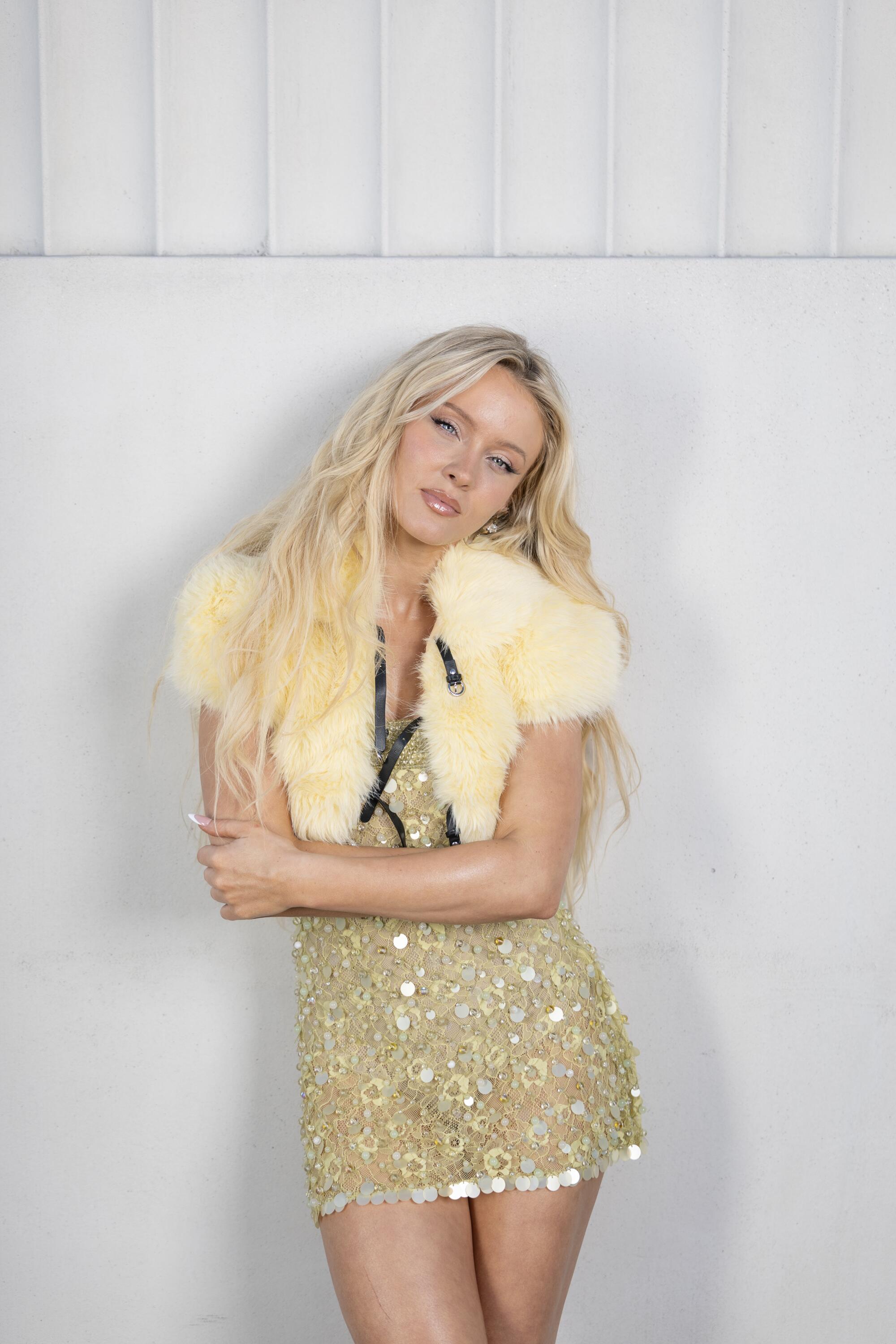
Zara Larsson
(Allen J. Schaben / Los Angeles Times)
You told PinkPantheress in Interview magazine that you’ve been practicing your Grammy speech since you were 8.
Maybe not practicing but definitely fantasizing: “Wow, I can’t believe it!” Me and the mirror growing up were like [crosses fingers]. When I think back on it, the mirror was like the ultimate manifestation tool. That’s what I was doing my whole childhood — picturing myself onstage in front of people, entertaining them but also entertaining myself.
What did the people in your life make of that disposition?
I mean, it was always embarrassing doing that performance in the mirror, then looking back and seeing my sister looking into the room with her friends: “What is she doing?”
You’re playing Jingle Ball tonight. Would you say you were aiming “Midnight Sun” at U.S. Top 40 radio?
With love and respect for iHeart, I really did not give a f— about radio. Wanting to do something for other people — Will the radio play this? Will other people think this is a hit? — I don’t think that’s ever gonna truly benefit you. I understand why people do it. But it’s not very inspiring. And weirdly enough, when I stopped doing that, that’s when they were like, “Do you want to come and perform?”
Was success in America always important to you?
Yes. That’s why I never wanted to sing in Swedish. Back home, all our popular artists sing in Swedish.
Writing lyrics in Swedish —
[Cringes]
It wouldn’t be good?
Maybe. I haven’t really tried. As a language, it’s very melodic. And what’s interesting is I love to write in Swedish — I used to have this blog that I wrote in Swedish.
Do any Swedish people resent you for not singing in Swedish?
No, because we’ve had so many amazing artists who sing in English: Roxette, Ace of Base, a lot of huge DJs. Everybody knows that Sweden has a huge export of music — that’s probably what made me feel like I can do this because all these other people have done it: Robyn, Lykke Li, Max Martin, obviously.
Is Max Martin regarded in Sweden as a national hero?
He’s so low-key. If anybody with semi-long hair came up and said, “I’m Max Martin,” people would be like, “Yeah.” I don’t think he’s a recognizable person in people’s minds because he’s not on TV. We don’t have a celebrity culture.
In pop music, most of the big performers are women and most of the big producers are men. Yet I was struck by the fact that Addison Rae made her album in Sweden with two women: Elvira Anderfjärd and Luka Kloser.
I f— love them. Elvira is one of my favorite producers. I knew a few years back that I never want to be in the studio with only men. I’ve done that so many times, and they were always very nice. But I never felt truly seen and heard in those rooms. This time basically no straight men made the record, and it was wonderful.