
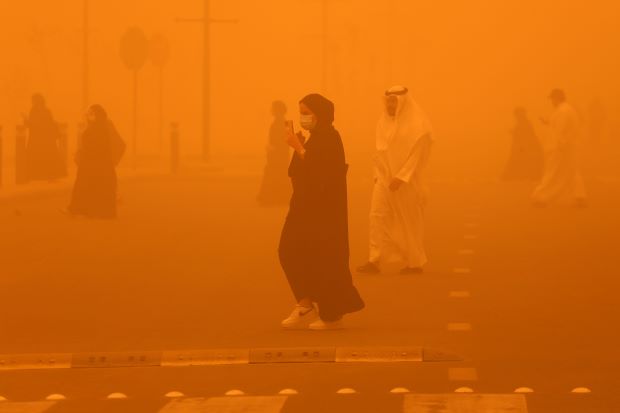
Pedestrians cross a road amidst a severe dust storm in Kuwait City on May 23, 2022.YASSER AL-ZAYYAT/AFP via Getty Images
In the heart of the Arabian desert,
Kuwait has some of the world’s highest rates of chronic diseases. Seven in ten
adults are overweight or obese, and a quarter has diabetes. With summer
temperatures topping 50 °C and choking dust storms; the stakes for health could
not be higher.
For decades, scientists have tried to
untangle why certain populations suffer disproportionately from chronic
conditions. Genetic advances, including genome-wide association studies and
national genome projects, promised to illuminate inherited risks. Yet even after sequencing
millions of genomes, the puzzle remains incomplete.
Genes account for only a fraction of the
risk. The rest comes from the environment; the air we breathe, the food we eat,
and the stresses we endure, which play a major role in chronic conditions like
diabetes and obesity. This is where ‘the exposome’ enters.
The idea of the Exposome
The exposome captures the sum of
environmental exposures accumulated across a lifetime. Think of it as a
molecular diary; air pollutants, diet, noise, chemicals, climate extremes, even
psychosocial stressors, all etched into biological signatures. Just as genomics
catalogues inherited variation, exposomics seeks to map this shifting external
landscape.
Technology allows us to measure exposures
with the same rigour applied to DNA. Satellites can track fine-grained
pollution, wearable sensors monitor heat and activity, and test kits detect
chemical traces in blood.
Integrating genome and exposome could
help us understand who is at risk, why, and under which conditions. In our recent commentary on precision health in Kuwait, in Nature Reviews
Genetics, we argued that bringing genetic and environmental insights
together can help capture the true drivers of disease.

Hamad Ali, Associate Professor of Genomic Medicine, Kuwait University
Kuwait as a Natural Laboratory
Few places illustrate the urgency of this
integration more vividly than Kuwait. The country is at the far-right tail of
global heat distributions, with climate change set to raise average
temperatures another five degrees by century’s end. Dust storms blanket cities,
with fine particulate pollution breaching the World Health Organization limits
on nearly nine out of ten days.
Environmental extremes worsen health
outcomes directly, supported by our study published in BMJ Diabetes Research & Care. Hot days alone were linked to hundreds of
excess hospitalizations for diabetes each year, while increases in dust
concentration added further admissions.
When heat and dust coincided, the risks were
compounded, sharply increasing the likelihood of hospital admissions among
people with diabetes. These extremes intensify diabetes complications, fuel
inflammation, and strain hospital services.
At the same time, Kuwait’s genetic
landscape is distinctive. High rates of consanguinity (marriage among relatives)
have produced a relatively homogeneous population with certain hereditary
traits occurring more frequently. For researchers, this presents a unique
opportunity: a controlled setting to study how specific genetic predispositions
interact with relentless environmental stressors.
Do certain variants protect against
heat-induced cardiovascular strain? Are others particularly vulnerable to
dust-triggered inflammation? Answering such questions could provide insights
that benefit not only Kuwaitis, but populations worldwide facing rising heat
and pollution.
A Chance for integration
Kuwait is yet to launch a national genome
project, unlike its Gulf neighbours. But being late may prove an advantage.
Instead of replicating earlier models that focused narrowly on DNA, Kuwait can design
a programme that integrates
exposome data from the start.
Such a programme could sequence genomes
while simultaneously collecting high-resolution exposure data including; air
quality and climate records, personal sensor readouts, biomarkers of chemical
pollutants, and lifestyle surveys.
Artificial intelligence could knit these
data streams together, revealing patterns invisible to any single layer. The
result would be a model of how environment and inheritance combine to shape
disease. If successful, other nations with harsher climates, high pollution, or
rising chronic disease rates could replicate this model.
This opportunity does not stop at
Kuwait’s borders. The Gulf region already hosts advanced biomedical ecosystems.
Qatar has built strong genomics and health research platforms, while the United
Arab Emirates has rapidly expanded its genomic medicine programs. By aligning
efforts, sharing expertise, pooling resources, and coordinating strategies, the
region could shape the standards for genome–exposome science.
The idea of integrating genomic
information with environmental exposure data is beginning to gain real momentum
in Kuwait, with efforts to connect genetics, environmental factors, and
precision medicine into a unified vision for health.
What is required now is political will.
Mobilizing resources for such an initiative demands courage and clarity of
purpose. But the payoff is immense: healthier lives for Gulf citizens, and a
template for tackling chronic disease in an age of climate stress.
doi:10.1038/nmiddleeast.2025.217
1- Alahmad B, et al.
Combined impact of heat and dust on diabetes hospitalization in Kuwait. BMJ
Open Diabetes Research & Care. 2024;12(4). doi: 10.1136/bmjdrc-2024-004128.
2- Ali H, Alahmad B,
Al-Refaei FH, Tayoun AA, Lashuel HA, Sabah SA, et al. Integrating the genome
and exposome for precision health in Kuwait. Nature Reviews Genetics. 2025.
doi: 10.1038/s41576-025-00883-6.