
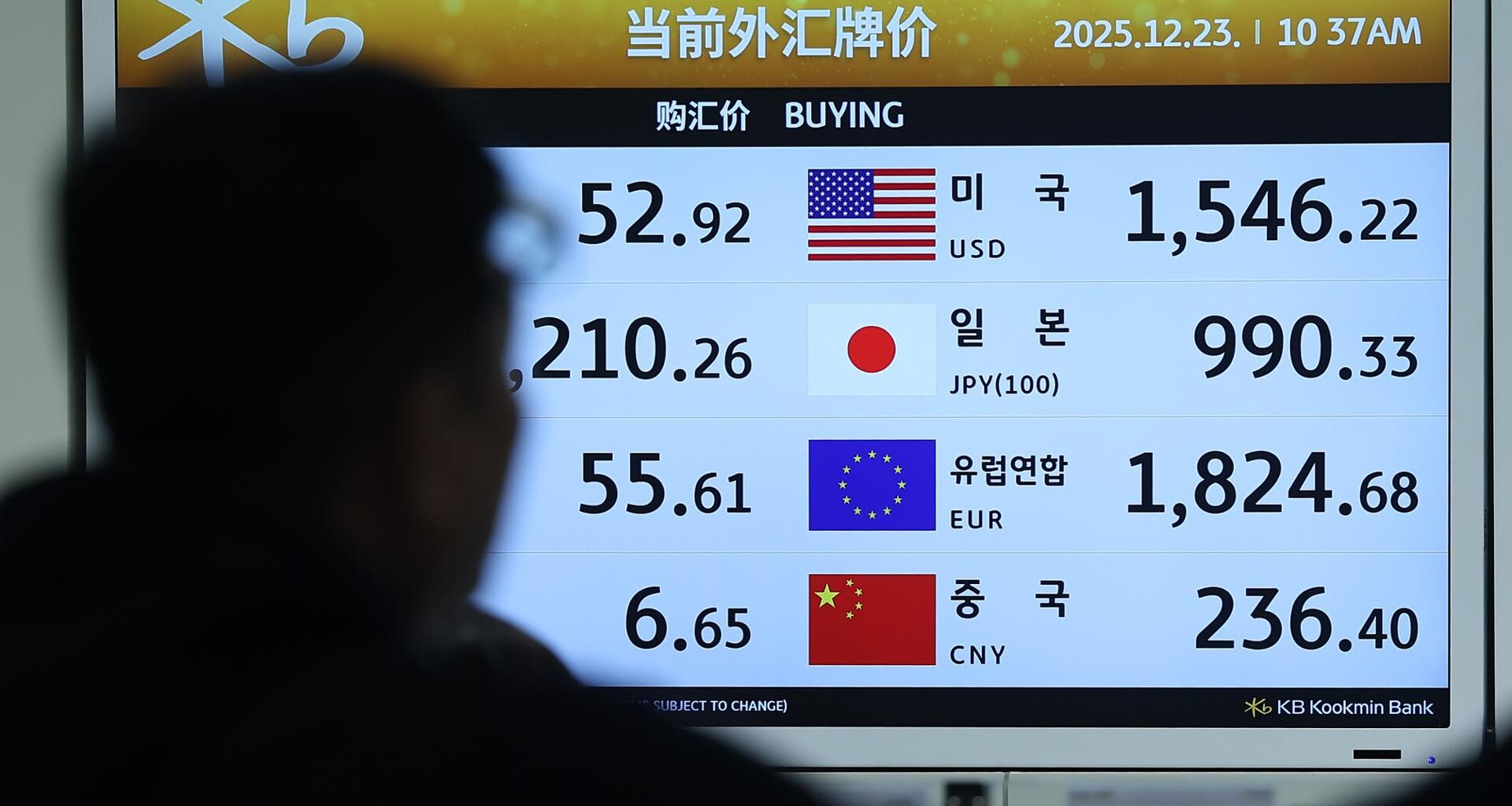

The won-dollar exchange rate is displayed at a bank counter in Terminal 2 of Incheon International Airport, Tuesday. Yonhap
Korea’s demand for the U.S. dollar has been growing sharply across the board, pushing the value of the local currency to its lowest level since 1998, the height of the Asian financial crisis, according to economists and market analysts Tuesday.
This trend will likely continue, and in a worst-case scenario the exchange rate could fall past 1,500 won per dollar in the coming days, far past the 1,380-won level analysts consider desirable for Asia’s fourth-largest economy.
“Dollar demand is unusually high across a range of market participants, and this is driving the won down to levels last seen during the Asian financial crisis, even though Korea’s economy is not under strain,” said Shin Se-don, professor emeritus of economics at Sookmyung Women’s University.
Moon Jung-hiu, a KB Kookmin Bank economist, echoed that view, saying, “The won is unusually weak due to an imbalance between supply and demand, while economic fundamentals are far better off than they were during the Asian financial crisis.”
Experts noted that the won has weakened despite Korea’s foreign currency reserves rising to $430.6 billion over the past six months, ranking ninth in the world.
The country also posted a record cumulative current account surplus of $89.58 billion from January to October, while annual exports are expected to surpass an unprecedented $700 billion in 2025.
Alongside these developments, several major market players are seen as contributing to the won’s steep drop.
For instance, the National Pension Service (NPS), the state-run pension operator, added about 70 trillion won ($33.7 billion) to its overseas investments this year, bringing the total abroad to 771 trillion won, or 58 percent of its assets.
Korean corporations’ retained earnings abroad — profits kept overseas rather than repatriated — rose by $7.8 billion, a 40.2 percent increase from last year, while individual investors set a record with $32 billion in net purchases of U.S. stocks, supported in part by the artificial intelligence boom.
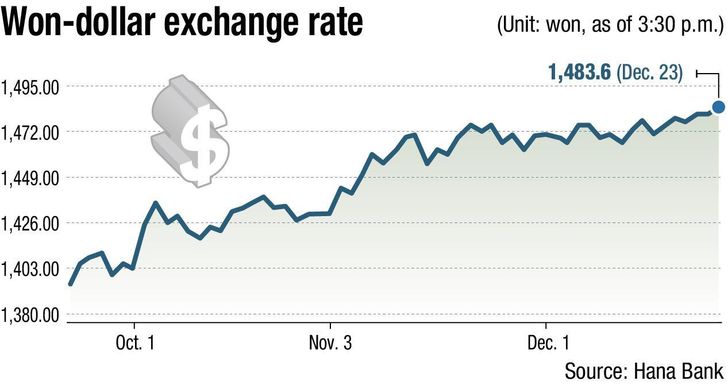
Reflecting these trends, Bank of Korea (BOK) data showed the Korean currency averaging 1,421.16 won per dollar so far this year as of last week, which is already weaker than the 1998 average of 1,394.97 won.
In daytime trading this week, the won breached 1,480 for the first time in eight months, closing at 1,480.1 on Monday and 1,483.6 on Tuesday.
Regarding comparisons with other countries, Moon said the gap between dollar demand and supply in Korea is exceptionally large, as reflected in the won’s high correlation with the Japanese yen against the dollar.
The correlation is measured at 0.9 — close to the maximum of 1, which indicates two currencies moving almost exactly together, according to Moon.
“The trend is concerning because Korea, unlike Japan, is not a major reserve currency, and its currency ideally should not move in lockstep with the yen,” he added.
Taking the sharp depreciation into account, some experts said the won-dollar rate is likely to remain around the 1,480 range, while others warned it could rise above 1,500.
“The 1,480-won range appears to be the near-term peak,” said Suh Jung-hoon, an analyst at Hana Bank, adding that financial authorities’ willingness to stabilize the foreign exchange market could help limit further decline.
Suh noted, however, that the current exchange rate is “far from” the 1,380-won level he considers appropriate based on Korea’s overall economic conditions, including its capacity to absorb internal and external shocks, support growth and bolster domestic demand.
The KB Kookmin Bank economist forecast that the won-to-dollar rate could approach the 1,500 level but is unlikely to surpass it, saying, “It may come close, but only just shy of that threshold.”
By contrast, Lee Seung-suk, a research fellow at the Korea Economic Research Institute (KERI), said the won-dollar rate could rise beyond 1,500 and even move into the 1,530-1,540 range.
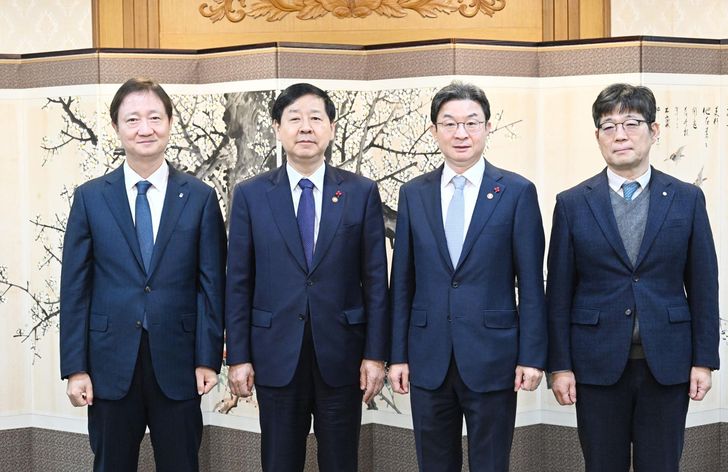
Deputy Prime Minister and Minister of Economy and Finance Koo Yun-cheol, second from left, poses with Financial Services Commission Chairman Lee Eog-weon, third from left, Financial Supervisory Service Gov. Lee Chan-jin, left, and Bank of Korea Senior Deputy Gov. Ryoo Sang-dai ahead of a market oversight meeting at Government Complex Seoul, Thursday. Yonhap
Dollar supply measures to take time
Regarding a series of monetary measures taken by the government and central bank to stabilize the foreign exchange market, analysts said the policy direction is on the right track in increasing the dollar supply, though the impact is expected to be gradual.
The measures include emergency meetings between the presidential office and major export-oriented conglomerates, a foreign exchange swap agreement between the BOK and NPS, and the temporary suspension of stress tests that had pressured financial institutions regarding their dollar holdings.
Regulatory ratios for foreign banks’ Korean subsidiaries, including Standard Chartered Bank Korea and Citibank Korea, were eased to facilitate the borrowing of foreign currency from their overseas headquarters to supply to the local market.
“The measures will help financial institutions release dollars they have unnecessarily hoarded into the market, but it may take until early 2026,” the Hana Bank analyst said.
Moon, the KB Kookmin Bank economist, said the measures “are not a short-term fix to boost the won but a medium- to long-term policy aimed at bolstering market resilience and ensuring smooth functioning.”
Asked whether these measures could put Korea at risk of being labeled a currency manipulator by the U.S., the KERI research fellow downplayed the possibility.
“They are intended to stabilize the won, not weaken it to make exports cheaper and gain an unfair trade advantage, which is what the U.S. warns against,” he said.
Seo described the risk as “unlikely,” noting that Korea agreed to provide the U.S. with monthly data on foreign exchange interventions as part of their bilateral tariff deal. “The agreement is meant to boost transparency in forex market operations at Washington’s request, so concerns about currency manipulation can be set aside.”