
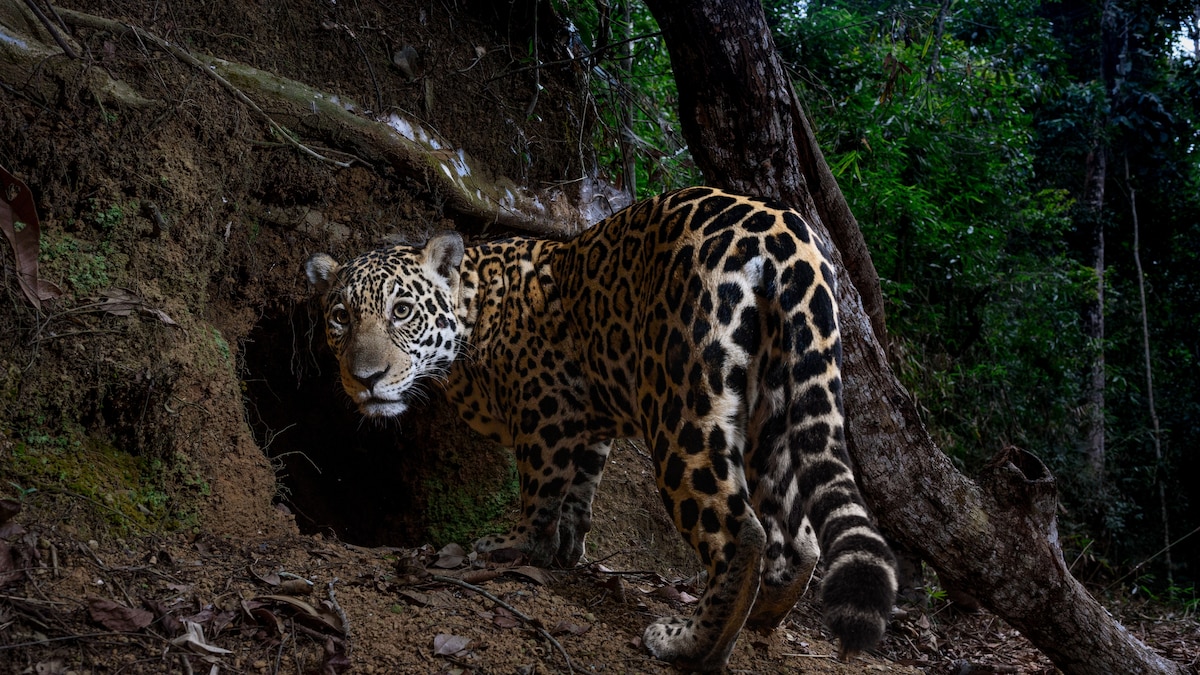
Faciole’s jaguar portrait is just one of the top wildlife photos of 2025, selected by the photography staff at National Geographic. All together, they transport us to unique environments worldwide and give us rare glimpses of creatures both familiar and strange.
A beaver gnawing into a tree, captured by Ronan Donovan, a National Geographic Storytelling Fellow, represents the unappreciated superpower of these creatures to fireproof large tracts of land and protect ecosystems from the consequences of climate change. Other photographers capture rare moments in time, like the motion of a meerkat in a photo by Thomas Peschack, or a Japanese giant mantis striking a lizard in a photo by Takura Ishiguro.
Such photos can also be important for science. Researchers found fish interacting with anemones in surprising ways, such as using them as shields, in images from underwater photographer Linda Ianniello.
For the photographers, the moment of capturing a stunning scene in nature is as powerful as any eureka moment in science. After photographer Roie Galitz heard about a sperm whale carcass drifting north of the Arctic circle, he re-directed an ice-breaker vessel to the scene and flew a drone to get epic aerial shots of the whale and polar bears.
“When I was flying the drone, I was shouting and cursing, just because as a photographer you get really excited,” Galitz laughs. “The day I stop being excited is the day I stop taking photos.”