
I stood in line at Aldi’s, a few items in my cart for supper. Nearby, store clerks restocked grocery bags. One worried that his paycheck wouldn’t last the month. Another, close to tears, had just learned that his sister—newly enlisted in the military—had been in a near-fatal accident. A third lamented the toxic work environment she faced day in and day out.
One aisle over, several moms shared Advent and Christmas survival stories—restless children at home, late-night online shopping for forgotten gifts, neighborhood debates about the number and color of holiday lights, worries about credit card balances, and even a pastor telling one mom that Christmas shouldn’t be such a big deal for Christians. “We’re an Easter people,” he said.
The huddle broke up with one mom sighing, “I’m just so ready for this Christmas to be over.”
A Joy That Endures
No matter how clearly it seems the world is falling apart—perhaps especially because it seems to be falling apart—the joy this season brings is great. No, the joy is more than great. It is brilliant.
Some say Christmas joy is a distraction from the world’s pain. It can be that, an escapist, fanciful refuge, but this happens only when the manger, is relegated to an afterthought or a sentimental detail.
When the manger is exchanged for tinsel, Mel Tormé, and Salvation Army kettles, the effort to sustain seasonal contentment can expand and become an all-consuming task and burden. Eventually, even the most exuberant spirit can falter—much as it did for the moms and clerks at Aldi’s.
A Diary of the Heart
When you were young, your diary was thin. Life was opening before you, its pages unwritten. Over time, your heart filled that diary: a first love, a lost love, an academic disappointment, the death of a grandparent, the loss of a friend.
A family move, a physical injury, a marriage, the birth of a child, the death of a best friend, professional triumphs and failures, the slow effects of aging, the loss of memory and control—all these became entries in your life’s diary.
Particularly painful are the entries near Christmas. They can overshadow the thrill you once felt in the season. Perhaps this is why our culture largely treats Christmas as a feast for those with thin diaries, or—as the modern legend of St. Nicholas insists—a feast for children alone. How often have you wondered if you would ever experience Christmas as you did when young, only to resign yourself to the role of a stand-in Nicholas, hoping your heart might be warmed by the act of giving?
A Return to the Manger
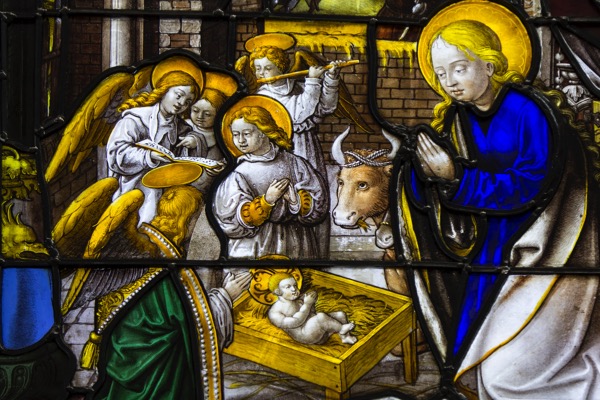
To be lost in stress this Christmas, confined by past and present pain, or to seek hope only in gift-giving is to miss the manger, or stumble over it unaware.
You have spent a season, Advent, preparing to visit the manger and present your heart as a home for the Christ Child. The joy of Christmas lies in this: God loves you so much that he could not leave you alone.
The taste of paradise still lingers. The Tree of Life that sustained us in Eden is not forgotten, but our choices bear out the truth of the Fall. Banished from the Garden, our first parents received the promise of a coming Messiah who would restore us. Hearts that mourn paradise lost come to Bethlehem longing for paradise restored.
The angels sing of peace on earth. Shepherds, eager for that peace, leave the comfort of what they know for a glimpse of what God has done. Come with them and see the salvation of the world. A stable light is lit, and the Tree of Life bends low. The joy offered at the manger becomes the foundation upon which all hope is built. God is among us.
The Tree of Life Restored
The 14th-century Northumbrian poem Cursor Mundi—“the course of the world”—draws on old legends to tell creation and redemption as one great arc of divine mercy: the Gospel of Nicodemus, The Life of Adam and Eve, The Legend of the True Cross.
Adam lies on his deathbed, longing for a taste of the Tree of Life. He asks his son Seth to return to Eden and bring back a drop of its oil so his pain might be lifted, if only briefly. Seth despairs—he has never seen Eden. But Adam tells him, “Follow the footsteps your mother and I left as we were driven from the Garden. Everywhere we stepped, the grass beneath our feet withered.”
In essence Adam is saying, Follow the pain of my life. Follow the path of my tears. By them you will find Eden. By them, you will find the balm of the Tree of Life.
Seth makes the journey. Though Adam dies while he is away, Seth returns with seeds from the Tree of Life—the promise of salvation in Jesus. He plants them in Adam’s grave, and they grow into the tree that will preside over all history.
Wood from this tree provides a staff for Moses, a throne for David, beams for Solomon’s temple, the manger for the Christ Child, and finally the cross for the Lord of all. From Adam’s longing and Seth’s quest comes a tree that serves as a constant sign of joy and hope, offering paradise restored and anticipating the hope found at the manger.
Incarnation and the Hope of the World
Robert Jenson once wrote that the true God is not eternal because he lacks time, but because he takes time; indeed, “His very identity is set by what he does in time.”
At Christmas, that “what he does in time” is not an abstraction—it’s about flesh and blood. It’s about the mystery of the Incarnation, where God condescends, enters history, and makes our fragile, time-bound life the dwelling place of divine mercy. In the Christ Child eternity does not stand apart from time; eternity inhabits time.
God does not remain distant, watching from the heavens. He enters as an infant—fragile, dependent, subject to every ache—and begins to transform the world from within. The Word becomes flesh not to rescue us from our humanity, but to redeem it and make it whole, including anxious moment in line at Aldi’s where the burdens of the world threaten to overwhelm
Longing for Paradise
Do you hope for a family gathering at which father and son forgive one another? That’s a longing for paradise. Do you miss the child, spouse, sibling, or parent who died this past year? That’s a longing for paradise.
Do you hope for wars to end, for hunger to be conquered, for the stranger to be welcomed, for injustice to be abolished? That’s a longing for paradise. Do you long for every exile to find a home, every wound to be healed, every tear wiped away? That’s a longing for paradise.
Do you hope to see the face of God, to walk with him in the cool of the evening? That is the deepest longing for paradise.
This Christmas hear the good news announced by angels. Rush to the manger with shepherds and kings. See the salvation of the world. Come and taste the fruit of paradise
The Feast of Hope
You may be tired and exhausted, worn out from the year, but even a glimpse—just a glimpse—of the Christ Child’s face will sustain you through every trial and tear. The carpenter’s workshop, the desert, and the cross lie ahead. Beyond them, the empty tomb and the Mount of Olives. But for now—and especially on the Feast of the Nativity—know this: This manger cradles every joy and hope of your life and the world.

The Rev. Timothy E. Kimbrough is a Guest Writer. He is the Director of the Anglican Episcopal House of Studies and the Jack and Barbara Bovender Professor of the Practice of Anglican Studies at Duke Divinity School. Previous appointments include Dean of Christ Church Cathedral, Nashville, TN. He is a seven-time deputy to General Convention.