
Astronomers have long struggled to capture the true nature of stellar nova explosions. However, thanks to cutting-edge techniques, a team of scientists has finally been able to observe these cosmic events in unprecedented detail. Through advanced imaging and interferometry at the CHARA Array in California, they have revealed the surprising complexity behind nova explosions. Their findings, published in Nature Astronomy, offer new insights into the processes that drive these violent stellar events, fundamentally shifting our understanding of their behavior and impact.
A New Era in Observing Stellar Explosions
For decades, studying nova explosions was a challenge due to their rapid and transient nature. Traditionally, astronomers could only observe the aftermath of these explosive events, with the expanding gas appearing as a single point of light. However, the new study, spearheaded by researchers from Georgia State University, used interferometric techniques to capture the earliest moments of two stellar explosions, providing a detailed view of the processes involved.
“The images give us a close-up view of how material is ejected away from the star during the explosion,” said Gail Schaefer, director of the CHARA Array. “Catching these transient events requires flexibility to adapt our night-time schedule as new targets of opportunity are discovered.”
This breakthrough offers a real-time look at novae, which were previously only understood through indirect clues. For the first time, scientists observed the formation of multiple outflows of gas that were ejected in perpendicular directions during an explosion, providing direct evidence of the complexity behind these stellar events. The team’s findings challenge the earlier view of novae as simple, single-phase explosions, revealing the intricate dynamics of material ejection and shockwave formation.
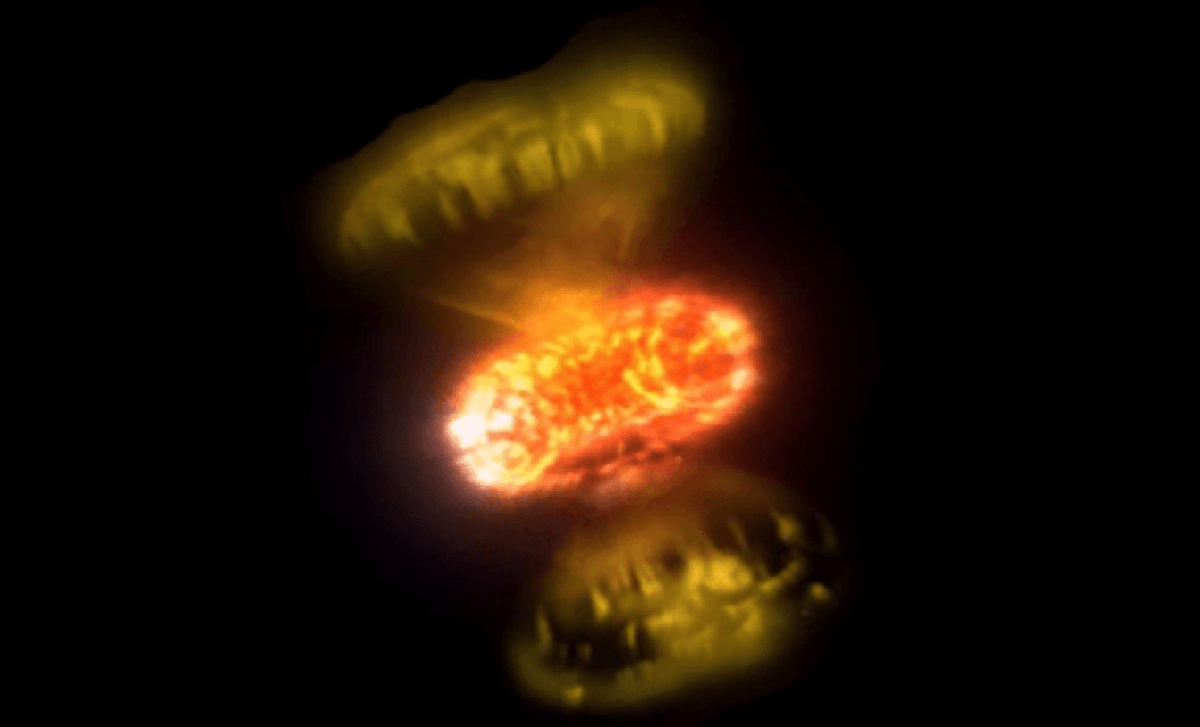
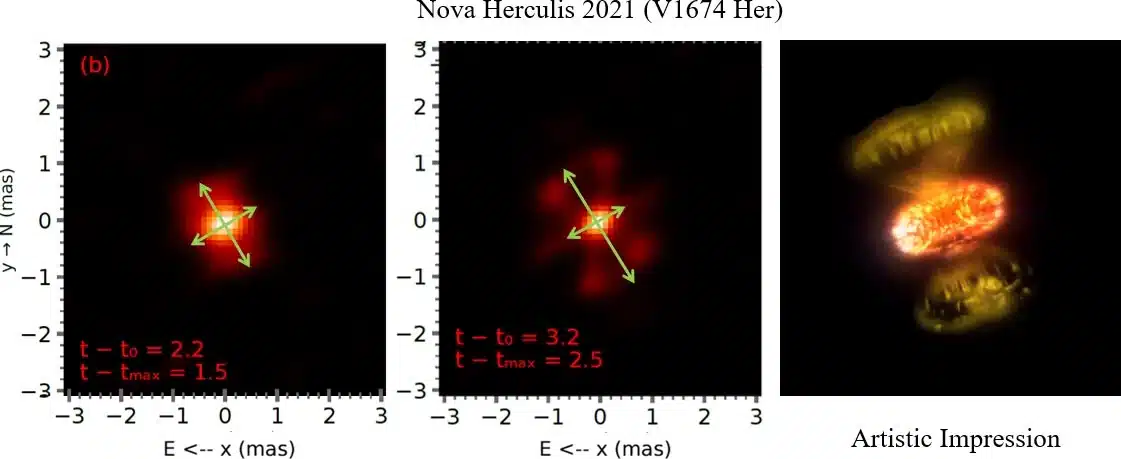 Scientists at Georgia State’s CHARA Array captured images of Nova V1674 Herculis — one of the fastest stellar explosions on record. Images of Nova V1674 Herculis obtained 2.2 days (left) and 3.2 days (middle) after the explosion. The images reveal the formation of two distinct, perpendicular outflows of gas, as highlighted by the green arrows. The panel on the right shows an artistic impression of the explosion. Credit: The CHARA Array
Nova V1674 Herculis: An Explosive Discovery
One of the novae studied, Nova V1674 Herculis, was one of the fastest stellar explosions ever recorded. The team obtained images of the explosion just days after it occurred, showing two distinct, perpendicular outflows of gas. These outflows, which formed in close succession to the explosion, were observed to evolve rapidly, capturing the explosive energy in stunning detail. The images reveal how the gas streams collided, producing shockwaves that are crucial for understanding the high-energy radiation associated with these events.
The connection between the shockwaves and gamma-ray emissions observed by NASA’s Fermi Gamma-ray Space Telescope was established, further linking the explosion to high-energy particle acceleration. The study emphasized how novae, once thought to be simple explosions, are far more dynamic and complex than initially realized.
The Role of Interferometry: A Window into the Unknown
The ability to capture such fine details comes from the use of interferometry, a groundbreaking technique that merges light from several telescopes to create highly detailed images of distant objects. This technique has been instrumental in other astronomical breakthroughs, including the first image of a black hole. “This is an extraordinary leap forward,” said John Monnier, a co-author of the study published Nature Astronomy, and an expert in interferometric imaging.
“The fact that we can now watch stars explode and immediately see the structure of the material being blasted into space is remarkable. It opens a new window into some of the most dramatic events in the universe.”
Interferometry has allowed scientists to resolve fine-scale structures in these explosions, shedding light on the geometry and composition of the expelled material. These images were complemented by spectra from other major observatories, which tracked the evolving composition of the gas. By combining these observations, researchers were able to build a detailed picture of how material is ejected from the star and how the shockwaves are formed.
Nova V1405 Cassiopeiae: A Slower and More Mysterious Eruption
The second nova studied in this research, Nova V1405 Cassiopeiae, displayed a very different behavior. Unlike Nova V1674 Herculis, which erupted rapidly, Nova V1405 Cassiopeiae evolved much more slowly, with the outer layers of the star taking more than 50 days to expel. This delayed release of material is a new discovery, providing insight into the complex nature of nova explosions. The delayed ejection led to the formation of shockwaves after the gas was finally released, once again producing gamma-ray emissions detected by NASA’s Fermi telescope.
“This is just the beginning,” said Elias Aydi, lead author of the study and a professor of physics and astronomy at Texas Tech University. “With more observations like these, we can finally start answering big questions about how stars live, die, and affect their surroundings. Novae, once seen as simple explosions, are turning out to be much richer and more fascinating than we imagined.”
The Connection Between Nova Eruptions and Extreme Physics
The new observations not only reveal the complexity of nova explosions but also demonstrate how these events can serve as laboratories for studying extreme physics. The shockwaves produced during these explosions accelerate particles to high energies, resulting in the gamma radiation observed by telescopes like NASA’s Fermi.
“Novae are more than fireworks in our galaxy—they are laboratories for extreme physics,” said Professor Laura Chomiuk, a co-author from Michigan State University. “By seeing how and when the material is ejected, we can finally connect the dots between the nuclear reactions on the star’s surface, the geometry of the ejected material, and the high-energy radiation we detect from space.”
The study of novae is providing valuable insights into the behavior of matter under extreme conditions, such as the high temperatures and pressures present during a stellar explosion. By observing these processes in detail, astronomers are uncovering the underlying physics that governs the dynamics of stellar death and the formation of cosmic shockwaves.