
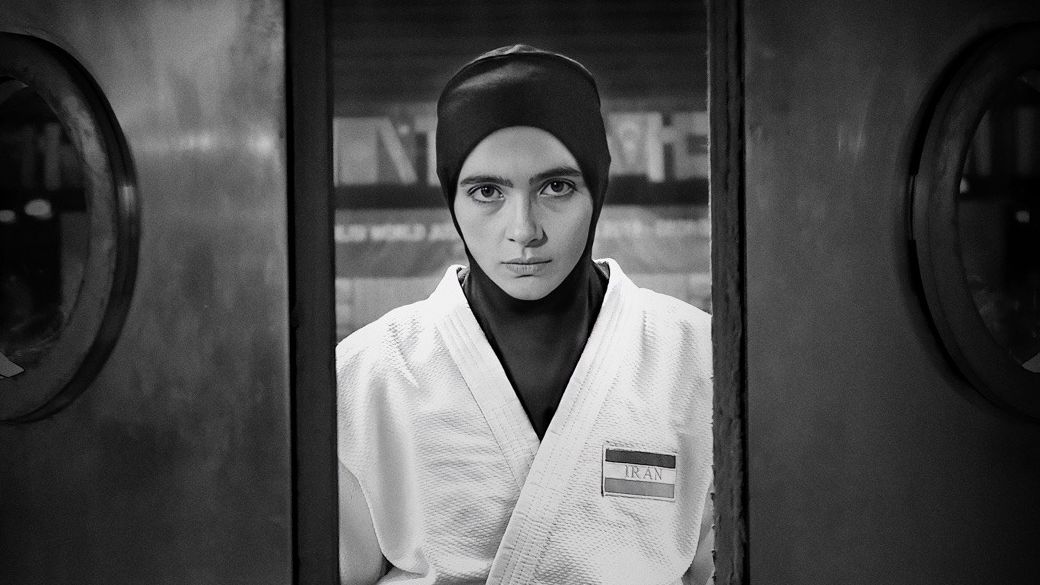
While it’s a significant triumph that Tatami—a feature co-directed by Iranian (Zar Amir Ebrahimi) and Israeli (Guy Nattiv) filmmakers—was both made and released amid global existential tensions, don’t let that distract you from the fact that it’s also just a riveting drama, a masterful sports film pitting the underdog (in this case, one woman with an indomitable spirit) against the oppressor (an authoritarian government) in the sort of way that has thrilled and gripped audiences since Rocky.
The basics: Leila (Arianne Mandi) is a world-class Iranian judoka competing at the Judo World Championships and killing it; a gold medal (which would be the first-ever for Iran) is seemingly within her grasp if things go well. Well, of course things don’t: As she makes her way through the tournament, word comes down from her government, via her coach (Amir Ebrahimi again), that she is to forfeit her next match—she’s scheduled to compete against an Israeli athlete, and Iran doesn’t recognize Israel—by faking an injury.
Suffice it to say that Leila begs to differ with this approach—anything beyond that is firmly in spoiler territory—and the ensuing drama is both fraught and gorgeous, shot in the kind of sumptuous black and white that calls to mind Scorsese’s Raging Bull. Again: You don’t need to be immersed in geopolitics to love this film, which gets at something elemental in all of us—the need to conform, or to simply do what someone tells you to do, when every fiber of your being is twitching in a way that says hell no. The fact that Leila has painstakingly ordered her life while hoping and dreaming of just such an opportunity—only to have people she’s never met try to deny that opportunity for reasons she may or may not even care about—only adds fuel to the fire.
Tatami was released in the United States in June during a particular escalation of the Israel–Gaza hostilities, which did two things at once. It made the film—which actually premiered at the Venice Film Festival in 2023—almost supernaturally topical and relevant, but it also made promoting it uniquely tricky. When I saw it on opening night at the IFC Center in Manhattan, the audience was absolutely rapt, and as we all emerged from the theater afterward, a few of us gathered around the producer Adi Ezroni, who began to speak a bit about the complicated making of the film and its relevance and importance. (An earlier public discussion had been canceled due to security concerns.) When IFC Center security swiftly put a stop to our ad hoc discussion, it was quickly relocated to a nearby cocktail bar and, in short order, Arianne Mandi—who was in town filming something else—cabbed over to join us all, as our mesmerizing screening turned into one of those only-in-New York nights out on the town. I can’t promise you the same one-off experience, but I can guarantee that no matter your politics, this film possesses a thrilling magic.