
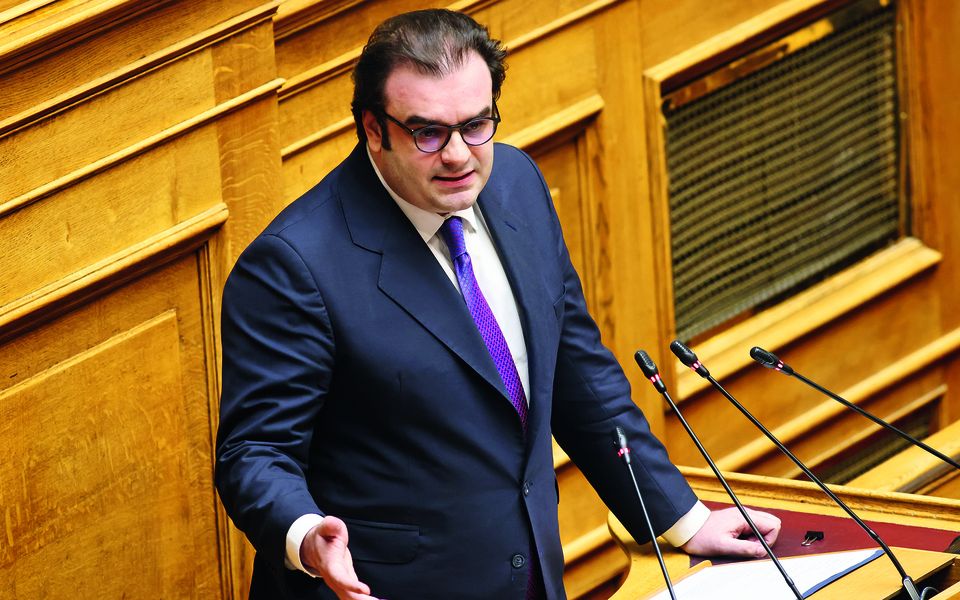
Private and public investments will maintain high economic growth in Greece after the end of 2026, Finance Minister Kyriakos Pierrakakis told Kathimerini, responding to one of the most crucial questions about the economy, as we enter the last year when resources from the European Union’s Recovery and Resilience Facility will be available.
For Pierrakakis, the new year will bring the additional challenge of guiding the Eurogroup – the meeting of finance ministers from the eurozone – after his election as its president. It was a success that he aspires to capitalize on, guided by the belief that European competitiveness is built with reforms and credibility.
He also announces that before the end of the year (possibly even by Monday) the ministry will publish a tender for a private investor that will operate the Property Acquisition and Leaseback Entity, which is expected to be put into operation in the first half of 2026.
Are you concerned about the future of Europe? What will you aim for as the new president of the Eurogroup so that the eurozone has a hope in international competition?
Europe does not have the luxury of complacency or pessimism. It is in a period of major geo-economic reshuffling and international competition is becoming more intense. This is not a reason for concern; it is a reason to move faster and more decisively. Europe faces challenges in three crucial dimensions: productivity, the depth of capital markets and the speed of decision-making. That is where we need to focus. First, with policies that boost investment in innovation, digital infrastructure, energy and skills. Second, with real progress in the Savings and Investment Union, so that European businesses are financed within Europe and do not turn elsewhere. And, third, with institutional efficiency, less bureaucracy and more credibility in common rules.
At the same time, we must be realistic. International competition is not won by violating the rules that ensure stability. It is won by reforms that increase productivity, by investment security and by adhering to the rules that we have all agreed upon. The experience of countries like Greece shows that when you combine sound public finances, reforms and investments, you can regain credibility and momentum. This is a message that is valuable for the whole of Europe.
2026 is the last year of the EU Recovery and Resilience Facility and forecasts, including yours in the 2026-2029 Multiannual Financial Framework (MFF), predict a decline in growth thereafter. Does this concern you?
The end of the Recovery Fund does not signal the end of growth. Greece is moving from the era of emergency tools to the era of normal, sustainable and self-sustaining growth. This is the real challenge and this is exactly the one we intend to win. 2026 is a year of high disbursements, with approximately €7.2 billion [being disbursed] in grants and over €6.9 billion in loans from the Recovery Fund. These resources are indeed non-recurring, but the economy is not left without “fuel.” Growth is ensured, first of all, through the steady increase in private investment, which is a catalyst for competitiveness and the most reliable indicator of confidence in the Greek economy. It also continues through a strong Public Investment Program. The Public Investment Program amounts to €16.7 billion for 2026, an amount three times that of 2019, while the National Development Program 2026-2030 is the largest in the history of Greece, with a total budget of €22.4 billion. It covers a wide range of interventions in strategic priorities, such as infrastructure, transport, boosting private investment, the digital and green transition, artificial intelligence and strengthening resilience to crises.
‘The utilization of public property is an economic policy tool that is directly linked to development, investment and the improvement of citizens’ everyday lives’
At the same time, the country is securing new European resources of over €8 billion for the period 2026-2032, through the Social Climate Fund, the Modernization Fund and the Island Decarbonization Fund, which support social cohesion, the green transition and development in every corner of the country. And, of course, there is something that qualitatively goes beyond the simple quantitative results: it is the “reform surplus” that remains to us from the projects that are being implemented. Projects that shape the conditions for sustainable development, through the modernization of justice, the digitalization of the state and the improvement of the investment environment.
Will we ever approach the EU’s GDP per capita average or will we find ourselves even behind Bulgaria?
Greece is currently at 70% of the EU average in terms of GDP per capita in purchasing power parity terms, up from 66% when we came to power. From 2019 to 2026, GDP per capita in constant values increased by 15.7% in Greece compared to 5.3% in the eurozone. Convergence is visible for the first time, with the necessary condition that the economic and political stability achieved in the last six years of Kyriakos Mitsotakis’ leadership is not undermined.
Private investments, including foreign direct investments, have increased in recent years, but there are questions about what they are: Many are residential properties, some are acquisitions of existing businesses. Why do we have a shortage of greenfield investments and what needs to be done to increase them?
Greenfield investments are, by their nature, the most demanding. They require large initial capital, years of maturation and full exposure to licensing, technological and macroeconomic risk. They are not comparable to real estate or acquisitions of existing businesses, which yield faster returns and with much less uncertainty. That is precisely why, after a decade of [debt] crisis, the first wave of investments that returns to an economy is never the Greenfield type. They are those that “test” the environment. What is important is that from 2019 onwards, the state has been systematically working to reduce the risk of productive investments: a more stable tax framework, lower rates, digitalization of the state. These are the necessary ingredients so that a full range of investments can be implemented, as has been the case in recent years. The result is starting to become visible. Private investment is growing at a rate of 5.7% in 2025 and 10.2% in 2026, while Greece is gradually covering a large part of the investment gap incurred during the [debt] crisis.
The most crucial element, however, is the change in the composition of investments. In 2026, total investments are estimated at €46 billion, with 61% coming from the private sector. By 2029, they will reach €51.7 billion, with private investments accounting for 78%, reflecting a clear structural transformation. Less dependence on the state, more productive initiative. In the large increase in investments that we observe in our country after 2019, the role of foreign direct investments is also decisive. In the previous six years, foreign direct investment exceeded €32 billion, an amount greater than the total of the previous seventeen years from 2002 to 2018. In 2025, it seems that we will have another very good year, as in the first 10 months of the year they reached €10.3 billion, an amount significantly higher than the total of 2022, when a record of foreign direct investment was recorded.
Regarding the housing crisis, in addition to the measures to increase the supply announced by the prime minister, there is the pending issue of the Property Acquisition and Leaseback Entity. What should interested parties expect?
This is another pending issue that will be closed before the end of the year, possibly even on Monday, when the announcement for the final phase of the tender is expected to be published, namely for the submission of binding offers to become the private investor that will operate the Property Acquisition and Leaseback Entity. It is a crucial social policy tool, which gives a real second chance to vulnerable debtors and ensures the protection of their main residence, even in cases of bankruptcy or forced execution. The entity will acquire the residence and re-lease it to the previous owner, with a state subsidy for the rent and with a clear, institutionalized right to repurchase it, if their financial situation improves. Our goal is for the entity to be fully operational within the first half of the year. Until then, the interim support program remains in effect, suspending the foreclosure process of the primary residence and providing a state subsidy of the loan installment of up to 210 euros.
You have repeatedly spoken about the need to utilize public property. What does the planning for 2026 include and, in particular, how is the plan for the utilization of real estate owned by the Hellenic Public Properties Company (ETAD) progressing?
The utilization of public property is an economic policy tool that is directly linked to development, investment and the improvement of citizens’ everyday lives. The planning for 2026 focuses on three directions: On the systematic recording and maturation of public property, so that we know precisely what we have and what can realistically be utilized. On the transition from passive management to value creation through long-term leases, partnerships and targeted investments. And, finally, on the interconnection of utilization with broader development goals, such as high-value-added tourism, urban revitalization and local development. The crucial element is that public property is treated as development capital and not as an inactive burden.
2026 is a pre-election year and it is reasonable to expect handouts and announcements. What do you think the government should promise based on the capabilities and needs of the Greek economy?
We have proven in recent years that we can simultaneously support society through strong surpluses, which result from the limitation of tax evasion and the growth dividend, and at the same time protect the foundations of the economy and fiscal stability. We learned in the very difficult years of the debt crisis what it means to not have stability and we are not going to return to those practices. Regardless of the fact that 2026 is an pre-election year, I can tell you clearly that all the necessary actions will be taken to ensure the social cohesion and growth potential of the country, while always maintaining fiscal balance.