
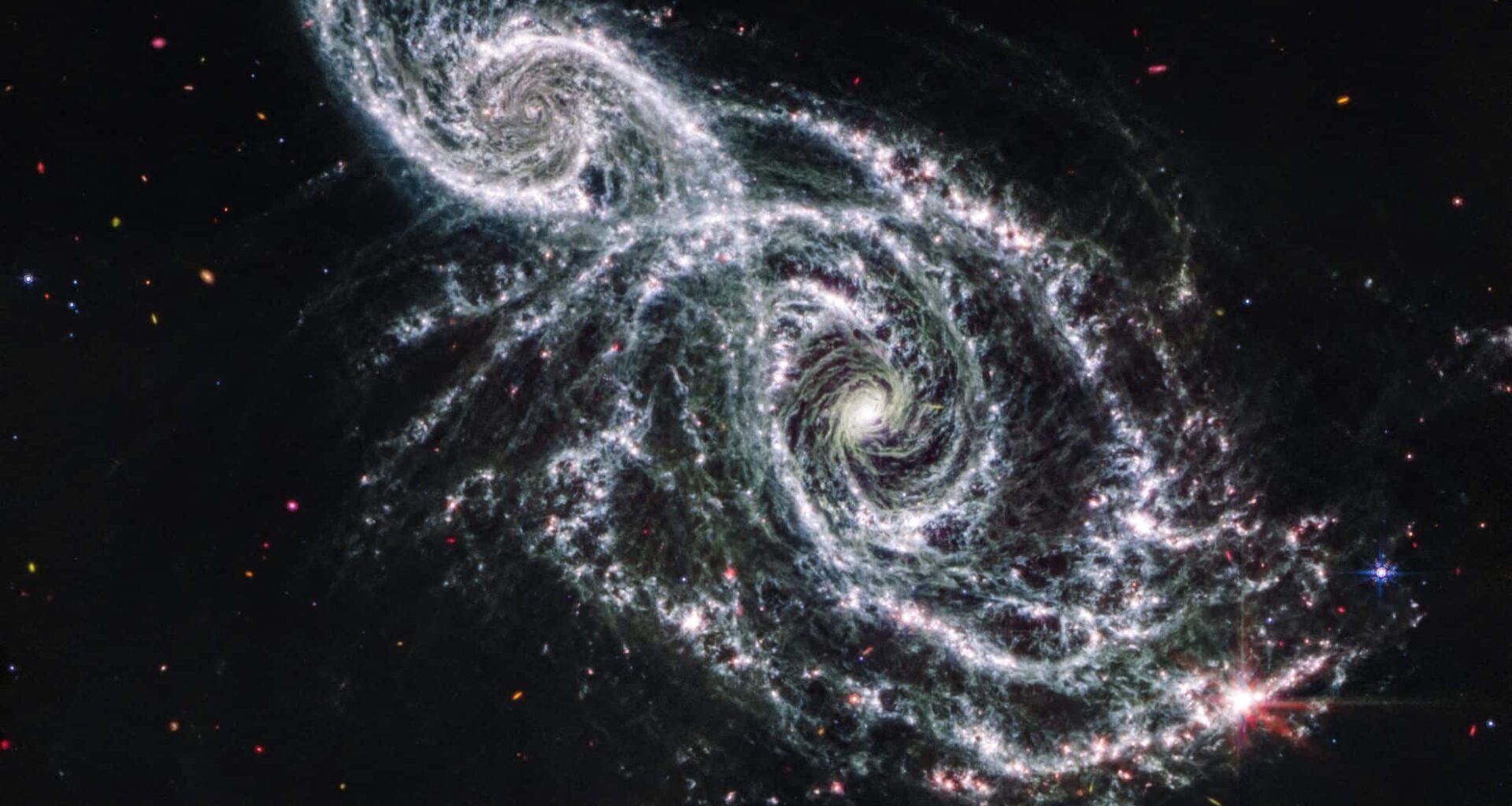
Astronomers have observed the most distant supernova ever recorded, capturing a glimpse of a massive star’s death when the universe was just 730 million years old. Detected by the James Webb Space Telescope (JWST), the explosion was linked to a powerful gamma-ray burst (GRB) and confirmed through detailed follow-up imaging.
The event, called SN in GRB 250314A, occurred during the epoch of reionisation, a key era when the first stars and galaxies were forming. This rare detection offers researchers a direct look at stellar death in the early universe, something never seen at this scale or distance before.
Such an observation marks a new milestone in high-redshift astronomy. According to the paper published in Astronomy & Astrophysics (December 2025), the JWST’s Near Infrared Camera (NIRCAM) captured the light from the explosion with remarkable precision, allowing scientists to separate the supernova from its faint host galaxy. While GRBs are known for their powerful emissions, linking one so clearly to a supernova at this distance has never been achieved.
Beyond the record-breaking redshift, this discovery matters because it challenges many assumptions about how the earliest stars lived and died. The light signature, spectral properties, and timing all appear strikingly familiar, despite coming from a period when the cosmos was vastly different in composition and structure.
A Gamma-Ray Burst Lights the Path
The chain of discovery began on March 14, 2025, when the space-based SVOM satellite detected an intense long-duration gamma-ray burst. This sudden burst of high-energy radiation, labeled GRB 250314A, immediately drew attention due to its strength and suspected distance. Follow-up spectroscopic data from the European Southern Observatory’s Very Large Telescope (ESO/VLT) confirmed its redshift at around z ≃ 7.3, placing it squarely within the universe’s first billion years.
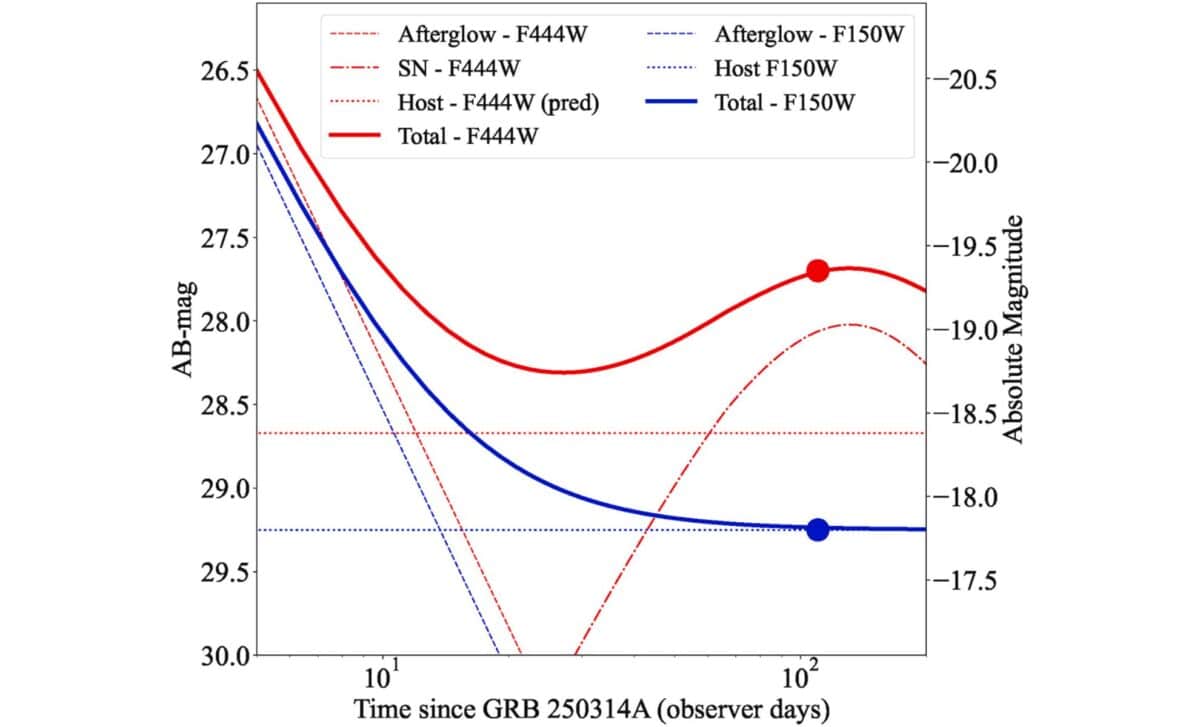 Light curve of GRB 250314A as expected in the F150W2 and F444W bands. ©Astronomy & Astrophysics
Roughly 110 days after the burst, astronomers used JWST/NIRCAM to investigate the site. The imaging revealed a clear signal rising in the infrared bands, a key indication that a supernova had followed the gamma-ray burst. As noted by Dr. Antonio Martin-Carrillo, an astrophysicist at UCD School of Physics and co-author of the study, “The key observation, or smoking gun, that connects the death of massive stars with gamma-ray bursts is the discovery of a supernova emerging at the same sky location.”
According to the team, nearly all previous GRB-linked supernovae had been found relatively close to Earth. This ancient detection opens a new window into early star death and the role massive stars played in shaping the young universe.
An Ancient Explosion with a Familiar Face
One of the most surprising findings from the JWST observations is how ordinary the explosion appears to be. Scientists compared the light curve and spectrum of SN in GRB 250314A with SN 1998bw, a well-known supernova associated with a GRB in the local universe. The resemblance was close, not only in peak brightness but also in spectral shape.
The F444W band captured the supernova peaking at an absolute magnitude of MB = –19.41, just slightly fainter than SN 1998bw. In fact, when the team corrected for the contribution of the host galaxy, the supernova light aligned almost perfectly with expectations based on local GRB-SN models.
According to the Astronomy & Astrophysics article, these findings rule out the possibility that the explosion was a superluminous supernova (SLSN) or another exotic type. The result surprised researchers, since early universe stars were thought to have unique properties, such as low metallicity, that might influence their deaths in dramatic ways. Yet here was a cosmic event from billion years ago behaving much like one from our own corner of space.
Insights into Early Galaxies and Their Stars
Alongside the supernova, JWST also detected light from the host galaxy. This galaxy was faint and compact, with characteristics resembling Lyman-break galaxies typically found at z ~ 7. Researchers estimate its ultraviolet absolute magnitude at about –17.8, slightly dimmer than other known GRB hosts at this redshift but still within expected ranges.
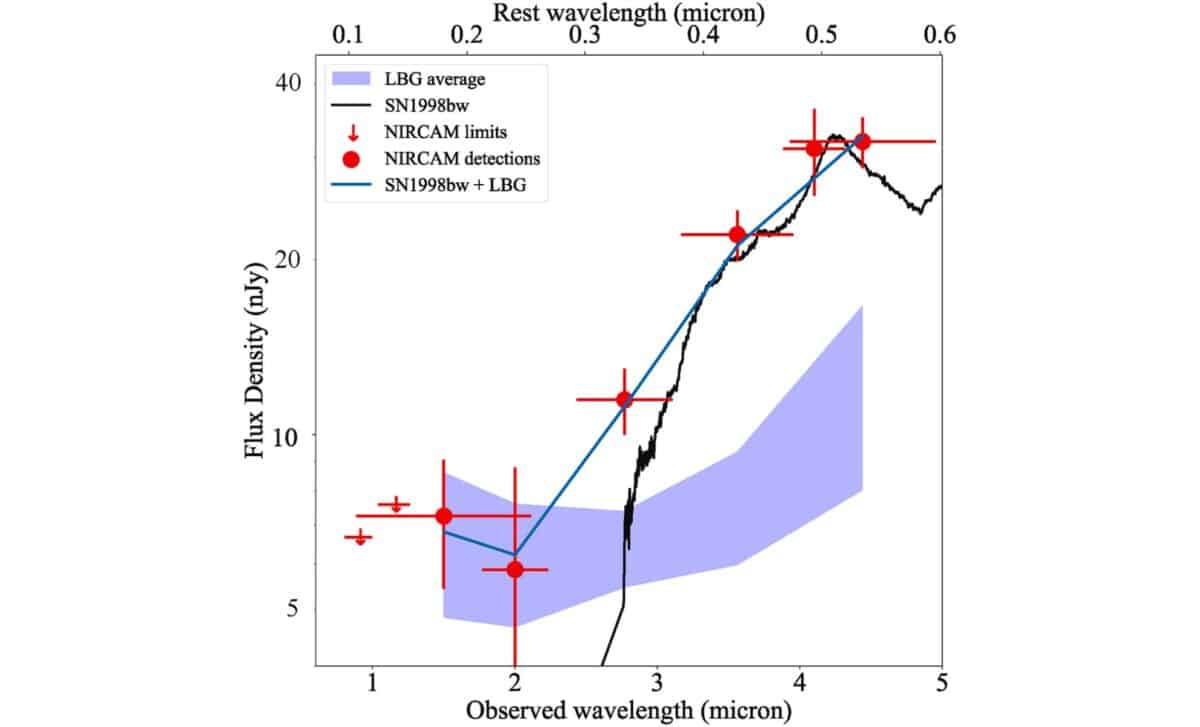 Observed SED of the location of GRB 250314A as observed with NIRCAM at 110 days post-burst, roughly 13 days rest frame (red points). ©Astronomy & Astrophysics
Crucially, the team was able to isolate the supernova light from that of the galaxy thanks to the timing of the observations, about 13 days after the explosion in the rest frame. According to the analysis, the spectral energy distribution (SED) of the light closely matched that of a supernova and not just a young star-forming galaxy. This distinction helped confirm the nature of the event.
The analysis published in Astronomy & Astrophysics also addressed and rejected other interpretations, such as the light being entirely from the galaxy or a lingering afterglow. Although some model fits suggested those were possible, they introduced inconsistencies in the data, like improbable star formation histories or spectral shapes. Ultimately, the evidence pointed most clearly to a combined source: a GRB-associated supernova embedded in a faint, high-redshift galaxy.
A Reference Point for Cosmic History
By capturing the light of SN in GRB 250314A, astronomers have secured a vital datapoint for understanding stellar evolution across time. The fact that this explosion mirrors those seen nearby suggests a striking uniformity in how massive stars die, regardless of when or where they formed.
This does not necessarily settle debates about early star populations or the influence of metallicity and environment on star death, but it does provide a robust example against which future findings can be compared. According to the researchers, a second round of JWST observations is planned in the next one to two years, once the supernova has faded significantly. These follow-ups should allow a cleaner view of the host galaxy and more precise separation of the emission sources.
For now, the detection of the most distant known supernova confirms that JWST is capable not only of peering deep into the early universe, but also of capturing some of its most fleeting, spectacular events, explosions that shaped the cosmos long before Earth existed.