

Franck Marchis, a French-American astronomer and planetary scientist at the SETI Institute, has a knack for predicting the future. Decades ago, he foresaw the rise of adaptive optics, which revolutionized astronomy. Today, he’s predicting another transformation — one powered by artificial intelligence.
Scientists aren’t just adapting to this new technology; they’re embracing it wholeheartedly.
Digital platforms are unlocking massive datasets once locked away in isolated silos, while AI now helps researchers process and interpret that information in real time. In astronomy, these technologies are already reshaping the field — speeding up discoveries and making participation in space research more accessible. For those working in data infrastructure, cloud services, or research itself, it signals a shift toward a faster, more connected, and open era of scientific exploration.
AI has fundamentally changed how we observe space. As observatories like Vera Rubin and missions such as Euclid generate staggering volumes of data, AI has become essential. Traditional methods simply can’t keep up with the volume, complexity, and speed required to make sense of this constant stream of information.
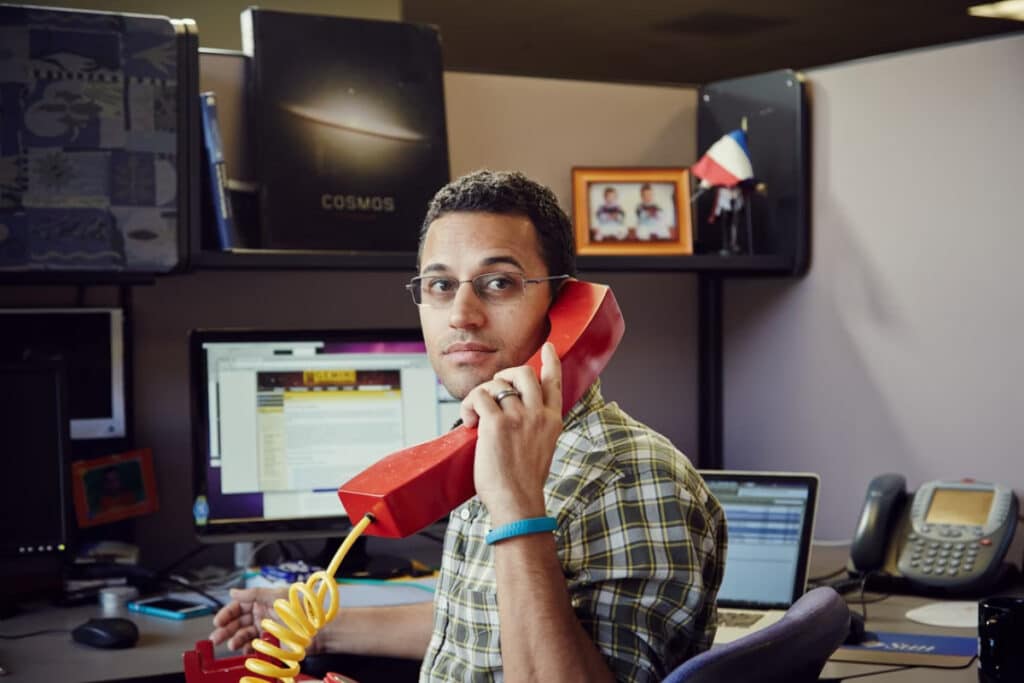
Franck Marchis, senior planetary astronomer at the SETI Institute, has been elected a Fellow of the California Academy of Sciences (Cal Academy) for 2023. Recognized for his outstanding contributions to the natural sciences, Marchis joins a distinguished group of scientists, including other prominent members of the SETI Institute and the Cal Academy, such as Jill Tarter, Nathalie Cabrol, Seth Shostak, and Andrew Fraknoi. © Franck Marchis, SETI Institute
Science itself is in the midst of a revolution. In the past, studying the cosmos depended on individuals or small teams of specialists. Today, AI and data-driven technology play a central, collaborative role in nearly every aspect of research.
Modern radio telescopes now gather thousands of terabytes of data each night. Where scientists once waited weeks to process a single signal, they can now perform near-instant analysis. Anomalies and cosmic events that once required an entire team of researchers can now be detected and verified in real time using AI models.
But AI’s capabilities extend well beyond detection. It sharpens image resolution, enriches data quality, and digs deep into archives to uncover long-forgotten phenomena. In one recent student-led project, AI analyzed years of observation data and identified over 1.52 million potential new astronomical targets — a scale of discovery that would’ve been unthinkable just a few years ago.
This evolution has redefined the astronomer’s role. Researchers now spend less time on tedious data tasks and more time forming hypotheses, designing experiments, and interpreting results. Scientists are becoming conductors, with AI handling the rhythm and tempo of discovery.
Will Machine Learning Help Us Find Extraterrestrial Life? Yes
Applying deep learning techniques to previously analyzed datasets from the Green Bank Telescope survey revealed undetected 8 signals of interest coming from 5 stars out of the 820.
https://t.co/lNEYdqwrmk pic.twitter.com/4iFQtQzAaF
— Franck Marchis (@AllPlanets) January 30, 2023
The future of AI-driven astronomy
The influence of AI on astronomy is only beginning. The Vera C. Rubin Observatory alone will soon issue tens of thousands of alerts every night, each one potentially marking a transient event — a supernova, an asteroid, or a cosmic flare. AI will be key to sorting through the flood, identifying what matters, and prioritizing what to observe next.
Another frontier lies in AI-driven simulation. Traditionally, modeling complex phenomena — like the origins of life — required years of trial and error. Now, AI can simulate and test thousands of scenarios at once, accelerating progress and expanding the boundaries of what science can explore.
Imagine intelligent systems that not only watch the skies but decide where to look next, coordinating a network of telescopes across the globe — all in real time. AI is making that vision possible.
For today’s scientists, AI isn’t just a tool; it’s a collaborator, seamlessly woven into their daily work. Much like search engines revolutionized access to knowledge in the early 2000s, AI is doing the same for science — not just boosting productivity, but serving as a catalyst for discovery itself.
Research made more accessible
AI is also transforming who gets to do science. Students anywhere in the world can now access open telescope data and analyze it with their laptops using open-source AI tools. They can discover comets, track asteroids, or study how galaxies form — no observatory required.
But access to data remains a hurdle. Many datasets sit behind paid cloud services, limiting opportunities for independent researchers and underfunded institutions. To fix that, new decentralized platforms are emerging to make major data repositories freely available, leveling the playing field for scientists everywhere.
Space science is entering a new era — one where machines amplify human potential. With AI as our partner, we can process more information, generate deeper insights, and bring more people into the pursuit of discovery. This could help us answer some of humanity’s most profound questions — even the search for life beyond Earth. The future of astronomy is faster, smarter, and more inclusive — powered by AI and shaped by digital innovation.

Laurent Sacco
Journalist
Born in Vichy in 1969, I grew up during the Apollo era, inspired by space exploration, nuclear energy, and major scientific discoveries. Early on, I developed a passion for quantum physics, relativity, and epistemology, influenced by thinkers like Russell, Popper, and Teilhard de Chardin, as well as scientists such as Paul Davies and Haroun Tazieff.
I studied particle physics at Blaise-Pascal University in Clermont-Ferrand, with a parallel interest in geosciences and paleontology, where I later worked on fossil reconstructions. Curious and multidisciplinary, I joined Futura to write about quantum theory, black holes, cosmology, and astrophysics, while continuing to explore topics like exobiology, volcanology, mathematics, and energy issues.
I’ve interviewed renowned scientists such as Françoise Combes, Abhay Ashtekar, and Aurélien Barrau, and completed advanced courses in astrophysics at the Paris and Côte d’Azur Observatories. Since 2024, I’ve served on the scientific committee of the Cosmos prize. I also remain deeply connected to the Russian and Ukrainian scientific traditions, which shaped my early academic learning.