
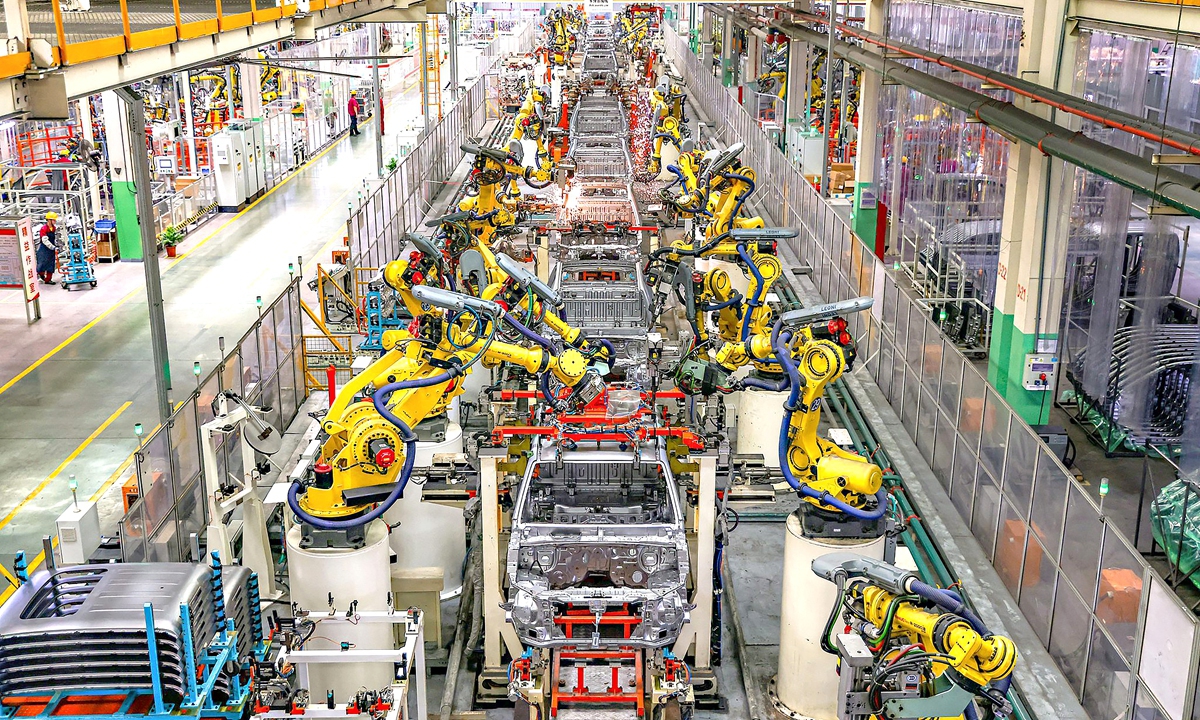
A view of an auto manufacturing line in Suzhou, East China’s Jiangsu Province, on May 13, 2025. Photo: VCG
China’s manufacturing sector advanced steadily under pressure, moving toward innovation and higher quality in 2024. Its manufacturing power index has reached the same range as Germany and Japan, placing China in the second tier of global manufacturing powers and making it the fourth country — after the US, Germany, and Japan — to enter the ranks of global manufacturing powers, according to the 2025 China Manufacturing Power Development Index Report released in Beijing on Tuesday.
The report is jointly compiled by the strategic consulting center of the Chinese Academy of Engineering, the China Academy of Machinery Science and Technology Group Co, and the National Industrial Information Security Development Research Center. Continuously released since 2015, it has become an important indicator for objectively assessing the overall level of China’s manufacturing industry.
Based on data analysis, the report summarizes the main characteristics of China’s manufacturing development in 2024, including a clear rise in innovation-driven growth, sustained positive momentum in quality and efficiency, and a rebound in the share of manufacturing exports in global exports.
These findings show that, while steadily consolidating its position as the world’s largest manufacturing country, China has made solid progress in promoting high-quality manufacturing development and achieved positive results, according to the report.
The latest findings can be seen as an important milestone in China’s transition from a major manufacturing country to a manufacturing powerhouse, and it also reflects the rapid rise of China’s manufacturing sector after decades of reform and opening-up, Li Changan, a professor at the Academy of China Open Economy Studies under the University of International Business and Economics, told the Global Times on Tuesday, noting it is a highly significant development not only for China itself but also for the global industrial landscape.
On a further note, Li said that the index highlights improvements across multiple dimensions of China’s manufacturing sector, including the integrity of industrial and supply chains, pronounced scale advantages, steadily strengthening technological innovation, and a highly skilled workforce, “all of which are key factors driving China’s move toward becoming a manufacturing powerhouse.”
Also on Tuesday, the Green Paper on Technological Innovation in Key Sectors of China’s Manufacturing Industry – Technology Roadmap 2025 was released, highlighting the main progress and development directions across 17 key sectors and 35 priority development areas in China.
By 2030, seven industries, including information and communications equipment, shipbuilding and marine engineering equipment, and household appliances, are expected to continue to maintain world-leading positions and achieve breakthroughs in original innovation, according to the paper.
By 2035, six industries, such as new display equipment, robotics, and energy storage equipment, are expected to enter the ranks of world leaders.
Meanwhile, other science- and technology-intensive manufacturing fields, including aerospace equipment, integrated circuits, and new materials, are also expected to overall move into the world’s advanced tier, the paper said.
China has built a significant presence in the global manufacturing landscape. According to the latest government data, China’s manufacturing value-added now accounts for nearly 30 percent of the global total, with its overall scale ranking first worldwide for 15 consecutive years, People’s Daily Online reported, citing data from an official of China’s Ministry of Industry and Information Technology.
All these achievements have been underpinned by strong policy support and long-term planning, laying a solid foundation for the upcoming year as China embarks on the 15th Five-Year Plan period (2026-30), Li said.
Global Times