
This is the 189th in the ‘China Chronicles’ series.
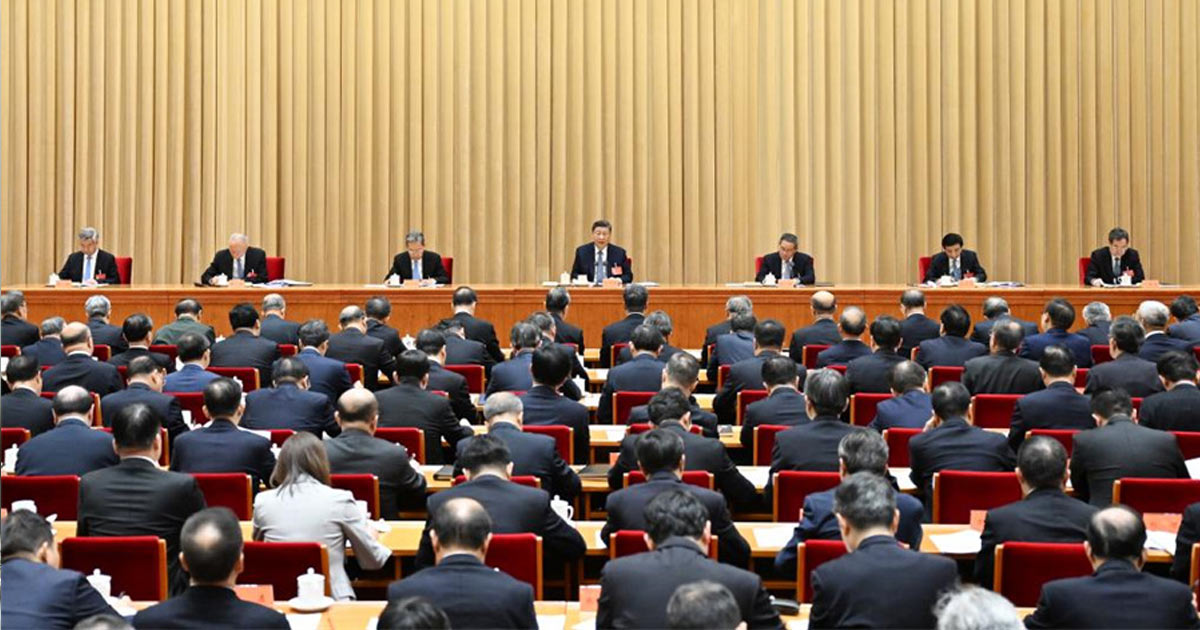
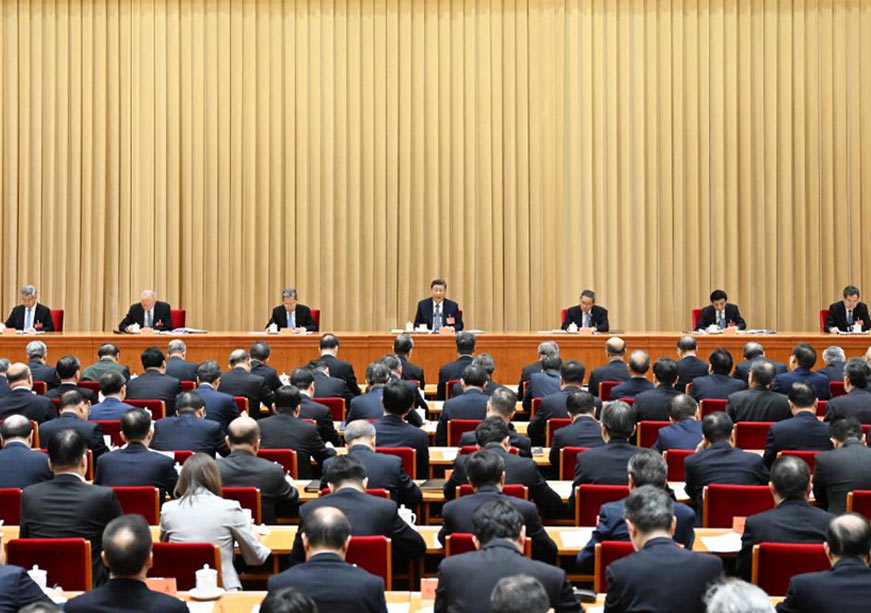
As the year draws to a close, the focus shifts to a key event in China’s political calendar—the Central Economic Work Conference—a conclave during which the Communist Party of China’s (CPC) leadership deliberates the health of the economy, the domestic and external factors that could have a bearing on it, and its future course. While a closed-door convening, the address of Chinese President Xi Jinping and commentaries in the media provide insights into the economy’s policy direction.
Geopolitical Pressures on China’s Economy
This year, the economic agenda-setting meeting took place amid rising trade tensions with the United States (US). As Donald Trump assumed office as US President for a second term, it was expected that the new administration in Washington would turn its focus towards China. Shortly after assuming office, Trump announced his ‘America First’ trade policy that promised to look into China’s practices related to technology transfer, intellectual property violations, third-country export, and discriminatory trade practices. Washington was keen to discuss the trade deficit, China’s currency manipulation, and subsidies for manufacturing. The Trump administration chose to redress America’s trade deficits with other nations, leading to the announcement of the sweeping ‘Liberation Day’ levies in April, and subsequently, pursued bilateral deals with selected countries. L, tariffs were deployed as a targeted instrument against the Chinese economy to extract strategic and economic concessions. In a sequence of retaliatory measures, US tariffs escalated to 145 percent at one point, prompting China to impose 125 percent duties on goods imported from the US. China and the United States reached a temporary accord in October, mutually agreeing to cut tariffs after Xi and Trump met in South Korea on the sidelines of the Asia-Pacific Economic Cooperation (APEC) summit.
The concept of ‘new quality productive forces’ (新质生产力) emerged as a defining pillar for the next stage of economic development at the conference. It is frequently referenced by economists and in CPC official discourse to describe productivity-driven growth through revolutionary technological breakthroughs, new forms of sustainable factor allocation, and deep industrial upgrading.
The CPC Politburo met in December, and the readout stated that efforts should be undertaken to improve coordination between “domestic economic work and endeavors in the international economic and trade arena” as well as development and security. This phrasing suggests that the CPC’s assessment remains that the international trade environment will continue to present a challenge. In the current “economically interdependent” world order, trade wars with established economies will be central to geopolitical positioning between rising and declining powers.
Technological Innovation as a Growth Driver
The concept of ‘new quality productive forces’ (新质生产力) emerged as a defining pillar for the next stage of economic development at the conference. It is frequently referenced by economists and in CPC official discourse to describe productivity-driven growth through revolutionary technological breakthroughs, new forms of sustainable factor allocation, and deep industrial upgrading. Strategic emerging industries—artificial intelligence, quantum computing, biotechnology, new energy, advanced materials, and commercial aerospace—are highlighted as the engines of future growth. This growth is expected to be driven by increasing ‘total factor productivity’, which measures gains in economic output from more efficient resource use through technology, innovation, and management, alongside the upgrading of skills. At the same time, traditional sectors such as manufacturing, agriculture, and services are expected to undergo digital and green transformation rather than be abandoned.
Domestic Demand as a Policy Priority
One of the important themes at the conference was the renewed emphasis on expanding domestic demand, especially household consumption. According to a recently released World Bank document on China, weak consumption has become a structural constraint, exacerbated by demographic ageing, income uncertainty, income disparity, and the lingering effects of the property downturn, contributing to the overall economic slowdown. A note published by China’s Commerce Ministry (MOFCOM) encourages financial institutions to incentivise purchases of big-ticket durable goods and electronics, and to support trade-in programmes. In the services sector, China seeks to promote innovation in financial products tailored to industries such as elderly care, catering, tourism, and education. A piece in Qiushi (the CPC’s Journal) summarising Xi’s speeches and writings argues that expanding domestic demand is a strategic imperative, given its implications for stability and economic security.
According to a recently released World Bank document on China, weak consumption has become a structural constraint, exacerbated by demographic ageing, income uncertainty, income disparity, and the lingering effects of the property downturn, contributing to the overall economic slowdown.
Commentaries in China Daily and Qiushi stress that boosting consumption is not merely about subsidies, but about raising household incomes, improving social security, and reducing precautionary savings. This consumption-led structural change aligns closely with the dual circulation strategy, under which the domestic economic cycle (内循环) becomes the mainstay, supported by international circulation (外循环). This approach requires building a unified national market, dismantling the hukou (household registration) system, improving logistics connectivity, and ensuring fair competition.
Technology-Driven Industrial Transformation
The conference’s call to expedite the establishment of a “modern industrial system with technological innovation at the core” is widely interpreted as a response to export controls, supply-chain disruptions, and what Beijing perceives as “technological containment” by Western powers. From this perspective, the conference was not merely an economic forum but a strategic response to a fragmented global order. Strengthening domestic innovation ecosystems, securing critical supply chains, and reducing dependence on foreign technology are critical components not just of economic policy but also of national security, as highlighted in the document, China’s National Security in the New Era, 2025.
Strengthening domestic innovation ecosystems, securing critical supply chains, and reducing dependence on foreign technology are critical components not just of economic policy but also of national security
Meanwhile, the conference’s directive to “effectively attract and utilise foreign investment” reflects a recognition that foreign capital, technology, and management expertise remain important—especially as global firms reassess supply chains. However, this ‘openness’ is increasingly selective and strategic. Priority is given to investments that complement China’s industrial upgrading goals, while sensitive strategic sectors are more tightly regulated. Thus, as China steps into 2026, it stands at a key juncture ahead of unveiling its 15th Five-Year-Plan that will run until the end of the decade. This economic blueprint will also set the stage for the 21st Party Congress in 2027, where Xi will presumably seek his fourth term in office. The longer-term mission of the 15th Five-Year-Plan, as articulated at the Central Economic Work Conference, is more ambitious: to reengineer China’s growth model, secure technological autonomy, and reposition the economy for a more contested global environment.
Kalpit A. Mankikar is a Fellow with the Strategic Studies Programme at the Observer Research Foundation.
Amit Ranjan Alok is a Research Intern at the Observer Research Foundation.
The views expressed above belong to the author(s). ORF research and analyses now available on Telegram! Click here to access our curated content — blogs, longforms and interviews.