
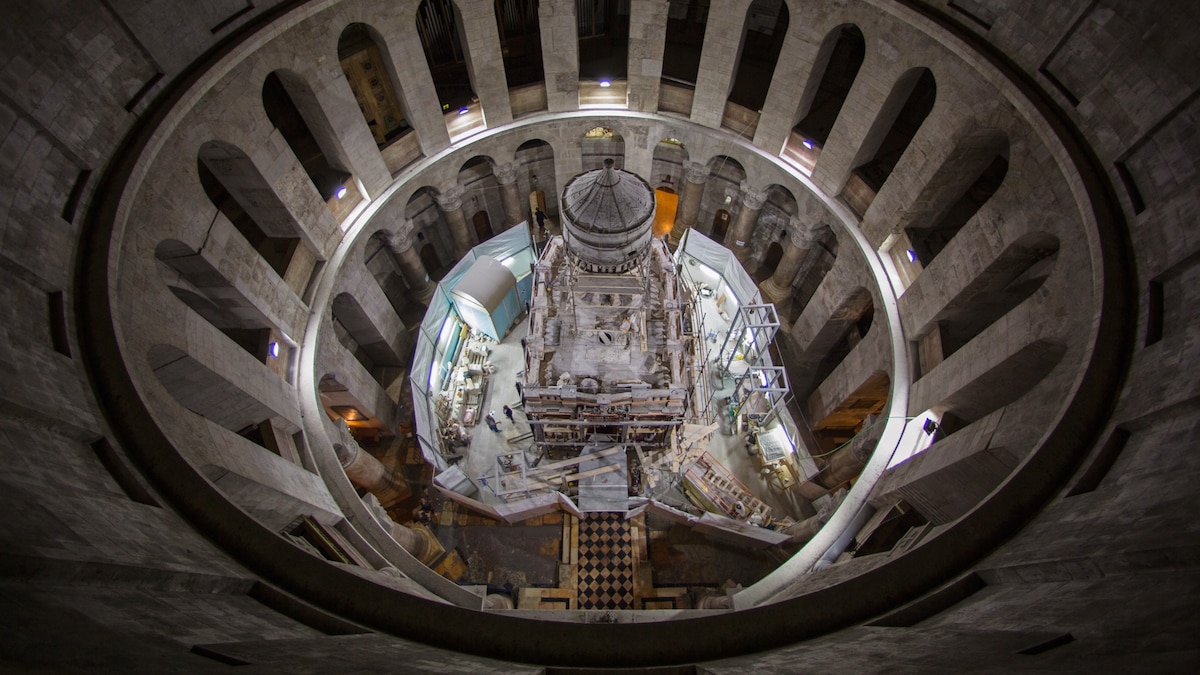
The biblical archaeology discoveries in 2025 paint a vivid picture of a rich, interconnected world whose traces echo down the millennia, in stone and text. Ongoing excavations at the Church of the Holy Sepulchre in Jerusalem, believed to have been built over the site of Jesus’s crucifixion and burial, continue to offer a glimpse at the site’s earliest days, indicating what the geography may have looked like prior to the church’s erection in fourth century. Archaeological digs elsewhere offer insight into Christianity’s early spread across the world, including traces of seventh-century monastic life in the Persian Gulf. New research is also revealing the roads Saint Paul, the apostle who spread the Christian faith across the Roman Empire, may have used during his mission. Meanwhile, sophisticated new technologies are enriching our understanding of the Dead Sea Scrolls and even shedding light on the sprawling trade routes that would have accounted for ivory’s many appearances in the Old Testament.
Taken together, these new discoveries and research offer compelling perspectives of the material realities of biblical stories, changing how we understand the Bible, both as a book of faith and a primary text of the ancient world.
An ancient garden discovered below the Holy Sepulchre
The Church of the Holy Sepulchre in Jerusalem has been a site of Christian pilgrimage and devotion since it was built by fourth century Roman Emperor Constantine. But the centuries have taken their toll—much of the current structure dates to the 12th century work of Europe’s Crusaders—and the site is currently undergoing extensive restoration to shore up its shaky, deteriorating foundations for future generations. That presents a rare and precious opportunity for archaeologists, who are currently working to unlock the site’s ancient mysteries.
A team led by Professor Francesca Romana Stasolla of La Sapienza University of Rome is conducting archaeological excavations under the structure’s floor, peeling back layers of history to peer at how the site has been used through the millennia. The team has found traces of an Iron Age quarry, for instance, but over time, it shifted to a place of cultivation. Specifically, archeobotanical analysis, the study of ancient plants, has revealed evidence of grains, grapes, and figs. That matches details given in the Gospel of John, which says Jesus was crucified next to and then buried in a garden: “The Gospel mentions a green area between the Calvary and the tomb, and we identified these cultivated fields,” Stasolla told the Times of Israel.
Discoveries and research show the spread of early Christianity from Abu Dhabi to suburban Rome
Far-reaching finds from many regions offered a window into the world of early Christianity. Taken together, they paint a picture of vitality and movement of ideas, as well as the diversity of the communities that embraced the nascent religion.