
Back to Article List
Saturn and Neptune lie close together in the evening sky. Use the brighter ringed planet to point the way to the more distant world.
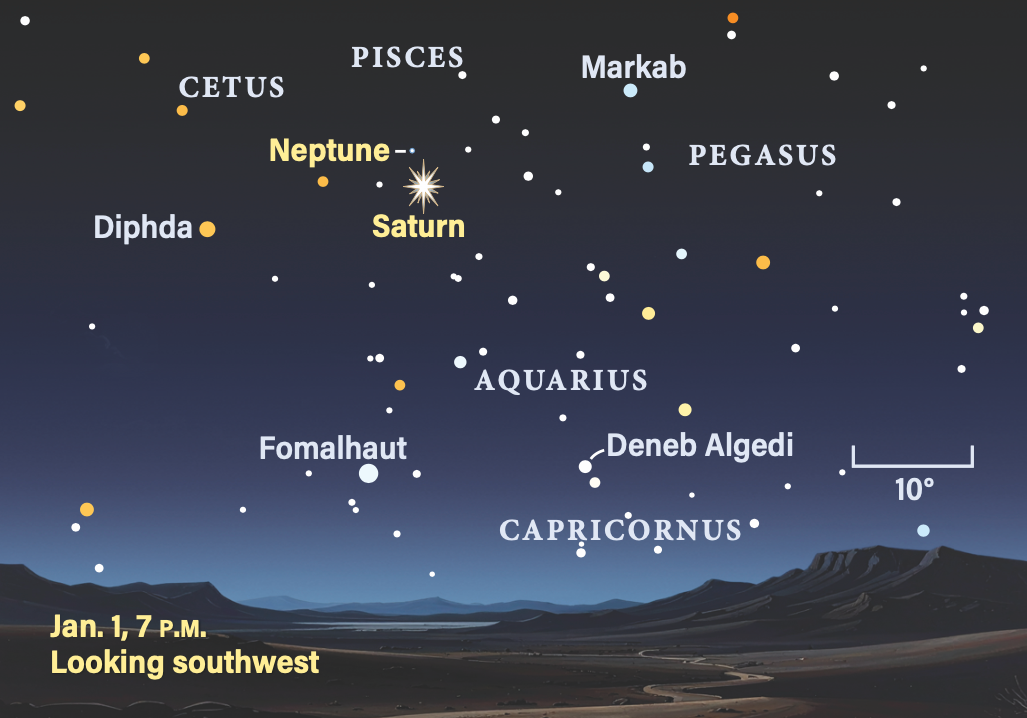
Saturn continues to point the way to Neptune all month; note that Neptune requires optical aid to view. They are best seen in early evening. Credit: Astronomy: Roen Kelly
Observational guidance is provided for locating Neptune using first-magnitude Saturn as a reference point in the early evening sky near the Circlet of Pisces, with specific instructions to scan 3.5° northeast of Saturn.
Planetary characteristics detailed include Neptune’s magnitude 7.8 with a 2”-wide bluish disk, and Saturn’s 17” disk with 39” rings appearing nearly edge-on, accompanied by its mid-8th-magnitude moon Titan.
The article notes the optimal viewing period for these distant worlds is the early evening, prior to local midnight, and describes Saturn’s decreasing angular separation from Neptune, from an initial 3.5° to 1.7° by the end of January.
Key astronomical data for December 31, 2025, from 40° N 90° W are furnished, including sunrise (7:22 A.M.), sunset (4:45 P.M.), moonrise (2:42 P.M.), moonset (5:47 A.M.), and a 98% illuminated waxing gibbous Moon.
Looking for a sky event this week? Check out our full Sky This Week column.
December 31: A Europa transit to welcome the new year
Saturn points the way to Neptune all through the month of January, offering an easy way to spot the solar system’s most distant planet. The best time to view these distant worlds is early in the evening, before they sink too close to the horizon and set by local midnight. First-magnitude Saturn continues to dominate the sky near the Circlet of Pisces, an easy naked-eye object in the southwest a few hours after sunset. Center the ringed planet in binoculars or a telescope, then slowly scan 3.5° to the northeast. That will land you right on Neptune, which shines at magnitude 7.8 and shows off a tiny, 2”-wide disk. Compared to the background stars, the planet may look like a “dull” star with a slight bluish hue.
This is the farthest the two planets will be all month; over time, Saturn will move closer to Neptune and end January just 1.7° from Neptune.
While you’ve got your optics out, make sure to take some time to enjoy Saturn as well. Its disk is 17” across, with rings stretching 39” from end to end and appearing quite thin, nearly edge-on. The planet’s brightest moon, mid-8th-magnitude Titan, lies nearby tonight, located just southeast of the disk.
Sunrise: 7:22 A.M.
Sunset: 4:45 P.M.
Moonrise: 2:42 P.M.
Moonset: 5:47 A.M.
Moon Phase: Waxing gibbous (98%)
*Times for sunrise, sunset, moonrise, and moonset are given in local time from 40° N 90° W. The Moon’s illumination is given at 10 P.M. local time from the same location.