
 Flying snakes are among the few vertebrates that move through the air without wings, membranes, or powered flight. Species within the genus Chrysopelea leave branches at speed, reshape their bodies, and travel across open gaps before landing on trees with repeatable accuracy. The behaviour has been documented across several Asian forest systems and is now examined through controlled measurements of airflow, posture, and motion. Interest in the animal reflects wider work on how bodies without rigid lifting surfaces interact with air. The flying snake offers a scenario in which anatomy, muscle control, and the surrounding structure dictate movement in the air rather than the use of specialised appendages or continuous thrust.
What sets the flying snake apart in appearance
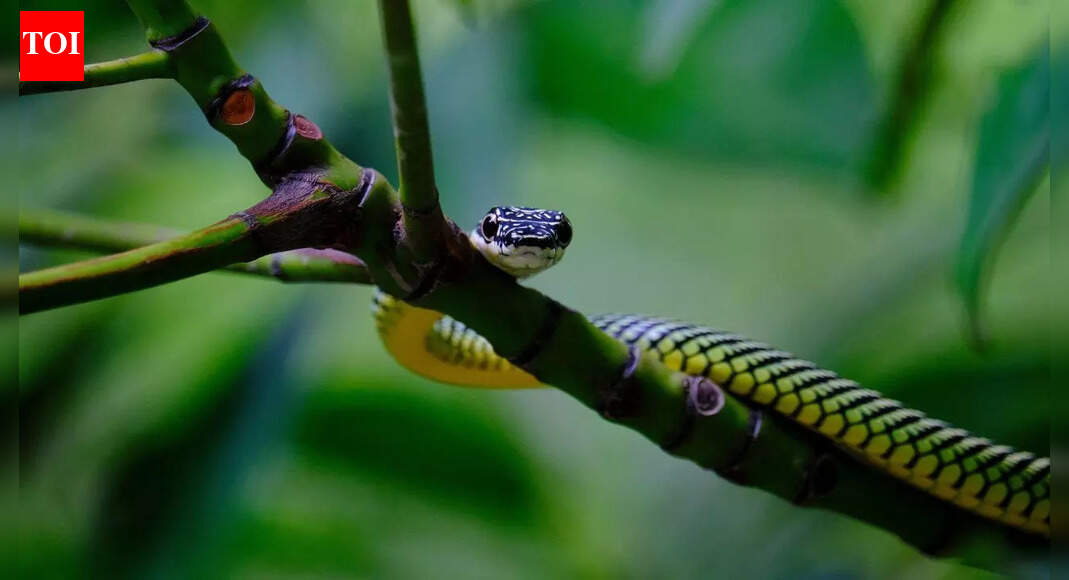
Adult flying snakes are slender colubrids, commonly measuring between 70 and 130 centimetres in length. The trunk shows a slight lateral compression even when the animal is stationary, giving the body a flattened appearance compared with terrestrial snakes. Scales are smooth and tightly overlapping, forming a continuous surface along the body that reflects light in motion. Colouration varies by species but often includes green, yellow, bronze, or olive backgrounds marked with black crossbars, spots, or net-like patterns that disrupt the outline among leaves and branches.
Scientists discover three underground snake species in Ecuador
The head is narrow and flattened, set off clearly from the neck. Eyes are relatively large and positioned to provide forward and lateral fields of view. The jaw allows a wide gape despite the slim skull. The tail tapers gradually and makes up a substantial proportion of body length. This elongated form not only helps balance the snake during climbing but also becomes mechanically very significant when the animal is airborne.
Where can flying snakes be found
Flying snakes are distributed across South and Southeast Asia and are found in India, Sri Lanka, southern China, Thailand, Malaysia, Indonesia, and parts of the Philippines. They inhabit the tropical and subtropical environments where trees provide a continuous vertical structure. Records include lowland rainforests, dry deciduous forests, wooded hills, and plantations with closed canopies.The species are strongly arboreal. Individuals are most often observed on branches, trunks, or within dense foliage rather than on the ground. Activity is mainly concentrated in the mid to upper canopy, where the movement from one tree to another can be done without going down to the ground. Open ground restricts both locomotion and concealment, thereby increasing exposure to predators. Distribution, therefore, reflects forest structure and canopy connectivity more closely than climate alone.
What does a flying snake eat
Flying snakes are carnivorous and feed mainly on small arboreal vertebrates. Reported prey includes lizards such as geckos and skinks, tree frogs, and occasionally small birds or bats. Hunting is carried out in trees. The snake proceeds slowly along branches with lateral body movements and a strong ventral grip and then strikes at close range.Prey is seized with the jaws and swallowed whole. There is no evidence that gliding itself is used to capture prey in mid-air. Instead, aerial movement allows access to new foraging sites without repeated climbs or exposure on the forest floor. Diet, habitat use, and gliding behaviour are therefore closely linked through the demands of arboreal hunting.
How does a snake generate lift without wings
Gliding begins with a distinct change in body shape immediately after launch. The snake drops headfirst, then spreads its ribs laterally along much of the trunk. This muscular action flattens the body into a broad, concave cross-section, replacing the cylindrical form used on the ground. The ventral surface becomes shallowly curved while the dorsal surface remains arched.Experiments involving wind tunnels, physical models, and high-speed imaging indicate that this shape leads to the production of lift as the air moves around the body. Pressure differences arise between the upper and lower surfaces; an upward force is produced that slows the descent and extends horizontal travel. Lift is strongest at moderate angles of attack, and stable airflow patterns can be maintained across a range of glide conditions. These measurements were reported in controlled studies published in the Journal of Experimental Biology.During the glide, the snake continues to produce lateral undulations that travel from head to tail. The motion resembles terrestrial locomotion in form but occurs at a lower amplitude. Rather than providing thrust, the movement alters local angles of attack along the body and distributes aerodynamic forces. This reduces rolling and pitching instability. Small movements of the tail produce corrective forces that affect orientation and direction, while the head is still comparatively stable, allowing visual alignment with landing sites.
What limits a snake’s ability to glide
Gliding without wings brings about definite physical and environmental constraints. Movement through the air is always a controlled descent rather than a sustained flight. The distance covered is dependent on the height from which the launch is made, but the snake is not able to gain altitude even from tall trees. The density of air, humidity, and wind are some of the factors that affect the snake’s performance, as are the spacing and height of the surrounding trees.Dense forests support short, frequent glides between nearby trunks and branches. Wide gaps restrict movement and increase the risk of landing failure. The absence of wings or membranes limits lift compared with birds or bats, placing firm bounds on speed and range. As a result, flying snakes remain closely tied to continuous arboreal habitats where their body form and behaviour function within narrow physical margins.Also Read | Why some animals die after mating: Male antechinus, praying mantis, octopuses and more