
3I/ATLAS, the third-ever interstellar object to cruise through the solar system after 1I/Oumuamua (2017) and 2I/Borisov (2019), flew the nearest to Earth on December 19, 2025 by a distance of 1.79 AU, that is roughly 270 million miles away. The rare event offered observatories around the world to gather more data on the baffling exocomet that was first spotted on July 01, 2025 by the Chile-based Asteroid Terrestrial-impact Last Alert System, aka ATLAS. While it behaves like a conventional comet, there are several anomalous behaviors on the object that defy the textbook definition of one
. Is it just one of those rare bizarre comets that doesn’t follow the rules or does it come bearing messages from our intergalactic voyeuristic neighbors? While no conclusive technological signatures have been detected, some of the 3I/ATLAS features are dubious. Harvard astrophysicist Avi Loeb who has so far flagged no less than 15 anomalies on the exocomet, continues in his pursuit of dissecting the true nature of the interstellar interloper despite the general consensus of 3I/ATLAS being a mere comet.
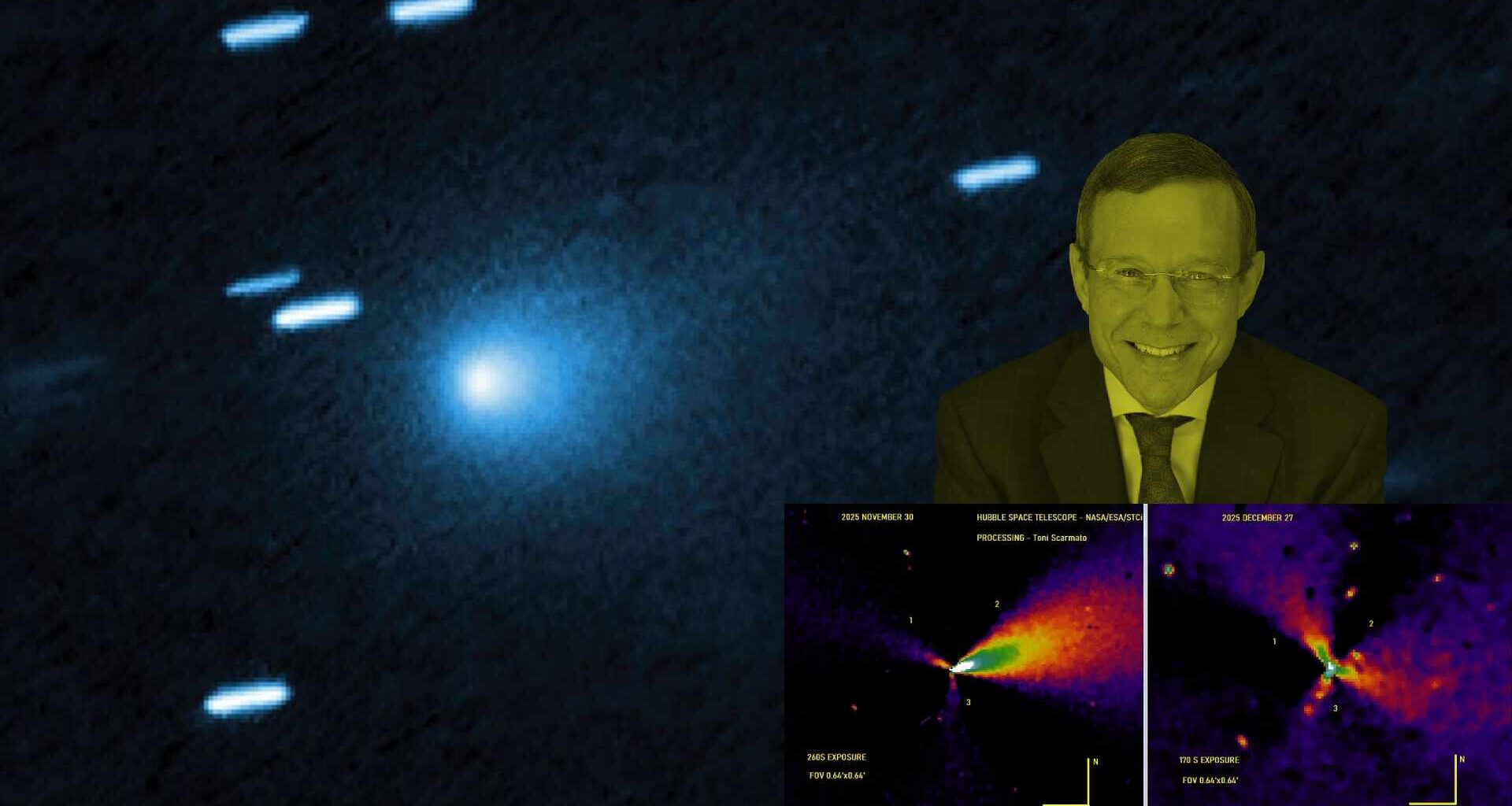
In his recent Medium blog, Prof. Avi Loeb focuses on the tail and the anti-tail of the 3I/ATLAS. Sharing a few of the 17 images snapped by NASA’s HUBBLE telescope of the exocomet, Loeb quips that “They reveal an intriguing configuration of evolving jets.” These images were captured on November 13, December 12, and December 27, 2025. Prof. Loeb states
On large scales out to 100,000 kilometers, the most prominent jet is an anti-tail directed towards the Sun, but on a scale that is 10 times smaller, there are three jets — one pointing roughly away from the Sun and two others pointing sideways
He adds,
The equal angular separations of 360 degrees divided by 3 among these three jet axes is puzzling. The orientation of the three axes is changing over time, presumably as a result of the rotation of the nucleus.
If it is a comet, then
The natural comet interpretation associates the jets with major pockets of ice on the surface of a rotating nucleus. The one that points at the Sun creates a prominent anti-tail jet that extends out to 100,000 kilometers. The activity of the other jets could be triggered by heat conduction through the body of the nucleus.
What if it is not? Prof Loeb remarks,
The anti-tail jet is ~10 times longer than it is wide. This suggests that its misalignment with the rotation axis is smaller than 6 degrees. The required geometric alignment of the rotation axis with the direction of the Sun has a small chance of 0.2% of occurring at random.
Are the symmetric triple-jet inner structure or the unlikely alignment of the rotation axis with the direction of the Sun, technological signatures? Or can they be a natural outcome of gas dynamics? Time will tell.