
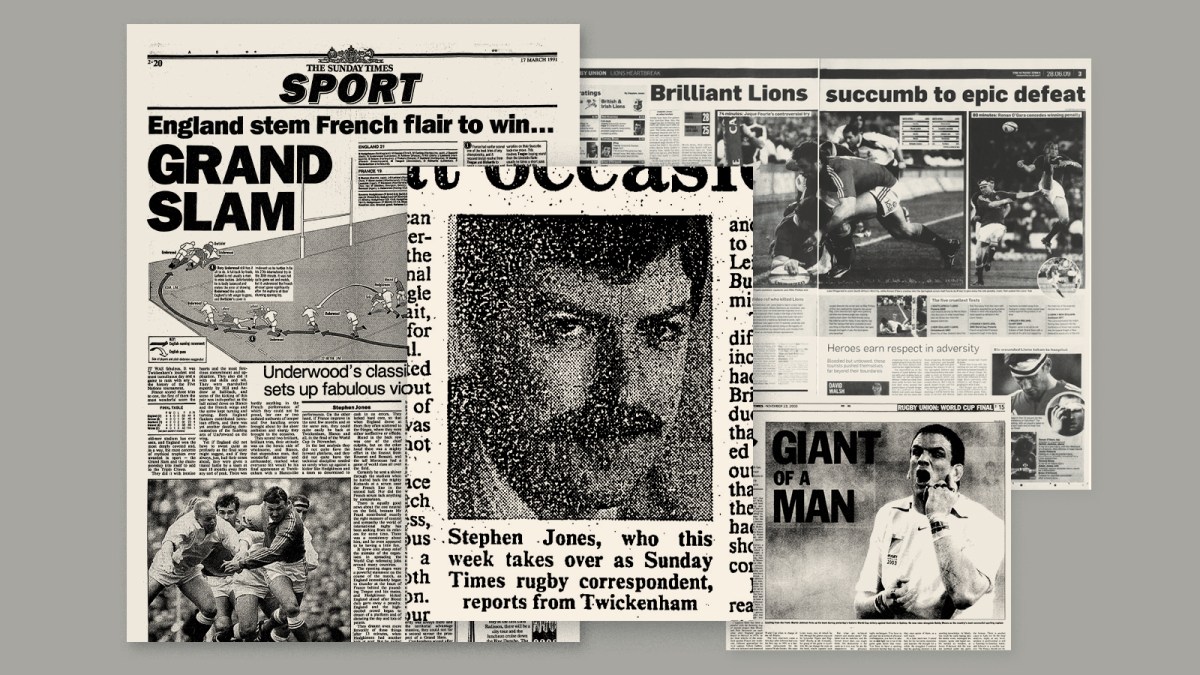
Read a selection of Stephen Jones’s reports for The Sunday Times from when he first wrote for the newspaper as a freelancer in 1980 to last autumn’s glorious World Cup final victory for the Red Roses.
One of Jones’s earliest reports in The Sunday Times, as a 25-year-old freelancer, was on Harlequins 0, Rosslyn Park 6
“The score in black and white might well give the impression that this was a pretty poor match. You’d be wrong. It wasn’t pretty poor, it was absolutely dreadful. There was no invention, no continuity and very little excitement.”
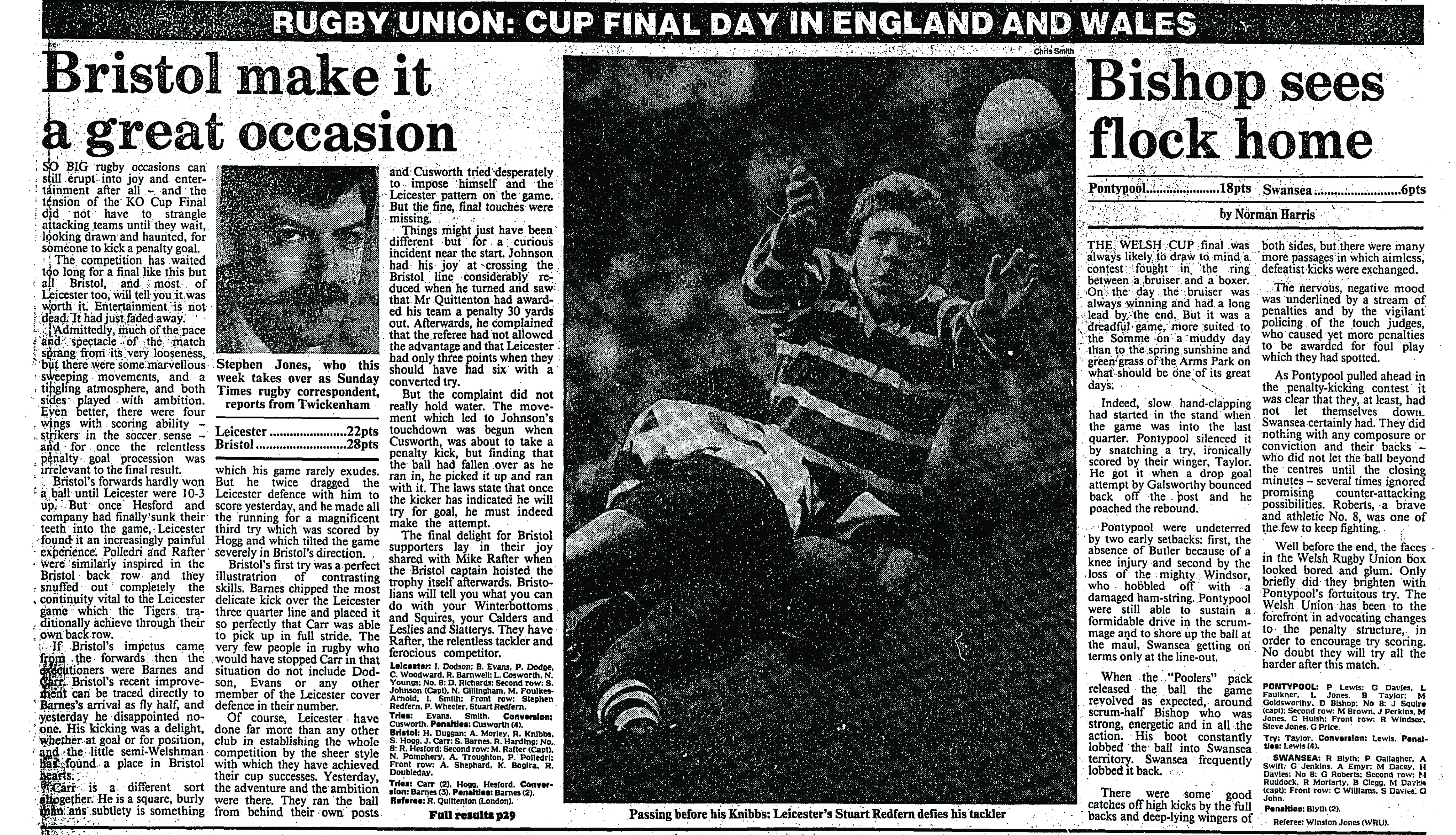
In his first week after being appointed as rugby correspondent, Jones reports on Bristol beating Leicester 28-22 in the John Player Cup final and praises the performance of Stuart Barnes
“If Bristol’s impetus came from the forwards then the executioners were Barnes and [John] Carr. Bristol’s recent improvement can be traced directly to Barnes’s arrival as fly half, and yesterday he disappointed no one. His kicking was a delight, whether at goal or for position, and the little semi-Welshman has found a place in Bristol hearts.”
Mobile app readers: Click on this image, then pinch and zoom
• Desktop readers click here for a PDF version
March 18, 1984
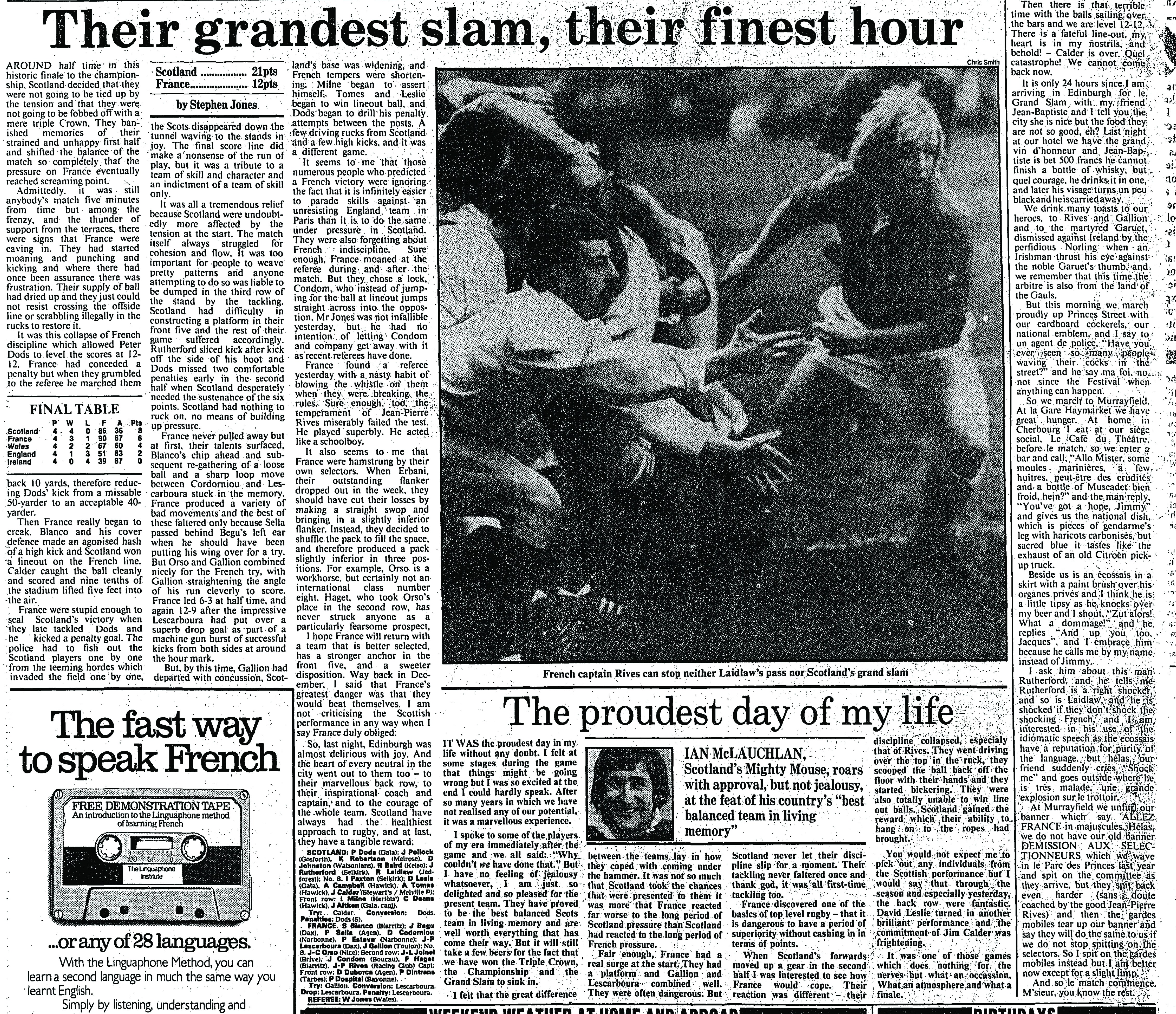
Scotland beat France 21-12 to win the grand slam at the end of Jones’s first year covering the Five Nations as rugby correspondent
“Around half-time in this historic finale to the championship, Scotland decided that they were not going to be tied up by the tension and that they were not going to be fobbed off with a mere Triple Crown. They banished memories of their strained and unhappy first half and shifted the balance of the match so completely that the pressure on France eventually reached screaming point.”
Mobile app readers: Click on this image, then pinch and zoom
• Desktop readers click here for a PDF version
March 17, 1991
England beat France 21-19 to win the grand slam
“It was fabulous. It was Twickenham’s loudest and most tumultuous day and a game to rank with any in the history of the Five Nations tournament.
“France scored three tries to one, the first of them the most wonderful score the old-new stadium has ever seen, and England won the most deeply coveted and, in a way, the most concrete of mythical trophies ever awarded in sport — the Grand Slam and the championship title itself to add to the Triple Crown.”

Mobile app readers: Click on this image, then pinch and zoom
• Desktop readers click here for a PDF version
March 24, 1991
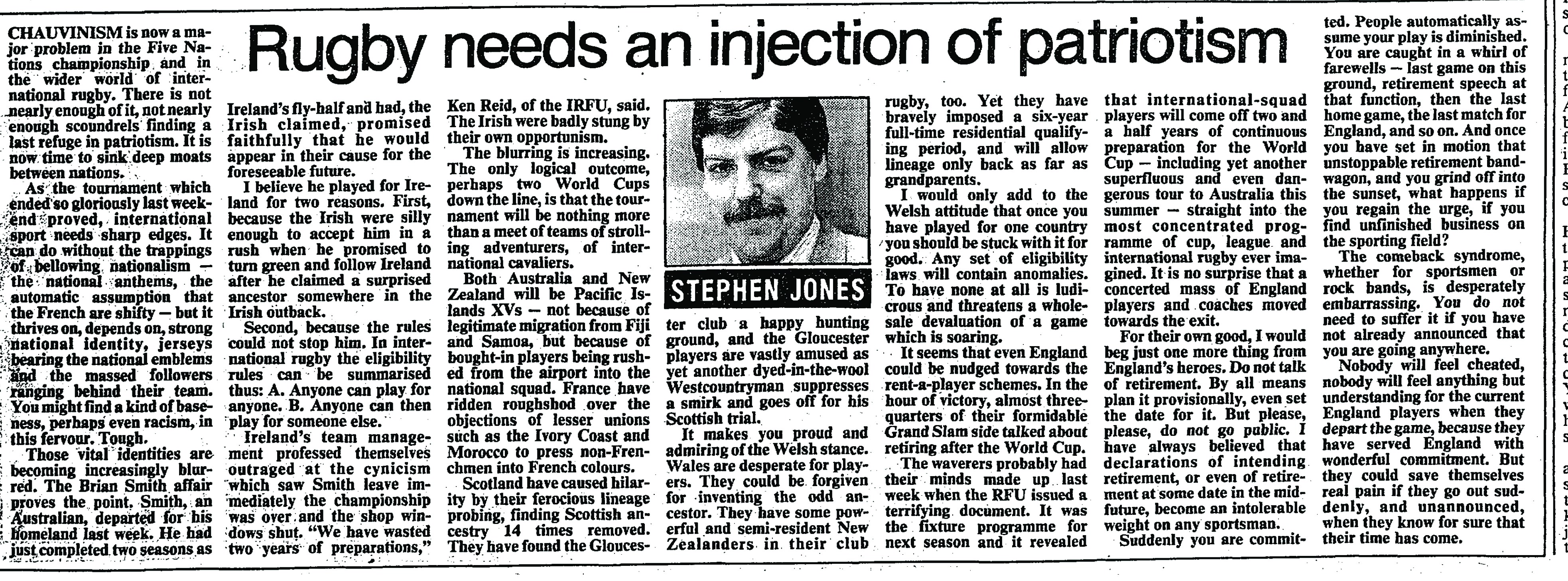
After England’s grand slam, Jones says rugby needs an “injection of patriotism”
“Chauvinism is now a major problem in the Five Nations championship and in the wider world of international rugby. There is not nearly enough of it, not nearly enough scoundrels finding a last refuge in patriotism. It is now time to sink deep moats between nations. As the tournament which ended so gloriously last weekend proved, international sport needs sharp edges. It can do without the trappings of bellowing nationalism — the national anthems, the automatic assumption that the French are shifty — but it thrives on, depends on, strong national identity, jerseys, bearing the national emblems and the massed followers ranging behind their team.”
Mobile app readers: Click on this image, then pinch and zoom
• Desktop readers click here for a PDF version
My 42 years as rugby correspondentJune 25, 1995
South Africa beat New Zealand 15-12 in Johannesburg to win the World Cup final after their readmittance to international sport that followed the end of apartheid
“Could you have ever dreamt that one single drop goal could have such significance, such historical weight, such redemptive qualities and such power to send a nation — including a dancing President Mandela — into joyous hysterics?
“The drop goal came from Joel Stransky, the Springbok fly half. It came eight minutes from the end of the second period of extra time and not even the power and passion of New Zealand could strike back.
“An ecstatic Francois Pienaar, the South Africa captain, was presented with the World Cup by President Mandela. Interviewed just before the presentation, Pienaar was asked how it felt to have 65,000 supporters behind him. ‘No,’ Pienaar said, ‘we had 43 million people behind us.’ It was a reference to the entire population of South Africa, black and white, and to the untiring power of this tournament for South African society.”

Mobile app readers: Click on this image, then pinch and zoom
• Desktop readers click here for a PDF version
June 29, 1997
The British & Irish Lions win the second Test against South Africa in Durban to seal the series
“Acclaim the most astonishing defensive performance, the most remarkable courage in adversity, in rugby history. Acclaim the counterattacks of the last ten minutes when the siege was raised and, with a short, stabbing, yet soaring drop goal by Jeremy Guscott, the Lions took the lead. Acclaim the 1997 British Lions, victors in the Test series in the home of the world champions. Now we have seen it all. The lot.
“… The Lions may not have been superior on the day as a rugby-playing force but, thank goodness, there is more to rugby at any level than simple tactics and techniques. There is heart and soul and indomitable courage. The British Lions had it. They won. They deserved to.”

Mobile app readers: Click on this image, then pinch and zoom
• Desktop readers click here for a PDF version
November 23, 2003
England beat Australia 20-17 after extra time in Sydney to win the World Cup
“Land of hope and glory. England are the champions of the world. They did it. By the gritted-teeth memory of all the heart-stopping sporting occasions ever played, they did it. It was easily the finest of the World Cup finals, with a biting intensity on the field and around the amphitheatre of the Telstra stadium. In terms of drama alone, it will stand tall in English sporting history.”

Mobile app readers: Click on this image, then pinch and zoom
• Desktop readers click here for a PDF version
Jones writes, on the same day, a piece praising England’s captain Martin Johnson
“The first sighting was in a suburb of Glasgow as England Schools played Scotland Schools. Johnson was so much bigger than the other players that he hung over them with a kind of diffidence, like a giraffe towering over the other beasts. It made him look languid and ferocious. So, while praising his ability, I doubted his fire, his playing heart. Hmm. All I can say in my defence was that it was the last time I ever doubted anything about Johnson and that as far as I can recall, I was later to become the first observer to commit what New Zealanders, and many others, felt was a sacrilege — to put Johnson above Colin Meads as the greatest lock who has played the game.”

Mobile app readers: Click on this image, then pinch and zoom
• Desktop readers click here for a PDF version
March 20, 2005
Wales beat Ireland 32-20 in Cardiff to win their first grand slam since the 1970s
“As Slams go, this was one of the Grandest. Of course you could never say it was worth the wait. Wales have endured 27 years of almost unbroken sporting agony, and there have been times when you feared they had left the ranks of the great rugby nations for ever. Well, they are back.”

Mobile app readers: Click on this image, then pinch and zoom
• Desktop readers click here for a PDF version
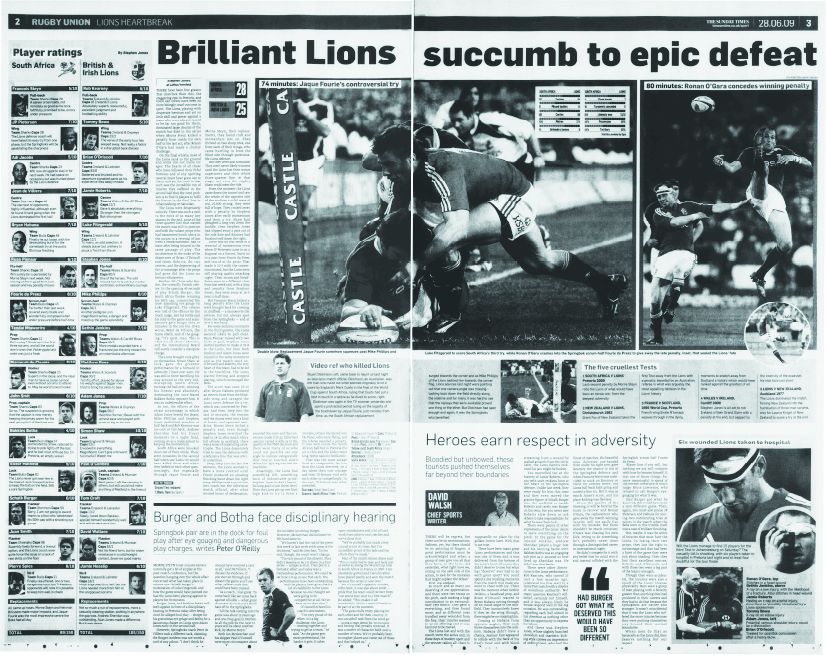
June 28, 2009
The Lions lose the second Test to South Africa 28-25 to concede the series in what Jones describes as a “staggering epic”. He praises several of the Lions highly in his player ratings.
“Simon Shaw 10/10. Involved in everything. Magnificent. Can’t give a forward full marks? Watch me.”
Mobile app readers: Click on this image, then pinch and zoom
• Desktop readers click here for a PDF version
October 2, 2011
During the World Cup in New Zealand, Jones writes about why he is so disliked in the country that a bar in Queenstown installed a ceramic replica of his head in a urinal
“As far as I can recall, it began on a long-forgotten tour when I observed that pumpkin soup was on every menu here, every day, and that it was not very nice.
“Maybe there were other things, such as the odd reference to the geographical accuracy of the New Zealand atlas, which has clearly given them the impression that they are in the centre of the universe.
“There were a few other scattered bits and pieces they didn’t seem to like, such as my humbly drawing attention to the fact that New Zealand, who, as they have never stopped telling us, have been arguably the best rugby team in the world for the past 24 years, have not won a single World Cup in all that time and therefore must be termed rugby’s greatest global chokers.
“Then they’ve been a little overprotective of their haka, the pre-match ritual that they insist is a homage to Maori warriors. Therefore they can get miffed at my view that it is a blatant and bullying attempt to strike a sporting blow even before kick-off, a corruption of Maori culture and a process they lace with the trappings of sheer arrogance.
“They tend to ignore my praise of this gentle, picturesque, roomy and good-looking nation, the warmth of the welcome from the public at large for their visitors. All they can recall is a side observation I once made, relating to a specific experience, that some parts of New Zealand are as rough as a badger’s backside, which they are.”
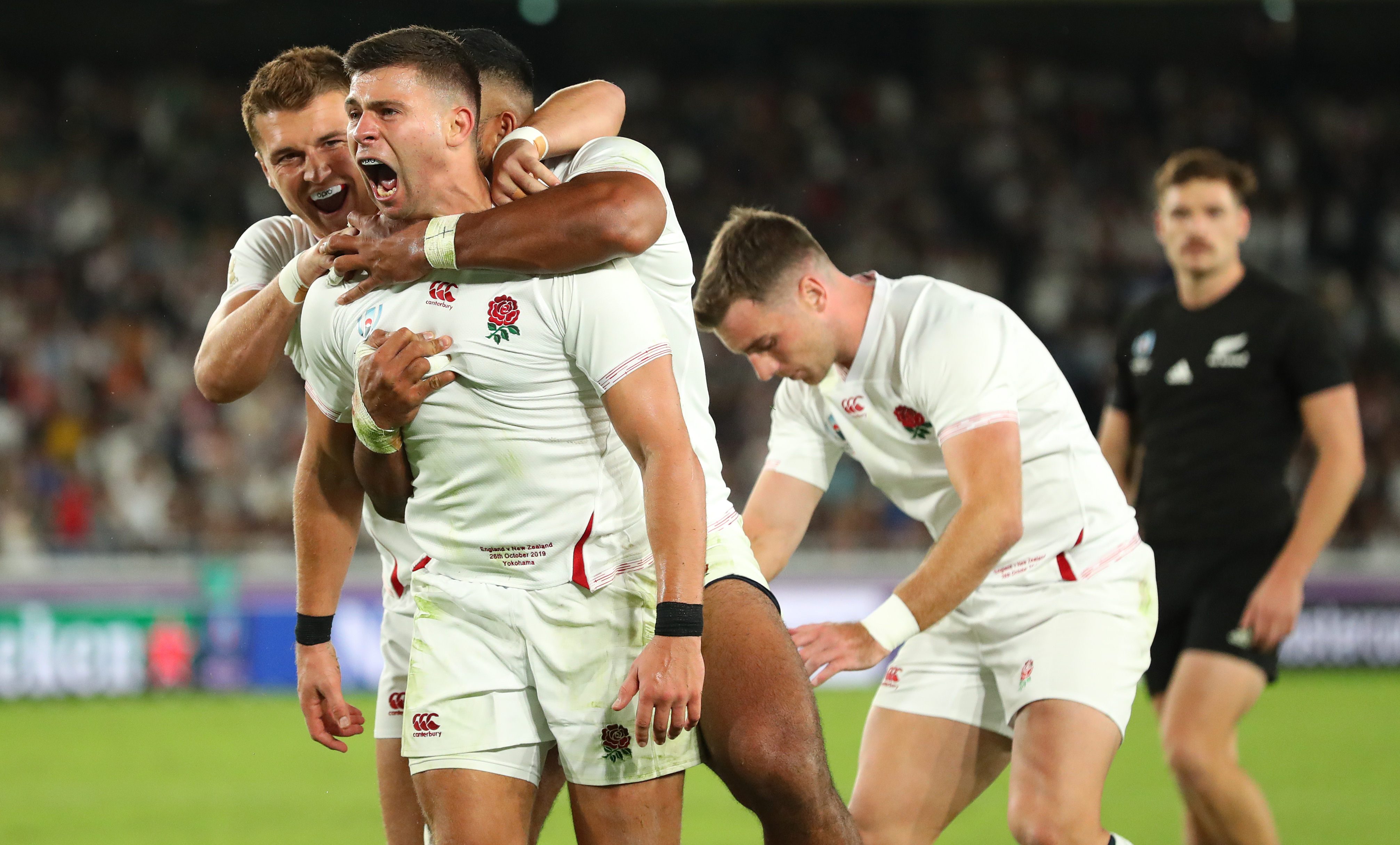
Ben Youngs celebrates scoring against New Zealand in the semi-finals of the 2019 World Cup
STU FORSTER/GETTY IMAGES
October 27, 2019
England beat New Zealand 19-7 in the World Cup semi-final in Yokohama
“When did New Zealand suffer the most crushing defeat in their history? No, you don’t need the record books. It was yesterday. It is not a matter of points. It may not look desperate on the scoreboard but they have surely never had so little of a big game, have never been played to a standstill and then to something approximating a rabble.
“This was England’s greatest performance in any World Cup. I cannot imagine the circumstances in which I would have seen a better one in any location, nothing better than the glorious exhibition of inch-perfect planning and execution that they gave in Yokohama, on their way to their third World Cup final.
“The last 20 minutes of this staggering game were played to a backdrop of English rugby songs, admittedly a genre not to everybody’s taste, but it was lovely to imagine the joy back home in England. English rugby needed this so badly, and now they must be favourites to become world champions.”
May 12, 2024
Reflecting on the destruction of Wales’s rugby heritage, Jones recalls his pride in his own first appearance in Newport colours
“They play in black and amber, of course. When I was just turned 18, still in school, I wore that jersey for the first time. Newport United, the second team, were hit by injury. That day they still had Welsh internationals, Wales B players, an Oxford Blue and people with vast first-team experience.
“They also had John Jeffery, the Welsh international No8 and an absolutely massive man, who was proving his fitness after injury.
“Just to see the jersey hanging on its peg was stupendous, to wear it in action against Chepstow RFC, was something else entirely. What I remember chiefly about the game is being completely exhausted in the second row by the awesome power of Jeffery pushing behind me. But I got through, and they chose me again the next week.
“My father came and stood on the touchline. He was the man who had introduced me to rugby, and Rodney Parade, without fanfare. Dad never said very much, but next day he was holding court in the Old Globe in Rogerstone. ‘Our Steve played for Newport yesterday,’ he was saying to fellow drinkers.”
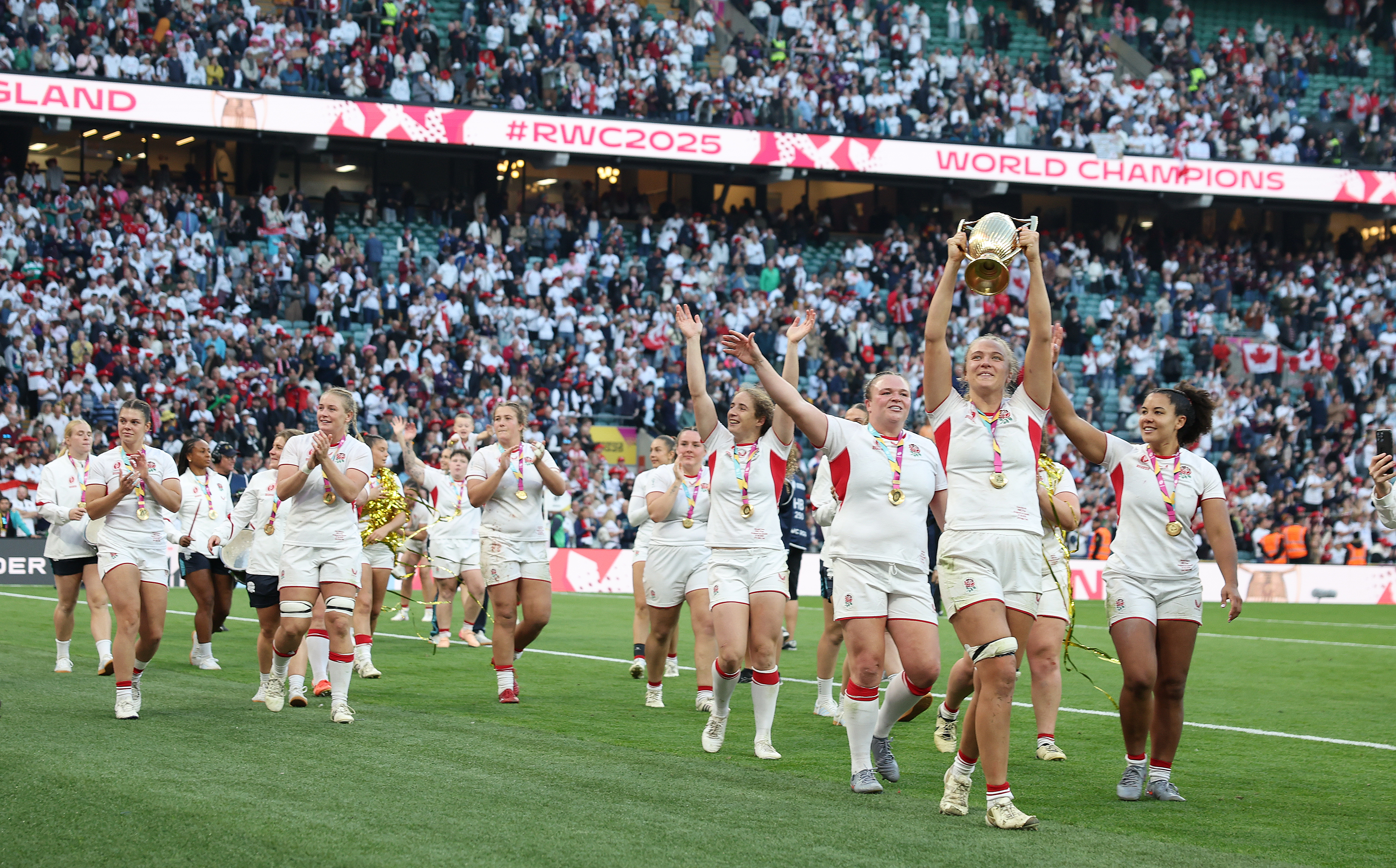
The victorious Red Roses parade the trophy at Twickenham
THE TIMES PHOTOGRAPHER MARC ASPLAND
September 27, 2025
England beat Canada 33-13 to win the Women’s Rugby World Cup
“Long before the end, everything was all white. Gleamingly white. England are champions of the world, they won an event that surpassed every single expectation, even for those who dared to dream really big. We can toast the incredible crowds at this tournament and the huge hearts of all the teams, especially the amateur ones.
“But first we must celebrate the thunderous triumph of the Red Roses. They are world champions for the third time, and they can now lay to rest their previously dire record in finals.”