
Scottish wind farms have been paid an astonishing £347million to not generate electricity – helping to rack up a Britain-wide bill of more than £1.45billion for wasted wind power in a single year.
Operators north of the Border have been handed the millions in so-called wind constraint payments, in order not to generate power.
But in total, wasted renewables have cost Britain a massive ten-figure sum with the cash spent on switching off wind turbines and firing up alternative power sources.
In constraint payments alone, wind farms in Scotland have been paid a remarkable £346,847,461 to stand idle.
All but five local authority areas in Scotland have wind turbines within them, laying bare the scale of how the power projects have taken over the country.
Politicians and campaigners alike have sounded the alarm about the scale of the constraint payments, which are ultimately borne by households and businesses through their bills.
MSP Douglas Lumsden, Scottish Conservative energy spokesman, said: ‘Hard-pressed Scots will rightly be questioning these soaring payments.
‘At a time when they are facing rising energy bills, they will wonder why they are footing an ever-increasing bill for turbines to be turned off.
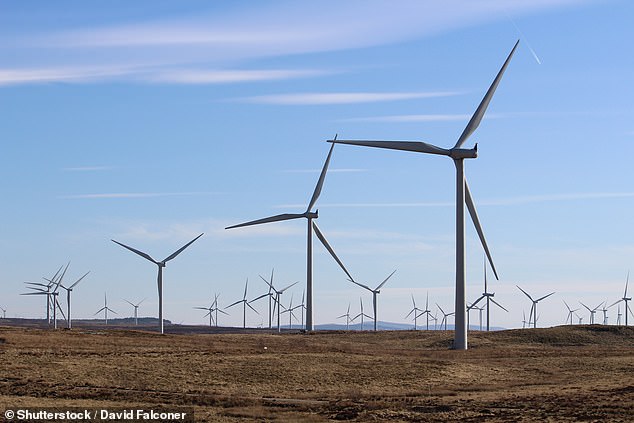
In constraint payments alone, wind farms in Scotland have been paid a remarkable £346,847,461 to stand idle
‘Rural communities are being overwhelmed by the number of wind farms spreading across the country.
‘Labour and the SNP are riding roughshod over local community concerns.
‘While the right balance must be struck on our energy needs, delivering value for money for taxpayers must be a top priority at all times.’
And campaigner Denise Davis, of Communities B4 Power Companies, said: ‘The whole of the UK is having to pay for this. Every single time they get a bill, they’re paying.’
The Highlands has the most onshore wind turbines with 862 built, latest figures have revealed. It is followed by South Lanarkshire, where there are 518, and Dumfries and Galloway, where there are 512.
But there are also huge wind farms offshore, developments which includes Scotland’s largest, named Seagreen, which is around 17 miles off the coast of Angus in the North Sea.
An astonishing £1,457,263,000 has been spent turning off wind turbines and paying gas plants to switch on in Britain so far this year, data from the Wasted Wind tracker website showed, jumping from £1.23bn the year before.
And separate figures from the Renewable Energy Foundation show that, as of December 15, wind farms in Scotland have been paid £346,847,461 in constraint payments alone.
So far this is the second highest on record, slightly down on the 2024 high of £393,492,798, with two weeks of the year left.
Constraint payments are dished out when the grid is congested and cannot transport power from wind farms in remote areas, often in Scotland, to where it is needed most.
But to keep the lights on in those areas grid operators must call on gas plants to step in to power up Britain often at great expense.
A Department for Energy Security and Net Zero spokesman said: ‘We are reversing decades of underinvestment and delivering the biggest upgrade to the grid, which will minimise constraint costs, meet the capacity needed to deliver clean power by 2030, and help bring down bills for households for good.
‘The more renewables on the system, the cheaper the wholesale price of electricity, which is why the only answer for Britain is our mission to get us off the rollercoaster of fossil fuel prices and onto clean, homegrown power we control.’
Gillian Martin, Holyrood’s energy secretary, said: ‘The current UK energy system is not fit for purpose – in an energy rich country like Scotland, nobody should be struggling to pay their bills or living in fuel poverty.
‘Despite UK Government promises to cut energy bills by £300, they are now more than £150 higher. We have consistently called for reform of the electricity market so that Scottish households can benefit from the green electricity produced in our country.
‘Scotland’s vast renewable potential is one of our greatest economic opportunities and can deliver thousands of well-paid, sustainable jobs across Scotland, as well as securing lasting benefits for communities.’