
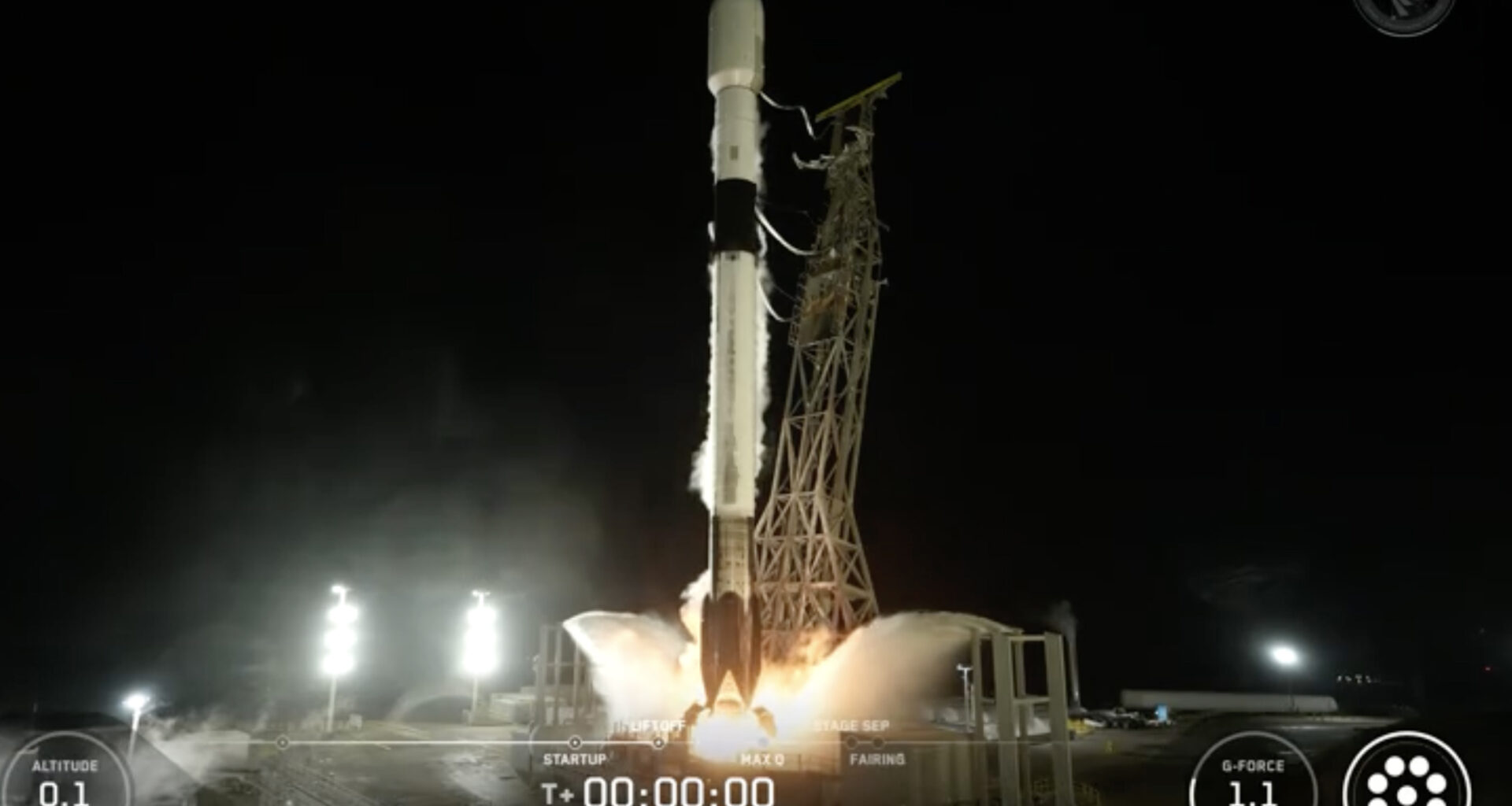
Getting off the ground during a break in rainstorms soaking the Central Coast, a Falcon 9 rocket on Friday launched the new year at Vandenberg Space Force Base while delivering an Earth-observation satellite for Italy.
The two-stage rocket built by SpaceX blasted off at 6:09 p.m. Friday from Space Launch Complex-4 on the South Base as crowds of spectators gathered around the Lompoc Valley, applauding and cheering as the Falcon 9 climbed upward.
In addition to the liftoff, the mission attracted onlookers hoping to see the first-stage booster, which was completing its 21st flight, return to Landing Zone 4 at Vandenberg, sparking sonic booms.
Mission managers had closely watched conditions Friday in hopes of finding a hole in the weather so that the launch could occur.
Other areas had good views of the rocket’s travels with reports of sightings as far away as Colorado.
The first blastoff of 2026 for Vandenberg also is the first for SpaceX and follows a busy and record-breaking 2025 for the company, which saw 165 Falcon 9 liftoffs last year from Vandenberg plus Florida.
In 2025, Vandenberg conducted 70 launches of rockets carrying satellites and missiles being tested, with the pace expected to be slightly busier in 2026.
On board Falcon was the COSMO-SkyMed Second Generation FM3 satellite, manufactured by Thales Alenia Space, for the Italian Space Agency and Italy’s Ministry of Defense.
Falcon successfully deployed the dual-use satellite shown via an onboard camera gently separating from the rocket about 13 minutes after departing Vandenberg.
“COSMO-SkyMed is an Italian technological gem that for nearly 20 years has been observing the Earth with unique precision,” said Teodoro Valente, president of the Italian Space Agency. “With FM3, we strengthen our global leadership in radar observation.”
Once slated to be SpaceX’s final launch of 2025, ground support equipment issues at SLC-4 pushed the COSMO-SkyMed into the new year.

Italy’s COSMO-SkyMed Second Generation FM3 satellite separates from the Falcon 9 rocket’s second stage 13 minutes after Friday’s launch from Vandenberg Space Force Base. Credit: Contributed photo
“For almost 20 years, COSMO-SkyMed has been observing the Earth using advanced radar technology capable of operating day and night in all weather conditions,” said Annie Cui, a SpaceX operations engineer and webcast commentator. “The system provides critical data for environmental monitoring, climate studies, security, emergency management, and protection of land, marine and coastal areas.”
The FM3 craft joins two first-generation COSMO-SkyMed satellites — launched from Vandenberg on Delta II rockets between 2007 and 2010 — still operating in orbit.
The new satellite also joins two second-generation spacecraft launched from Kourou, French Guiana in 2019 and Florida in 2022.