
Editor’s note: This article contains spoilers for the series finale of Stranger Things.
I remember the circumstances under which I watched most seasons of Netflix’s Stranger Things. Months after the first season’s release, I was recovering from the worst stomach flu of my life my sophomore year of high school, so I decided to give the much ballyhooed show a try. Friends and family told me endlessly that I look just like the character Steve Harrington, a truth I fought for a while but now accept. Season 2 came out my junior year shortly before a water main break shut down my school for most of the week of Halloween, giving me time to binge it. As a college student interning in New York City, I saw season 4 reinvigorate the series after a forgettable third season (that might be why I can’t remember what was going on in my life when I watched it) as Kate Bush’s “Running Up That Hill” became the No. 1 song in the world decades after its release thanks to the show’s masterful use of it.
Now a reporter at The Dispatch, I went to the apartment of my colleague to watch the series finale the day after Netflix released it on New Year’s Eve, ending the nearly 10-year run of the show. Creators and brothers Matt and Ross Duffer had a big task ahead of them: They had to give a proper send-off to characters who meant so much to so many. Unfortunately, they did not quite do it.
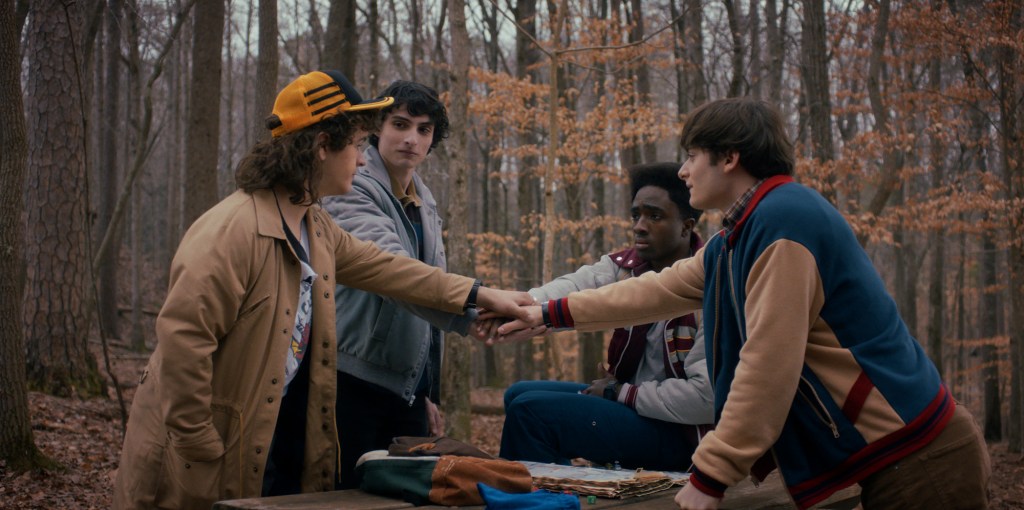
One of Stranger Things’ core themes is the David and Goliath motif. Much like the hobbits in J.R.R. Tolkien’s mythology, which the series references multiple times, the small ones, the unlikely heroes, must find the courage to defeat much stronger enemies and save those they love. The nerdy core gang of Mike, Dustin, Lucas, and Will must stand up not only to bullies in the schoolyard but also monsters from another dimension who invade their town through the Upside Down, a parallel world to Hawkins, Indiana, where the show takes place. They do so with the help of Eleven, a young girl who gains telekinetic powers due to experiments by the U.S. government. These people, along with various minor characters, make up the heart of the small town that is besieged by enemies domestic (corrupt actors in the federal government), foreign (the Soviets), and interdimensional (the Mind Flayer).
The fifth season carries on this theme through Will’s newfound powers—which he uses to kill the monsters attacking his friends after Vecna, the main antagonist of the last two seasons, underestimates him—and in the character of Holly, Mike’s younger sister who demonstrates unexpected courage in the face of horrifying circumstances.
Another theme of the show is honesty and trust. After Eleven meets Mike early in the series, one of the first principles he teaches her is that “friends don’t lie,” and she adopts it as an absolute moral code. Even if they do so with good intentions, she still feels betrayed when people lie to her, such as in the third season when Mike, after the two start dating, tells a lie because he erroneously believes it is the only way he can save their relationship.
In the finale, Eleven’s story ends ambiguously—but both of her plausible fates betray at least one of the show’s core themes. She learns that the government needs her in order to create more children with special powers, opening the possibility of creating another monster even if the party defeats Vecna and his master, the Mind Flayer. As the gang hatches a plan to destroy the Upside Down and sever Hawkins’ connection with the interdimensional monsters, Eleven gets the idea to remain in the parallel world, leading to her death and an end to the possibility of more superhumans.
The Duffer brothers have confirmed that whether Eleven goes through with that plan is up to the viewer’s interpretation: Either Eleven did stay behind and die in the Upside Down, or she made everyone believe that she did.
Killing herself is a choice that her loved ones begged her not to make. When police chief Jim Hopper, who has become her adoptive father, learns that she is considering such an option, he threatens not to execute the plan to destroy the Upside Down until he knows Eleven is safe. He acknowledges that she has unjustly suffered her whole life, but he implores her to fight on for a normal future. “I know you don’t believe you can have any of this, but I promise you, we will find a way to make it real,” Hopper tells her. “You will find a way to make it real because you have to, because you deserve it.”
It soon appears to the main characters, however, that Eleven will go through with dying, and Mike, who has become the love of her life, pleads with her to stay. But Eleven is adamant. “None of this will ever end, not if I’m still here,” she says to him telepathically.
That is questionable, at best. It is possible that the government will capture Eleven and create new superhumans who will cause carnage on Earth, but there is no guarantee. And even if there were, so what? For the whole series, the underdogs have won against much more powerful villains. One of the themes of the show is that a little good can overcome great evil if the heroes do not give up. But the show eschews that message and has Eleven (apparently) end her own life because of struggles she may face. She rejects the pleas of her father and boyfriend who love her and stays in the Upside Down as it blows up, perishing along with it—or does she?
Over a year after the party defeats Vecna, Mike proposes a theory to the rest of his friends, saying that Eleven only tricked everyone into thinking that she died, and actually escaped to safety in a faraway land to live in anonymity.
This ending is better than one in which Eleven actually dies, but it still betrays many of the show’s core themes. Again, it would require that Eleven believe she is not strong enough to face the powerful enemies that might try to hurt her and her loved ones. Additionally, if she did deceive everyone and is alive, then her last act in Hawkins is to lie to her friends—despite her aforementioned commitment to the truth.
Stranger Things has been a cultural touchstone ever since the Demogorgon first abducted Will, and Gen Z will view it as a key part of its growing up. Just as parents watching the show with their kids reminisced about the nostalgia of the 1980s, those who fell in love with the series during their formative years will tell their children of Stranger Things’ impact when media 40 years from now reference it.
But when today’s young people rewatch it with their future children, many will likely be disappointed as they revisit the ill-fitting conclusion to a story that delighted millions of viewers for almost a decade. Instead of giving a message of hope, the finale gives one of despair, recanting the themes that have made the show so rich.