
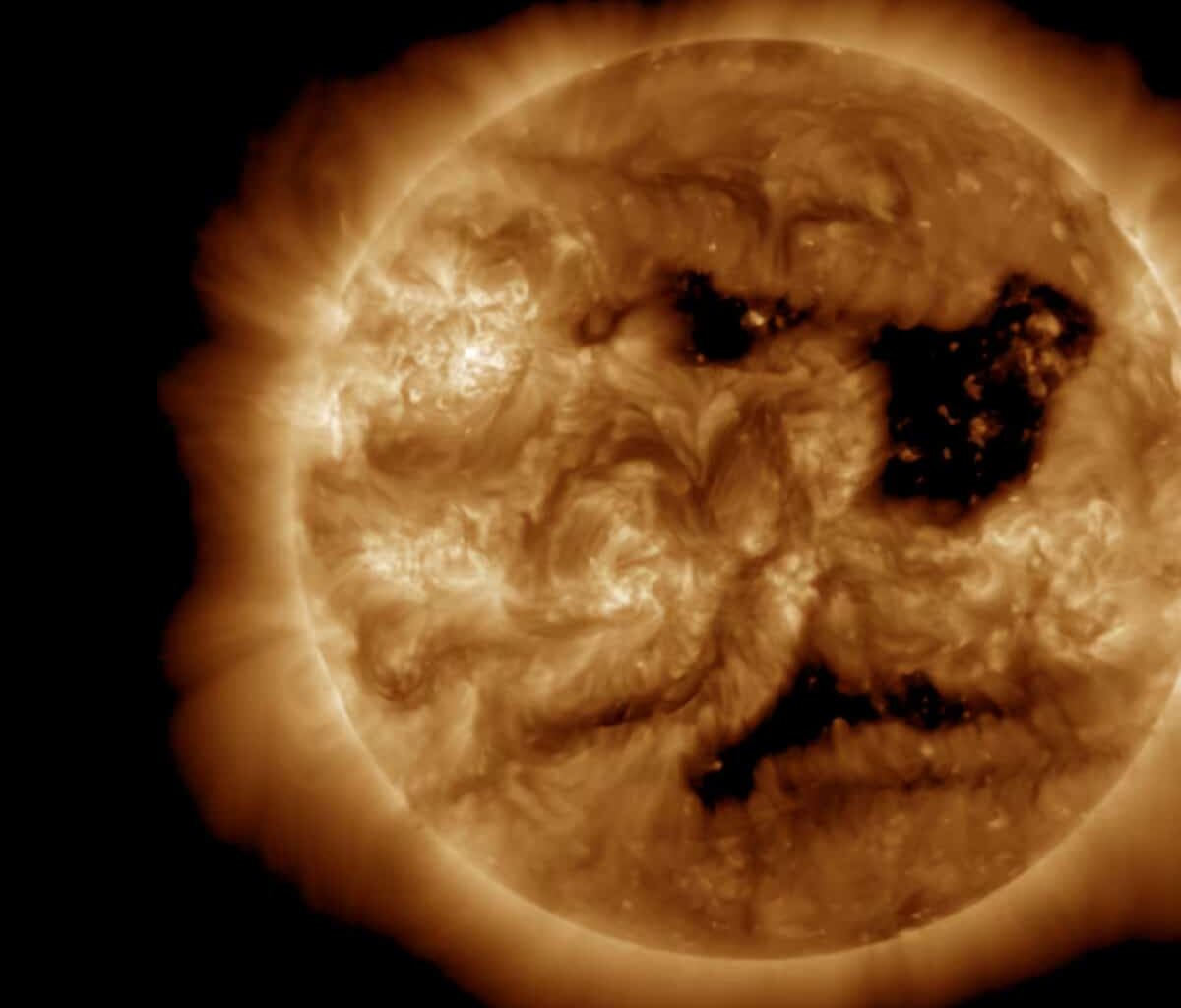
Over the past few days, NASA’s Solar Dynamics Observatory (SDO) has captured something striking on the Sun’s surface — a giant dark gap, or rather two of them, each stretching nearly 800,000 kilometers across. Both are pointed directly toward Earth. Astronomers call these vast structures coronal holes.
In ultraviolet images, a coronal hole looks dark because it’s cooler than the surrounding regions. That darker appearance gives it its name. But in truth, a coronal hole isn’t a physical hole carved into the Sun’s surface or atmosphere. Instead, it’s a region where the Sun’s magnetic field opens up and extends into space — like a window letting streams of charged particles escape at tremendous speed, forming what we know as the solar wind.
Long coronal hole, an area of open magnetic field, seen by @NASASunEarth on sun surface. Aurora likely on Earth: https://t.co/0DTC6JHvhQ pic.twitter.com/5wdCK4TRic
— NASA (@NASA) January 7, 2017
Could we see the northern lights?
These particles are the culprits behind geomagnetic storms that can disrupt satellites, electronics, and power grids on Earth. They’re also responsible for the mesmerizing glow of the northern lights.
Still, space weather experts say these enormous coronal holes, visible on the Sun’s front-facing side, aren’t expected to unleash any major solar storms. With a bit of luck, though, they might make auroras brighter and more widespread than usual — typically seen only in far northern skies.
So, could we catch the spectacle from France this Friday, January 31, or Saturday, February 1, 2025? The answer, much like a coronal hole’s magnetic field, remains delightfully open.

Nathalie Mayer
Journalist
Born in Lorraine on a freezing winter night, storytelling has always inspired me, first through my grandmother’s tales and later Stephen King’s imagination. A physicist turned science communicator, I’ve collaborated with institutions like CEA, Total, Engie, and Futura. Today, I focus on unraveling Earth’s complex environmental and energy challenges, blending science with storytelling to illuminate solutions.