

Researchers working on China’s Experimental Advanced Superconducting Tokamak (EAST) say they have managed to operate the reactor beyond a plasma density limit that has constrained fusion experiments for decades. This achievement could help improve the efficiency of future fusion reactors.

EAST, often referred to as China’s “artificial sun,” is a tokamak located in Hefei that uses superconducting magnets to confine ultra-hot plasma. In simple terms, higher plasma density allows more fusion reactions to occur. The problem is that, in most tokamaks, pushing density too far leads to instability, causing the plasma to break down and interact with the reactor walls. This boundary is commonly linked to the Greenwald limit.
The team behind EAST believes the issue is not just how dense the plasma becomes. According to researchers at the Institute of Plasma Physics, Chinese Academy of Sciences, the density limit is closely tied to impurities entering the plasma, especially metal particles released from the reactor’s inner walls. Tungsten, which is widely used in fusion devices, was identified as a major contributor.
To better understand and control this effect, the researchers developed a model called Boundary Plasma-Wall Interaction Self-Organization (PWSO). They then tested the theory on EAST using electron cyclotron resonance heating along with a pre-charged gas startup method. These changes helped reduce the impact of tungsten at the plasma edge.
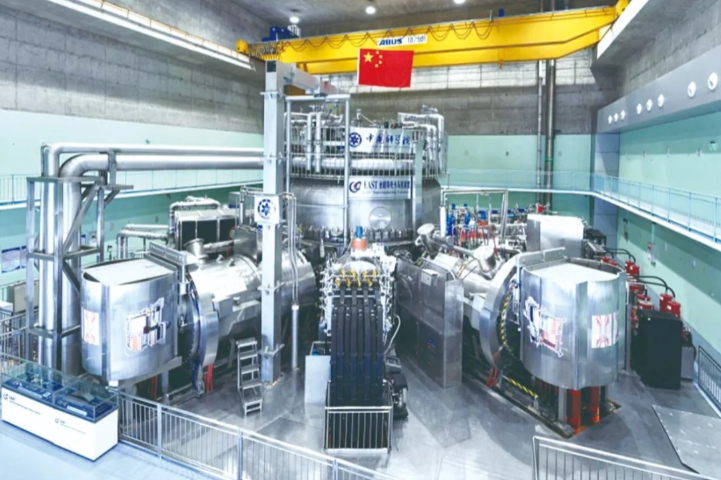
With impurity levels better controlled, the plasma was able to move into what researchers describe as a stable “density free zone,” operating beyond the traditional limit without triggering disruptions. The experimental results closely matched the predictions of the PWSO model.
The findings, published in Science Advances, offer new guidance for designing future high-density fusion reactors. While commercial fusion power remains a long-term goal, the work addresses one of the practical challenges that has slowed progress in magnetic confinement fusion.
Don’t miss a thing! Join our Telegram community for instant updates and grab our free daily newsletter for the best tech stories!
For more daily updates, please visit our News Section.
(Source)