
Happy New Year and welcome back to FirstFT Asia. In today’s newsletter:
Washington warns Venezuela’s new leader
China targets online vendors in tax crackdown
Inside Hong Kong’s car scene
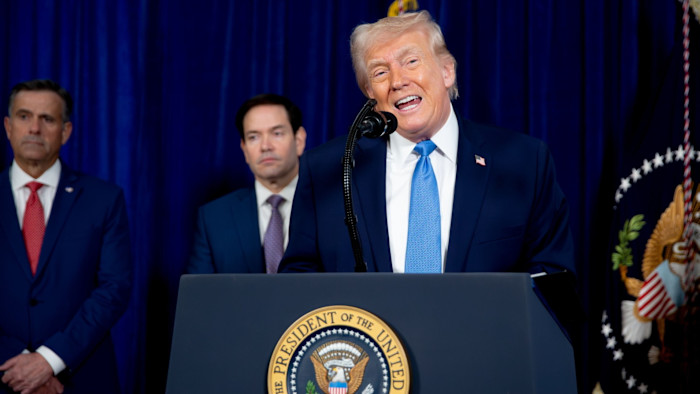
Donald Trump has warned Delcy Rodríguez, Venezuela’s de facto leader, that she must meet US demands after Nicolás Maduro’s capture, as Washington signalled its intent to dictate policy in Caracas rather than physically govern the country.
What to know: The US president’s message to Rodríguez came in an interview yesterday with The Atlantic magazine. “If she doesn’t do what’s right, she is going to pay a very big price, probably bigger than Maduro,” Trump said. Speaking to CBS yesterday, US secretary of state Marco Rubio suggested the US did not intend to occupy or administer Venezuela, but would dictate policy to Caracas — and suggested people had become “fixated” on Trump’s comment on Saturday that the US would “run” the country.
On Saturday, after capturing Maduro in a night-time raid on Caracas and transporting him to the US to face criminal charges, Trump had said the US would “run” Venezuela until further notice but indicated that Rodríguez was “essentially willing” to heed Washington’s diktats. Trump’s more aggressive tone towards Rodríguez came as his administration offered little additional detail on Washington’s next plans for the Latin American country after toppling Maduro.
Oil markets prepare for turmoil: Traders are bracing themselves for upheaval when the oil market reopens this morning. Venezuela produces less than 1 per cent of global oil output but holds about 17 per cent of the world’s proven crude reserves, giving it the potential to increase supply significantly. Here’s what traders expect.
We have more coverage of Trump’s intervention in Venezuela:
‘We will not be anyone’s colony’: The Maduro regime sought to maintain its grip on Caracas in the hours after US forces captured the authoritarian leader.
How will Trump ‘run’ Venezuela?: The US president has committed to establish the country of 28mn as a temporary protectorate. But critics fear a dangerous power vacuum.
Maduro’s downfall: The authoritarian leader withstood previous attempts to oust him, but presided over the collapse of the country’s economy.
Opinion: After ousting Maduro, what happens in Venezuela from now on will be on Trump’s account, writes Edward Luce.
Here’s what else we’re keeping tabs on today:
Economic data: Vietnam reports December inflation, trade, industrial output and fourth-quarter GDP data.
Monetary policy: Thailand’s central bank releases minutes of its last meeting.
South Korea-China relations: Chinese leader Xi Jinping meets South Korean President Lee Jae Myung in Beijing.
Results: Foxconn reports fourth-quarter revenue.
Five more top stories
1. Chinese authorities are raking in more tax from online vendors as part of a crackdown triggered by Beijing’s desire to bolster revenues to compensate for slowing economic growth. A new law that came into effect in October has contributed to a 12.7 per cent rise in tax revenues from ecommerce platforms in the third quarter from a year earlier.
2. British and French war planes have bombed an underground facility in Syria that was used by Isis militants to store weapons, the UK Ministry of Defence has said. The joint UK-French strike comes after the US launched a wave of strikes in December amid a recent uptick in attacks by Isis-affiliated or extremist militants.
3. Denmark’s Prime Minister Mette Frederiksen called on Trump and his allies to stop making threats to seize control of Greenland as tensions flared between the Nato allies following the US intervention in Venezuela. Frederiksen made her most significant rebuff of Trump after he said “we do need Greenland” in an interview with The Atlantic.
4. More than three-quarters of economists expect the US to maintain or widen its productivity lead over the rest of the world, because of AI, deep capital markets and relatively low energy costs, an FT survey has found.
5. German authorities suspect a leftwing group is behind a power outage in south-west Berlin. The outage is expected to last until Thursday, leaving tens of thousands of households, hospitals and nursing homes without electricity and heating in freezing temperatures.
Interview: Sparx founder Shuhei Abe Sparx founder Shuhei Abe: ‘One of the biggest catalysts for the coming years will be changes of management attitude’ © Ko Sasaki/FT
Japan’s executives have to change their mindset and exert more pricing power as the country moves on from an era of deflation, one of its biggest independent asset managers has said. Shuhei Abe, founder of asset manager Sparx, said managers of the previous era had “suffered from the trauma of the past bubble” and had it instilled in them to cut debt and hoard capital rather than raise prices. Read the full interview.
We’re also reading . . .
Hong Kong: Car ownership is considered a luxury in the city, where parking alone costs a premium. But that has not stopped Hong Kong’s car enthusiasts.
A ‘new kind of social network’: Two Silicon Valley veterans behind Twitter and Pinterest have launched a new app that is designed to be an antidote to social media.
Bin the bucket list: It’s the spontaneous moments that make life rich and exciting, not the ones for which you have sky-high expectations, writes Jemima Kelly.
Chart of the day
China plans to reinforce its dominance of global manufacturing, despite persistent deflation at home and growing complaints from abroad about soaring Chinese trade surpluses. Here’s why Beijing is doubling down on its export-led growth model.
 Take a break from the news . . .
Check out FT Weekend’s 2026 cultural calendar, where our critics share what they’re most looking forward to this year in film, TV, theatre, classical, art, gaming, pop and dance.
