
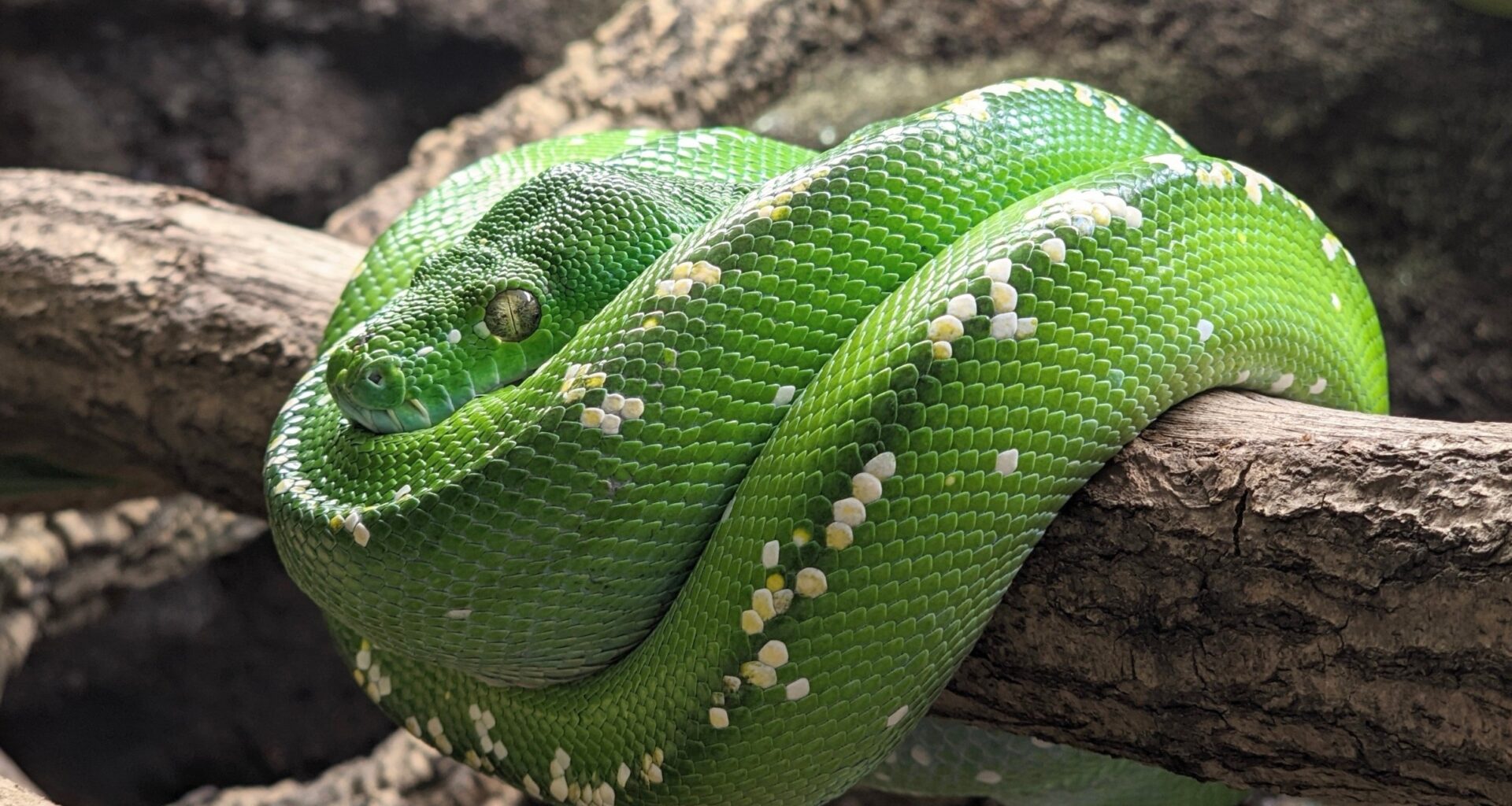
Millions of years before modern Britain took shape, snakes moved across a warm and humid landscape filled with forests, rivers, and wetlands.
Fossils from southern England now reveal one such snake, hidden in museum drawers for decades. Careful study has finally revealed a new species that helps scientists understand how modern snakes began.

Researchers have named the species Paradoxophidion richardoweni. Fossil bones show a small snake that lived around 37 million years ago, during a warm period known as the late Eocene.
At that time, England supported many reptiles that no longer live anywhere near Europe.
A fossil that was long overlooked
In 1981, fossil collectors recovered tiny snake backbone bones from Hordle Cliff on England’s southern coast.
Scientists stored these bones at the Natural History Museum in London. For many years, no one recognized the fossils as belonging to a unique species.
A recent study confirms that these vertebrae represent a new genus and species. Researchers used detailed comparisons and modern scanning methods to reach this conclusion.
Uncovered in the Headon Hill Formation, the fossils date back to a time when England had high carbon dioxide levels, warm temperatures, and lush ecosystems. Such conditions allowed snakes to spread widely across Europe.
What makes Paradoxophidion unusual
Only backbone bones remain, yet these bones hold important clues. Paradoxophidion shows a rare mix of features found across different snake groups.
Such a combination appears early in snake evolution and helps scientists track how advanced snakes developed.
The vertebrae show strong support structures, a large nerve canal, and a distinctive shape that differs from both primitive snakes and later modern groups.
Some traits resemble early aquatic or semi-aquatic snakes, while other traits resemble modern advanced snakes known as caenophidians.
Caenophidians include most living snake species. Fossils that sit close to the base of this group remain rare. Paradoxophidion fills part of this gap and shows that early caenophidians already displayed a wide range of spine shapes.
A name with historical meaning
The genus name Paradoxophidion means “paradox snake.” Scientists chose this name because the bones show an unexpected mix of traits.
The species name Paradoxophidion richardoweni honors Sir Richard Owen, a major figure in paleontology. Owen described some of the first fossil snakes from Hordle Cliff during the nineteenth century and played a key role in founding the Natural History Museum.
Study lead author Dr. Georgios Georgalis is an expert in the Institute of Systematics and Evolution of Animals at the Polish Academy of Sciences.
“It was my childhood dream to be able to visit the Natural History Museum, let alone do research there,” said Dr. Georgios. “So, when I saw these very weird vertebrae in the collection and knew that they were something new, it was a fantastic feeling.”
“It’s especially exciting to have described an early diverging caenophidian snake, as there’s not that much evidence about how they emerged. Paradoxophidion brings us closer to understanding how this happened.”
Digital models confirm the new species
The vertebrae measure only a few millimetres in length. Such small size explains why past researchers overlooked the fossils. To study the bones properly, the research team used micro CT scanning.
The scans allowed scientists to build three-dimensional digital models of the vertebrae.
The models revealed internal structures, subtle changes along the spine, and traits shared across all bones, confirming they belonged to a single species.
The digital models also allow researchers worldwide to study the fossils without traveling to London. Open-access data increases accuracy and transparency in paleontology.
How Paradoxophidion may have lived
The bones show no clear signs of burrowing or climbing specializations, and the body length likely stayed under one meter. Spine features suggest flexible movement rather than heavy body support.
Some vertebral traits resemble elephant trunk snakes, a small group of fully aquatic snakes living today in southeast Asia and northern Australia. Elephant trunk snakes belong to one of the earliest branches of caenophidians.
“As Paradoxophidion is really similar to the acrochordids, it’s possible that this snake could be the oldest known member of this family,” noted Dr. Georgios. “If it was, then it could mean that it was an aquatic species, as all Acrochordids are aquatic.”
“On the other hand, it might belong to a completely different group of caenophidians. There’s just not enough evidence at the moment to prove how this snake might have lived, or which family it belongs to.”
Why the discovery matters
The research highlights how European snake diversity once exceeded modern levels. England played an important role during early caenophidian evolution.
Fossils from Hordle Cliff already include some of the earliest known constrictor snakes.
Paradoxophidion adds another piece to this puzzle. The species shows that early advanced snakes experimented with many spine designs before modern groups became established.
Future research may uncover related species hidden in museum collections. Dr. Georgios plans further study of fossil snakes, including material first examined by Richard Owen.
“There are also several bones with differing morphology that haven’t been investigated before that I’m interested in looking at. These might represent new taxa and offer additional clues about snake evolution.”
The study is published in the journal Comptes Rendus Palevol.
—–
Like what you read? Subscribe to our newsletter for engaging articles, exclusive content, and the latest updates.
Check us out on EarthSnap, a free app brought to you by Eric Ralls and Earth.com.
—–