
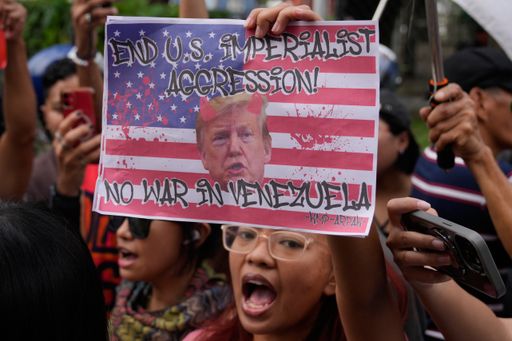
Once again, we are told that a “regime” must be “changed”, and, as is often the case, it is the United States government claiming the right to enforce it.
Although the term ‘regime change’ only gained prominence towards the end of the Cold War, the practice of removing a leader or government by force and installing a preferred successor has occurred more than a hundred times in modern history.
Sometimes it leads to a period of apparent stability, often at significant military or economic cost to the instigating power, like in West Germany and Japan.
Sometimes, it results in civil war as resentful local populations direct their anger at the occupying force and its collaborators, whom they see as traitors or sellouts.
When the occupying power deems the costs of maintaining control too great, violent conflicts can ignite and persist as in Iraq, Libya, and the Democratic Republic of the Congo.
Most often, however, it seems to lead to authoritarianism, violence, reprisals, and lasting tensions that can ebb and flow over generations, as evident in Chile, Argentina, Haiti, and Indonesia.
Nobody – least of all the architects of Maduro’s abduction – knows what will happen next in Venezuela.
Related
Experts assumed that the US President Donald Trump and Rubio would immediately install Maria Corina Machado, the divisive Nobel Peace Prize laureate, as Venezuela’s new leader, but Trump quickly distanced himself from the idea.
This has led to all manner of speculation about the type of ‘regime change’ we are witnessing: is it a palace coup? Is there a split (or splits) within Chavismo?
Is – and I think this is fairly clear – there a split in the instigating power’s ruling elite? Isolationists will want a quick result, with Maduro on trial, and agreements drawn up over oil and mineral resources.
This may suit Trump and his notoriously short attention span, as he can claim victory without worrying too much about the consequences.
Hawks like Marco Rubio will campaign for something more dramatic, however – not just the dismantling of Chavismo (which they view as a gross affront to the manifest destiny of the United States), but a stepping stone to action in Cuba or beyond.
And let us not overlook the agency of Venezuela’s government and people. There may well be Chavista politicians confident they can outlast Trump, and they could be right.
Meanwhile, the popular militias which emerged under the much-missed Chavez may take their own view on where the country’s resources should go.
Disregard for Venezuelans
What is painfully clear, however, is that ‘regime change’ has once again been carried out without any consideration for the population of the target nation.
As in Afghanistan, Iraq, and Libya, nuanced scholarly analysis of local power structures has been discarded, overshadowed by two persistent discourses.
First, that this ‘change’ is legitimate on the grounds of business and property, that somehow the mechanisms of extraction were being ‘unfairly’ impeded: Guatemala and Iran experienced this in the 1950s, albeit wrapped in the cant of anti-communism.