
[Editor’s note: The following interview contains spoilers about the ending of “Hamnet.”]
Writer/director Chloé Zhao drew on ancient storytelling traditions for the ending of “Hamnet,” the most emotionally overwhelming scene of the movie awards season.
“Crying together goes back to the Greeks,” Zhao told me. “In every indigenous tradition, you come around the fire, and then the shaman would channel a story.”
In fact, Zhao used daily meditations and dream sessions with her actors, and arranged weekly dance rituals to let off steam. “Animals, dreams, visions,” she said. “People have strong emotions. Warriors come back from battle. They don’t just take medication. They can go back home. They sit around the fire, and they dance, and they release these emotions, and that turned into theater, these Greek tragedies. You get together, everyone gets angry together, and then they rage, and then they cry. We have been dealing with this impossible tension to be alive. We so far have not been able to escape the law of nature. We’re going to be born, we’re going to die. And we have been using art and storytelling and a collective communal experience — to grieve, to feel, to deal with that since way before any of these things that are telling us we should be separated even existed. We’re remembering, ready to survive.”

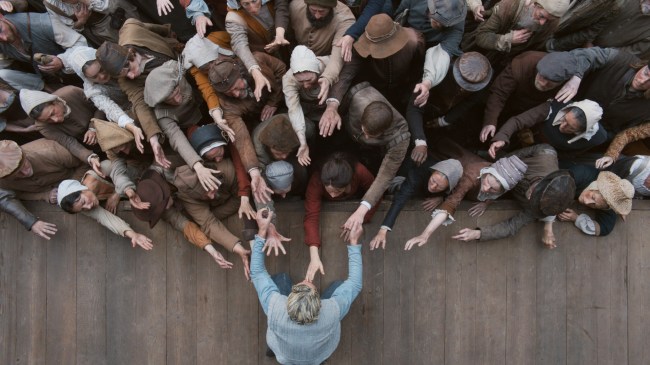
At the end of the movie, the grieving Agnes (Jessie Buckley), bereft of her lost child Hamnet (Jacobi Jupe) and her husband (Paul Mescal) — who has long been away writing and mounting “Hamlet” — comes to the Globe Theatre to see the premiere performance. She stands at the edge of the stage with hundreds of theatergoers behind her. She is riveted as the actor playing Prince Hamlet (Noah Jupe) is onstage with her husband, Will, playing the ghost of his father, King Hamlet.
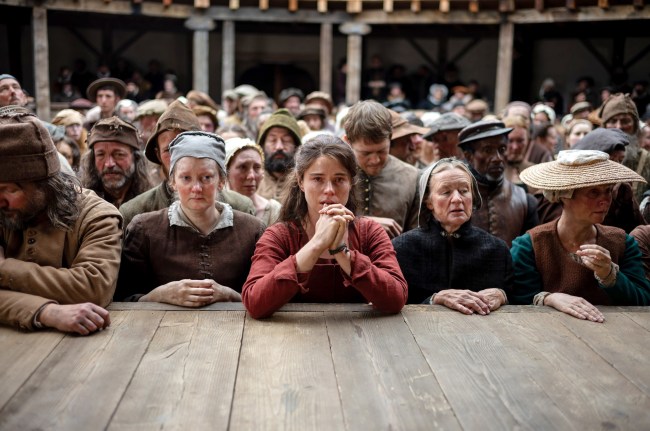 ‘Hamnet’©Focus Features/Courtesy Everett Collection
And across that stage, the estranged William and Agnes Shakespeare meet each other’s eyes again. “We stop seeing each other in the world,” said Zhao. “Or even allow ourselves to be seen, because there’s so much shame and guilt. It’s sometimes scarier to be seen, to allow yourself to receive that sameness, than [to try] to see other people.”
Mescal and Zhao had a disagreement about “where their marriage and relationship exists at the end,” he told me at the Soho House in Los Angeles. “But the way Chloe was describing it, which is totally a true reading, is that there is something shattered and repaired in a certain instance in that look, and for me, I don’t know how I can see Agnes and not feel like it’s a new beginning. Maybe it’s the romantic in me, and maybe it’s where I am in my head and my heart. That was always to me what that moment is. It’s so moving. At that moment, he is connected to Agnes on the wedding day, saying, ‘Look at me, look at me.’ And Will turns around, and it mirrors that. I felt a feeling of heartbreak and relief: ‘Thank God, you get to see this. Thank God you understand why I had to go away.’”
Shooting that sequence marked “four of the most difficult, but also life-changing days of my life,” said Zhao. “There’s barely any dialogue. This language is quite universal for everyone, right? Sometimes our truth can only be felt in silence and maybe with Max Richter‘s music playing in the background. All we’re asking is to see each other and be seen without judgment, unconditionally, and that was healing and also difficult to experience. Shakespeare worked hard his entire life to bring people together every day for a few hours: The illusion of separation dissolves.”
And that’s what Zhao has experienced at screenings of the film, from the premiere at Telluride to Roy Thomson Hall in Toronto to the Academy Museum in Los Angeles. “You go to these events,” she said. “You hold each other’s grief and anger and fear and shame in that short amount of time.”
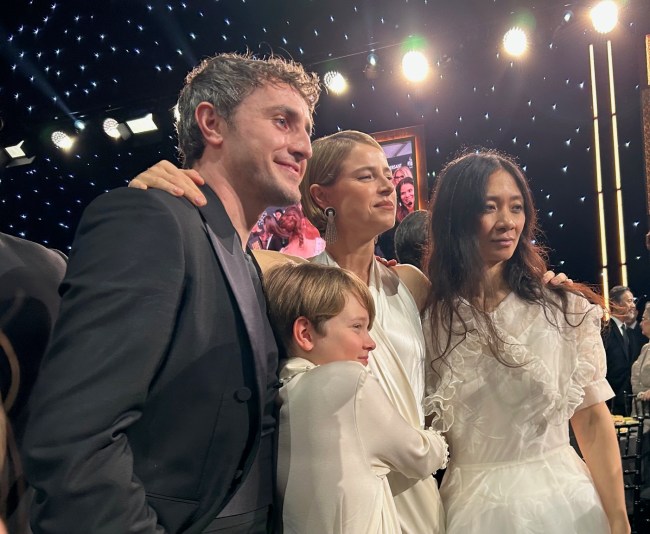 The ‘Hamnet’ team at the Critics Choice AwardsAnne Thompson
At the end of the film on the Globe stage, what Zhao wanted to convey was that “it’s so hard for this boy [Hamlet] to let go,” she said. “He’s in a lot of pain, but he can’t let go because the void is so scary. You don’t know what’s on the other end. He’s between life and death, like where Hamnet is. Hamnet is stuck because his mother won’t let him go. But what Hamlet needed at that moment, which Agnes was able to give to Hamlet, because it’s safer, he’s a symbol of her son, not really her son. She’s reaching out to him to say, ‘I give you strength to let you go.’ And all the audiences in that moment reach out to him so that this boy, in that moment of fear, can feel the oneness and the fact that separation is an illusion. And when you feel that oneness, then you suddenly feel peace. And the rest is silence. And then he lets go, and therefore allows her to let Hamnet go.”
“Hamnet” is now in theaters from Focus Features.