
Real journalists wrote and edited this (not AI)—independent, community-driven journalism survives because you back it. Donate to sustain Prism’s mission and the humans behind it.
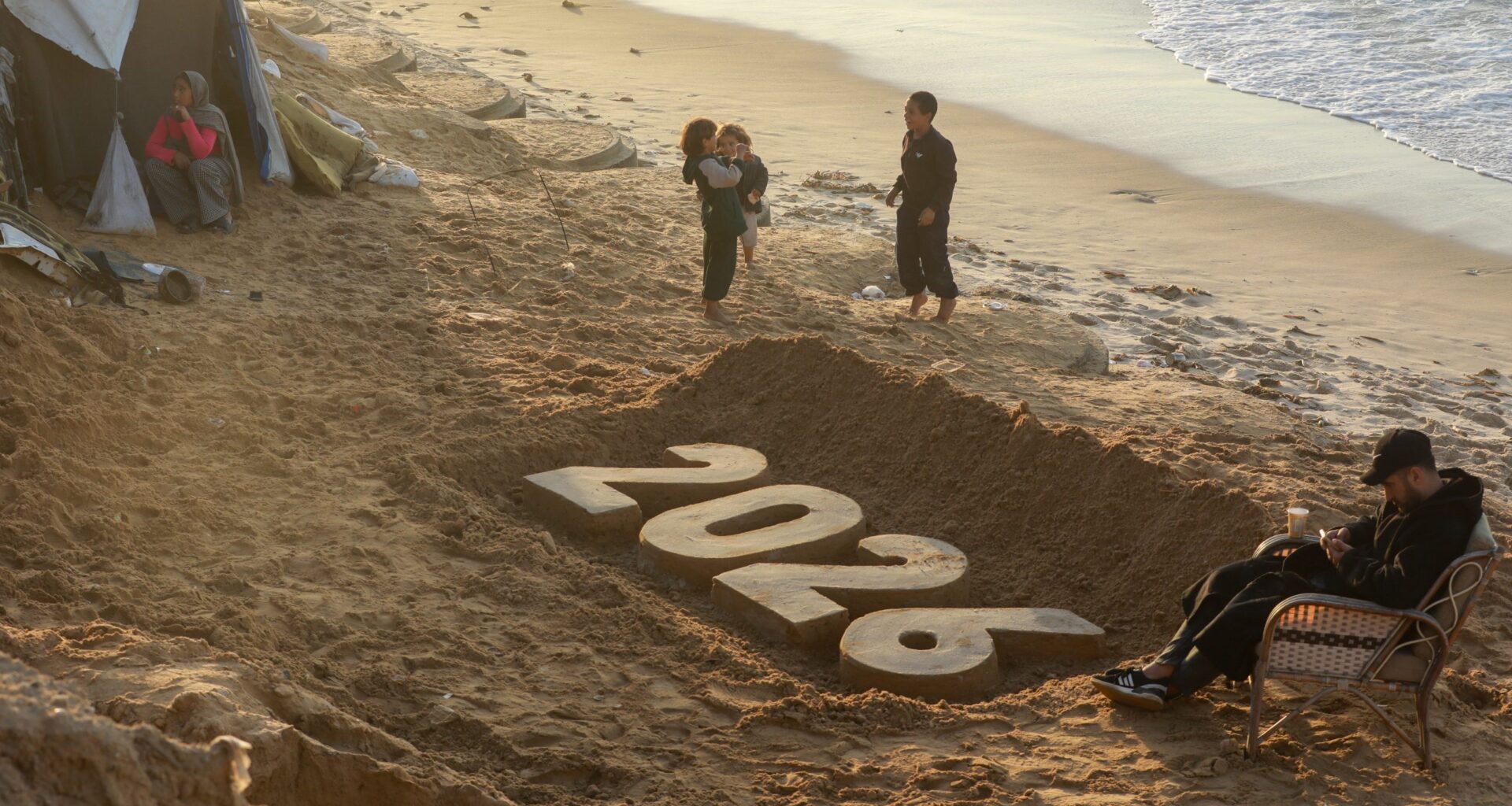
Just before midnight on Dec. 31, much of the world counts down in unison. Fireworks burst across city skies, and social media fills with familiar posts of people exchanging greetings and wishes for a new year that they hope will bring better days and brighter moments.
For Palestinians, welcoming a new year has become deeply complicated. Over the past two years, New Year’s Eve has been marked not by celebration but by skies crowded with rockets and warplanes, a harsh reminder that another year of suffering has passed without any meaningful progress in life.
Most people in Gaza receive the new year under crushing conditions: in tents inside Gaza or scattered in exile, alone, without celebration or the ability to plan with friends for the year ahead.
Nowadays in Gaza, there are no public New Year’s celebrations. I used to gather every year with my friends, Ahmad and Yasser, at the start of January. We would record a video talking about our goals for the coming year, then watch it again at the end. In the past two years, we did not have that chance. We did not dream of anything beyond survival—or of having a quiet lunch without fear.
This year, we were able to record the video together, but our dreams were fragmented. The three of us hope to continue our studies abroad, though none of us knows where. Most of our plans depend on securing a scholarship for the coming academic year. We cannot even say that one of our goals is to record another video next year, because we know reality may force us to part for a long time before we meet again.
Across Gaza, in tents, in hollowed-out houses with no walls, or in partially damaged homes, suffering is reflected in the nature of people’s aspirations, and the coming year feels more full of tasks than of dreams.
“I truly don’t have the time to sit and write goals or dreams,” Khitam Fahjan, a 29-year-old displaced teacher from Rafah now living in a tent in the al-Mawasi area of Khan Younis, told Prism. “I don’t feel like we are entering a new year at all. It feels like the same day repeating itself. I genuinely don’t care about these things anymore. My biggest concern is that water doesn’t enter my tent or pool on top of it.”
Fahjan said she missed the days of wearing heavy, warm clothes, drinking a cup of Nescafé, and sitting down to plan her goals for the year ahead.
“I used to love winter and the atmosphere of the new year,” she said. “This winter, I don’t have that luxury.”
She spends most of her time teaching children and trying to dig channels in the soil to divert rainwater away from her tent.
This year, Fahjan dreams of being able to sleep at night instead of staying awake from the catastrophic rains. She dreams that mobile homes will be allowed in “because living in a tent is unbearable.” She dreams of finishing her master’s degree, left incomplete due to poor internet access and because she has had to work to support herself. She also dreams of the Israeli occupation forces leaving Rafah so she can return home, even though her home is gone.
“Despite everything, it’s still my city, and it might give me a sense of stability,” Fahjan said.
When goals become modest
Young people are often the most enthusiastic about celebrating the new year and planning for milestones ahead.
Hanan Mosalam, 19, a content creator who returned from southern Gaza to the north and now lives in a house stripped of its walls, told Prism that her goal for the new year is to enroll as a university student in Gaza. Her studies were halted for a semester because she was constantly being displaced.
Now, her family is settled in what remains of her grandmother’s house, without electricity, internet, or other basic necessities to attend online classes.
“I know the situation is difficult and that things are not better than they were a year ago,” Mosalam said. “But last year, I only wanted to stay alive. This year, I can dream of something beyond that. It may not be a huge achievement, but for me, it’s more than enough.”
Speaking about her work as a content creator, Mosalam said, “I want my photos to reach more places around the world and for more people to see them, not because I’m from Gaza, but because I’m a girl working hard, like any other girl in life.”
She laughed as she added, “I don’t have a specific number of followers in mind, but I’d love to have more and more.”
A new year in exile
The Palestinians in exile, who were evacuated as students or medical patients, may have escaped physical suffering, but psychologically they often find themselves isolated in societies that enjoy a level of safety and stability entirely disconnected from what they left behind. Many are haunted by what is known as “survivor’s guilt”: a heavy feeling that they don’t deserve to survive while their friends and families remain trapped under a genocide or the so-called ceasefire.
“We can’t celebrate while Gaza is suffering. It feels wrong. Even saying ‘Happy New Year’ feels wrong,” said Yahya NaserAllah, 21, a student from Gaza who was evacuated to Italy. “I look at all these celebrations and feel conflicted: I want to be happy, to celebrate, but I feel like I don’t deserve it. I don’t deserve to survive while my family is still living in a tent.”
Watching his friends who are also international students travel home to visit their families is painful.
“I feel both envy and helplessness, especially when some of them ask whether I’ll visit my family during the holidays. I can’t. The crossings are closed. They can’t leave, and I can’t enter to see them,” NaserAllah said. “If I have one dream for the coming year, it’s to be reunited with them under better circumstances, and to somehow make up for the suffering they endured while I was gone.”
Time moves on—whether we’re ready or not
The new year does not ask permission to arrive. It does not wait for a genuine ceasefire, for justice, or for reconstruction plans. It comes anyway.
For Palestinians, this form of cruelty is familiar. History has moved forward before, leaving them suspended between what was taken from them and what has yet to be restored. Their goals may not align with conventional New Year’s resolutions, but they carry something heavier and harder to extinguish: tasks that cannot be postponed, that do not wait for midnight to strike or for Jan. 1 to begin.
These are tasks of survival, not wishes, in a time when living itself has become an act of resistance. Even the question, “What are your goals for the new year?” and the language of hope can sound naive in Palestine. Nothing here unfolds according to plan or desire. Everything can vanish in the instant of a missile strike, or be abruptly overturned by a single phone call from a donor agency, a foreign embassy, or the World Health Organization, informing you that within a week, you will be leaving for a life entirely unlike the one you knew before.
This is how Palestinians enter 2026: suspended between fear of what lies ahead and a stubborn optimism rooted deep within them. We do not welcome the new year because we trust it, but because we refuse to relinquish our capacity for hope, however fragile it may be.
Editorial Team:
Sahar Fatima, Lead Editor
Carolyn Copeland, Top Editor
Rashmee Kumar, Copy Editor
Related