
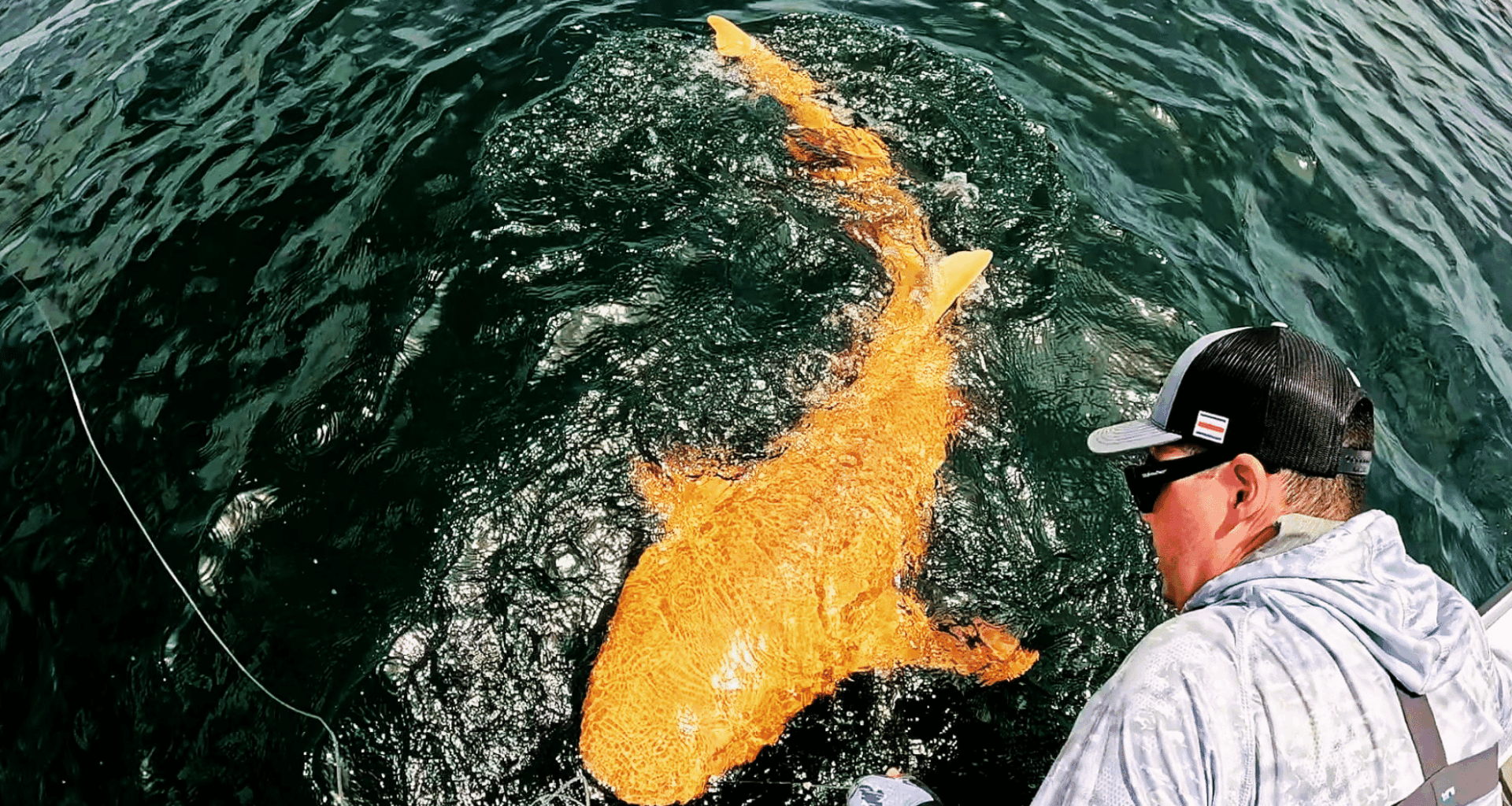
In a rare encounter off the coast of Costa Rica, a vividly orange nurse shark (Ginglymostoma cirratum) displaying a highly unusual pigmentation was caught and released by sport fishers. This rare specimen, whose appearance stunned both the fishers and scientists alike, has now been officially diagnosed with an extraordinary genetic condition known as albino-xanthochromism. The case, recently documented in a study published in Marine Biodiversity (August 2025), raises new questions about the hidden diversity and adaptability of marine life in the Caribbean Sea.
A Golden Predator In The Caribbean Waters
On August 10, 2024, a routine fishing expedition near Tortuguero National Park turned into an astonishing event when a local fisherman named Juan Pablo hauled up what appeared to be a “mango-colored shark” from 37 meters below the surface. The shark’s intensely vivid orange body and white, iris-less eyes immediately stood out. Photos taken during the brief encounter went viral after being posted by Parismina Domus Day, a Costa Rican eco-tourism company. Marine biologists quickly took interest, including a team led by Marioxis Macías‑Cuyare from the Federal University of Rio Grande in Brazil.
Their diagnosis: albino-xanthochromism, a condition rarely seen in marine life and never before documented in this species.
“The shark exhibited an intense, uniform yellow to orange coloration and white eyes, with no visible iris,” the scientists wrote in their study, published in Marine Biodiversity. “The presence of white eyes, particularly the lack of the typically black iris (Fig. 1d), suggests that the specimen was most likely displaying an abnormal condition known as albino-xanthochromism, rather than xanthism alone.”
The phenomenon results from the combination of albinism (the absence of dark pigmentation) and xanthism (an overproduction of yellow pigments). While each condition alone has been occasionally observed in aquatic and avian species, their simultaneous occurrence is exceptionally rare, and almost unheard of in sharks. The fish, measuring 200 cm (6.56 feet), was fully grown and appeared healthy, suggesting that its bright coloration has not compromised its survival in the wild.
The Rarity Of Albino-Xanthochromism In Marine Species
Albino-xanthochromism is an extremely rare genetic anomaly and, until now, was mostly limited to isolated cases among birds or certain fish species. A few notable marine examples exist, such as a spotted ray (Raja montagui) from the Irish Sea (2018) and a speckled hind (Epinephelus drummondhayi) caught off North Carolina in 1978. The documentation of this rare condition in a nurse shark pushes the boundaries of current biological understanding and may represent an evolutionary adaptation or a random genetic drift.
Published in Marine Biodiversity, the study raises essential questions about the biological, environmental, and genetic factors at play in the Caribbean ecosystem. Researchers asked:
“Is this an isolated case? Could it represent an emerging genetic trend within the regional population? Is it related to specific environmental factors in the northern Caribbean of Costa Rica, or does it reflect the natural genetic variability of the species and its capacity to adapt to changing environments?”
Their work invites marine scientists to reexamine how genetic mutations like this could be linked to local conditions, possibly including water temperature, nutrient availability, or pollution levels. The unusually bright pigmentation, while it might seem like a liability in a predator, hasn’t hindered this shark’s maturity, indicating some biological resilience or adaptation at work.
More Than A Curiosity: An Open Door To Genetic Research
While mutations like piebaldism, hypomelanosis, and albinism have been observed in other nurse sharks, this marks the first confirmed case of albino-xanthochromism in the species. That distinction has launched new scientific conversations about the frequency of such traits in underexplored ocean habitats. As the ocean remains a challenging frontier for exploration, many researchers suspect that these pigmentation mutations might be underreported, rather than truly rare.
“Addressing these questions highlights the need for further investigation into how local environmental conditions influence the expression of such genetic traits,” the researchers emphasized. This case also highlights how citizen science, in this case, a fisherman’s photos and social media, can contribute to important discoveries in marine biodiversity.
The visual anomaly of this golden shark is more than just a viral curiosity. It could serve as a key case study in understanding genetic adaptation under climate stress, pollution, or other environmental variables. The intersection of mutation and survival opens new avenues for long-term ecological monitoring of species once considered genetically stable.
How Many More Golden Ghosts Are Out There?
As researchers dig deeper into the factors behind this rare pigmentation, it becomes increasingly clear that we’ve barely scratched the surface of marine biodiversity. The bright hues of this shark, far from being a hindrance, signal a thriving, fully matured individual, a reminder that evolution may be operating in subtle and surprising ways beneath the waves.
With modern tools and growing public involvement, more such anomalies may come to light. Whether this shark was a singular fluke or the first documented member of a hidden genetic trend remains to be seen, but one thing is certain: the oceans still hold unanswered mysteries waiting just beneath the surface.