
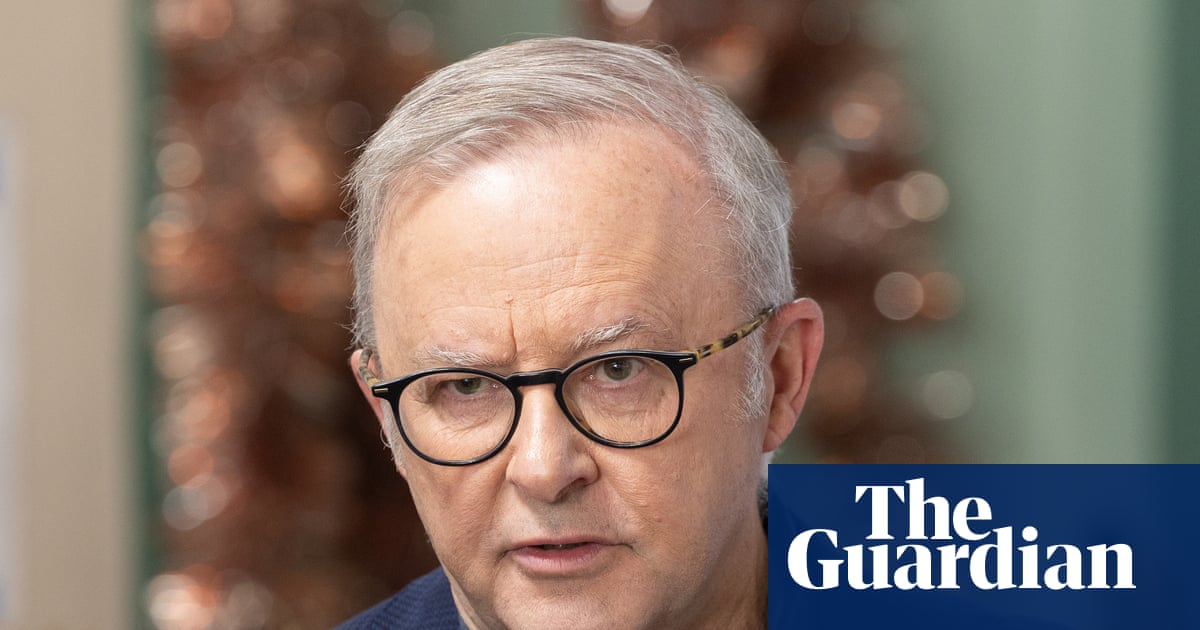
Anthony Albanese has softened his resistance to a royal commission into the alleged Bondi terror shooting, opening the door to a national inquiry amid growing pressure, including from victims’ families and some former Labor MPs.
While the prime minister insisted his priority was still on immediate steps, including a review of Australia’s intelligence and law enforcement agencies, he said he was speaking with Jewish community leaders to “examine everything else required” to respond to the 14 December attack, which left 15 people dead.
“I’m talking and meeting on a daily basis with people to make sure that we do everything that is possible to … promote unity at this time, and that is my focus,” Albanese said in a press conference on Tuesday.
Sign up: AU Breaking News email
When asked directly to clarify whether he was changing his mind on his decision to hold a royal commission, Albanese did not rule it out.
The comments mark a shift in language and tone from Albanese, who has previously warned a royal commission would be divisive and potentially delay urgent changes to prevent a repeat of Australia’s worst-ever terrorist attack.
The federal government has faced mounting pressure from across the parliament, the media and wider society to call a royal commission into antisemitism and the Bondi attack.
Open letters from victims’ families, the business community, sporting identities and some former Labor MPs have urged Albanese to convene such an inquiry, in addition to the more narrowly focused review from former Asio’s boss, Dennis Richardson.
The Law Council of Australia on Tuesday added its weight to those calls, but warned: “The timing, conduct and terms of reference of any Royal Commission should be structured so as not to interfere with ongoing criminal proceedings” into the Bondi attack.
Albanese and Labor ministers have repeatedly dismissed the need for a national inquiry, instead favouring a four-part response that includes the Richardson review; still-to-be-finalised reforms to hate speech, immigration and extremist groups; assisting a New South Wales-based royal commission; and implementing Jillian Segal’s antisemitism review.
But senior government ministers have softened their hostility to a royal commission – and those advocating for one – in the past 24 hours.
On Tuesday, senior minister and Albanese ally Mark Butler said the government respected the “sincere and heartfelt” calls for a royal commission, while the treasurer, Jim Chalmers, said: “We understand that those calls are coming from a good place.”
While backbenchers Mike Freelander and Ed Husic are the only federal Labor MPs to have publicly backed a royal commission, Guardian Australia has spoken with several others who privately support a national inquiry that also examines the broader issue of antisemitism.
The internal pressure has been building over the past week, one Labor source said, heightening expectation that Albanese would “do something to save face”.
“He has backed himself into a corner – there needs to be a way out for him,” one Labor source said.
The opposition leader, Sussan Ley, who has been demanding a commonwealth royal commission into antisemitism, said the prospect of a backflip was welcome.
Ley said the victims’ families must agree to the terms of reference.
“The prime minister has delayed, deflected and talked past those most affected for too long,” she said.
Albanese said the his government was discussing with its NSW counterparts how that state’s royal commission would work, but did not rule out a federal inquiry.
“We are engaged with the community, as well as with the NSW government, to make sure that we get done everything that is required to make sure we build social cohesion back in this country. That is what people want to see,” he said.
“I want to see an Australia that’s united. I want to see an Australia where someone, because of their faith, is not targeted. That they’re able to practise their faith, and with pride.”
Parliament is scheduled to resume in early February, but is expected to be recalled before then – potentially as soon as next week – to debate the hate speech changes.
On Monday, Ley demanded the government call a royal commission and urged Albanese to recall parliament as soon as possible. Ley claimed it should have been brought back “before Christmas” to respond to the antisemitic shooting, and that the opposition “should already be looking at them [the new laws] and studying them in the parliament right now”.
It is unclear how those laws could have been developed, drafted, finalised and shared with the Coalition for consultation before Christmas. Albanese rejected claims that parliament could have been recalled before the holiday period, saying consultation would begin in the coming days, but did not confirm when parliament would be recalled.
“I’ve seen some comments which suggest that we could have recalled parliament and done this legislation, which is complex, which has constitutional issues, which needs to be got right, in a matter of days. That’s not right,” the prime minister said.
“We are making sure that we get this legislation right.”