
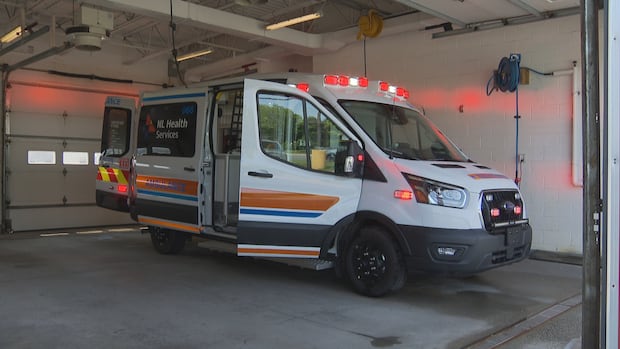
Paramedics are being forced to wait in the hallways of Newfoundland and Labrador hospitals, and the province’s paramedic association and health authority both say it’s a domino effect that’s plaguing the health-care system.
According to an access to information request shared by activist Matt Barter, there were 2,016.5 hours of delays in ambulance offload times at three St. John’s emergency rooms in October.
“Typically the reason why there is an offload delay is just the overall system has issues right across the board,” said Rodney Gaudet, president of the Paramedic Association of Newfoundland and Labrador. “And it all just kind of tumbles down to the paramedics as the end result.”
Gaudet said if there’s not enough nursing home beds, patients can end up waiting in hospital beds, which in turn decreases the number of new patients from the emergency department who can go to other places in the hospital.
As a result, paramedics stay with the patient in the hallways until there is a bed available.
“It’s not just an issue with the paramedicine system. It’s an issue right across the health-care system,” Gaudet said.
 Rodney Gaudet, president of the Paramedic Association of Newfoundland and Labrador, says offload delays can be demoralizing for paramedics. (Mark Quinn/CBC)
More than 2,000 hours of delays for October was definitely a lot for paramedics to handle, Gaudet said, but he couldn’t say whether or not the amount was unusual because the data isn’t readily available.
To put the number into context, CBC News asked the health authority on Dec. 12 for ambulance offload times on a monthly basis for St. John’s emergency rooms going back a year.
The health authority did not respond by publishing time.
Gaudet said it’s hard to get data about offload delays. He believes it’s a problem around transparency.
“Unless [access to information requests] are being done to see what each month those numbers look like, then unfortunately the transparency is just not there at the moment.”
‘It’s a capacity problem’
Cassie Chisholm, vice-president of provincial hospital systems with Newfoundland and Labrador Health Services, said the health authority sees offload delays as a serious problem.
“The way we look at offload delays is, any offload delay is too much offload delay, right?” Chisholm said. “Doesn’t matter where you are, when you show up and you need the care. We don’t want there to be any delay.”
The health authority is working to address the problem, she said, adding positive progress has been made in the last year in cutting down on delays.
“The way we staff our ambulances and the way we set up our emergency departments, the expectation is there that the cycle can keep moving and that the paramedics that are on shift that day can return to the community and be ready to respond to the next 911 call,” she said.
 Cassie Chisholm, NLHS vice-president of provincial hospital systems, says offload delays are a symptom of a capacity problem. (Mike Simms/CBC)
She said the offload delay clock starts 30 minutes after the ambulance arrives with a patient at the hospital.
Delays reflect staffing challenges and a shortage of accute care beds in facilities, said Chisholm.
“At its heart, it’s a capacity problem,” Chisholm said.
The most obvious issue is the clogging of emergency rooms and the inability to accept new patients, which in turn is affected by a lack of available beds or staffing for those beds.
No simple solutions
Paramedics are trained to help people in dire situations, so Gaudet said it can be demoralizing to be stuck in hospital hallways because of a lack of bed space.
“You don’t feel like you’re doing justice to the profession that you were trained to do,” he said.
“When you hear the radio constantly going off for other calls and calls pending, it can be really difficult for paramedics to know that their assistance is needed elsewhere.”
The inability to go to those calls is “definitely” putting lives at risk, Gaudet said.
Chisholm said work is well-underway to address the problem, including through creating a capacity plan identifying where the demand for beds and emergency spaces are.
In general, she said hospitals want to be around 85 per cent occupied but the Health Sciences and St. Clare’s are consistently at more than 100 per cent capacity.
“You can see that from a physical bed standpoint alone, we’re not positioned well to avoid offload delay. So we’re doing what we can to create new beds,” Chisholm said.
She said an additional challenge is also to ensure beds are appropriately staffed so patients get the care required.
While October’s 2,000 hours in offload delays can seem like a big number, she said the overall trend is well under 2,000 hours per month. Exact figures were not provided.
Chisholm said the number for 2025 is lower than the previous year, a sign of improvement in lowering offload delays.
She said Medavie Health N.L., a company recently contracted to integrate and manage the province’s road and air ambulance services, and the dispatch are also helping cut down offload delays, which provides a “bird’s eye view” of where resources are so patients can be allocated.
Download our free CBC News app to sign up for push alerts for CBC Newfoundland and Labrador. Sign up for our daily headlines newsletter here. Click here to visit our landing page.