
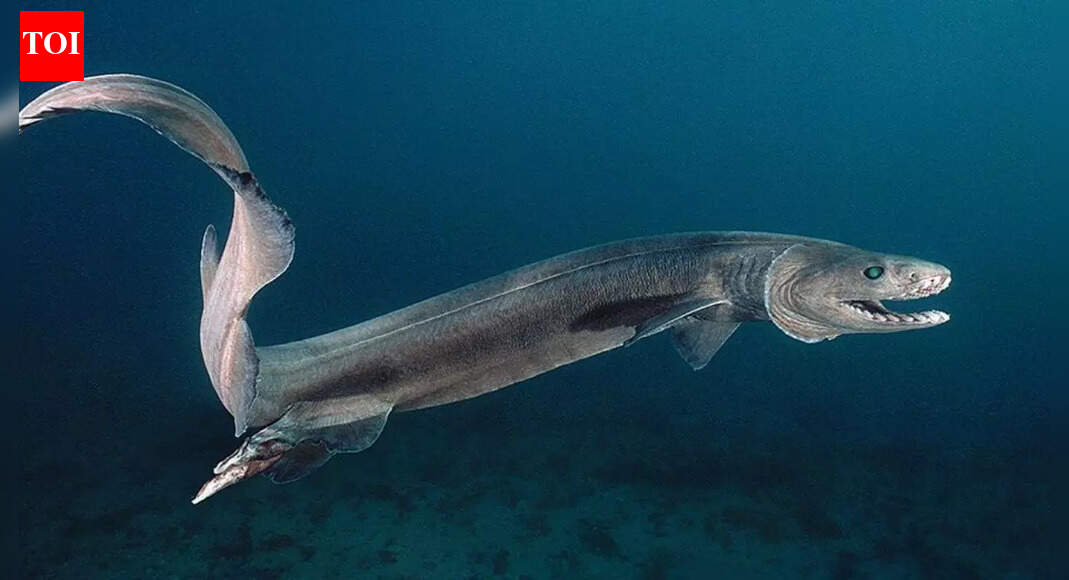
 Source: Australian Geographic The deep sea also harbours some of the most intriguing and alien-like species in existence, yet for several centuries, these creatures have continued to evade discovery by humans. One such intriguing species in the deep sea would be Chlamydoselachus anguineus, also known simply as the frilled shark, yet ironically nicknamed a ‘living fossil.’ This species, known to scientists for over a hundred years, remains a mystery regarding its life cycles, feeding patterns, and breeding habits. Frilled sharks rarely get caught in deep-sea fishing nets, and it’s due to this peculiar species that scientists today are granted a glimpse into evolution itself, believing that life itself can exist in an unaltered state for tens of millions of years in environments that are extremely hostile and light-starved.
Physical features and unique anatomy of frilled sharks
The frilled sharks have an average length of two metres (6.5 feet), with an elongated cylindrical body that looks like an eel rather than a shark. The frilled sharks also have an easy-to-maintain skin texture with little fins, with the dorsal fin being situated closer to the end of the tail rather than the centre of the body.The most characteristic trait of this species is the head and gills. The frilled sharks have six gill slits, a characteristic unmatched among most sharks. The gills of the frilled shark have distinctive frills, and this is the most distinctive feature of this species of sharks. The gills of the frilled shark are connected in a way that makes a collar-like ruffle under the throat. The gills of the frilled sharks are not only distinctive but very efficient, considering their surroundings.The shark has a wide mouth filled with rows of sharp teeth arranged like a trident. The shark utilises this mouth to catch soft-bodied organisms. Its jaw can bend to enable it to consume large squids as well as small fish whole. Such is uncommon among sharks.
Feeding habits and hunting adaptations of frilled sharks
Frilled sharks are top predators of the deep ocean. When examined, it was seen that their diet comprises mainly of squid, but they devour smaller fish and even other sharks. Their teeth are perfectly crafted for holding on to slippery, soft-bodied prey, and their elongated and flexible bodies enable them to strike their prey precisely.Unlike most other surface-swimming sharks, the frilled shark prefers stealth over speed. This is because of its snake-like nature, which allows the shark to swim through very narrow areas between rocks or coral formations in its pursuit of prey. This is yet another example of an evolutionary adaptation in the frilled shark.
Reproductive strategy and evolutionary legacy of frilled sharks
One of the most intriguing aspects of frilled shark biology is its reproductive strategy. These sharks are ovoviviparous, meaning that embryos develop inside the mother’s body and hatch internally before birth. Each pup is nourished initially by a yolk sac, which sustains it during early development.Scientists remain uncertain about the full gestation period, but studies of similar deep-sea sharks suggest it could last several years. This extremely slow reproductive cycle contributes to the species’ vulnerability and underscores why sightings are so rare.The frilled shark is sometimes referred to as a “living fossil,” which is actually a misnomer. Though its body resembles those of fossil specimens from the Late Cretaceous period, around 80 million years ago, the living frilled sharks are far from the exact identity of their ancestors. Fossil records indicate that the frilled sharks of old had similar body morphology, feeding behaviour, and deep-sea environments, which is indicative of evolutionary stability.The ancestry that is represented here shows how some species evolve quickly, while others, like frilled sharks, retain morphology over millions of years, continuing to exist in ecological niches that are stable and remote from human interference.
Rarity, threats, and conservation importance of frilled sharks
Frilled sharks are hardly ever seen in the wild, partly because of their deep-sea home. However, most information has been acquired from accidental catches of this species in deep-sea trawls. As a result of their slow reproduction rate, alongside accelerated deep-sea fishing and oceanic perturbations, their population is presumably threatened.Ecologists emphasise that while frilled sharks are not in the mainstream, as predators at deeper levels, they play a very important role in ecological balances within the ecosystem. Protection of these ancient animals means health for usually unexplored ocean ecosystems.