
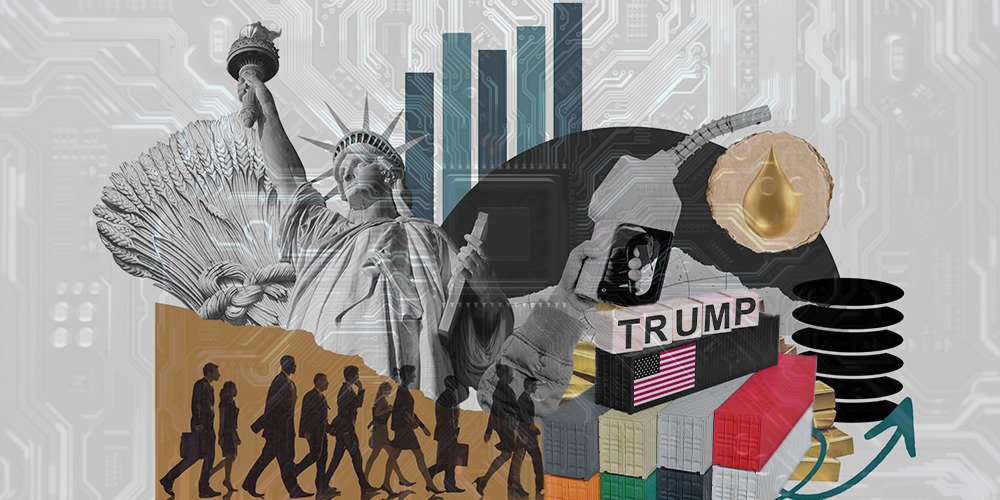
For the US, the road ahead is one of continued moderate growth. But with unusually wide tails, the US expansion will remain distinctly K-shaped as policy choices on tariffs, immigration and artificial intelligence investment amplify divergences across households, sectors and asset classes.
K-shaped economy
In the US, President Donald Trump’s policy mix has reshaped the present macro backdrop. Aggressive tariff hikes are generating sizeable revenue and, until recently, have been largely absorbed by retailers. As 2026 begins, an increasing share of these costs should shift to consumers, nudging inflation higher and eroding real spending power through mid-year before fading as a macro driver.
At the same time, a sharp slowdown in net immigration is constraining labour supply and likely shrinking the working-age population. The combination implies that even very modest job creation can keep the unemployment rate roughly stable around the mid-4s, but at the cost of weaker potential growth in 2026 and beyond.
Offsetting these drags is a powerful mix of wealth gains and investment booms that are sustaining aggregate demand and reinforcing the K-shaped pattern of the expansion – where different parts of the economy move in opposite directions at the same time after a shock. For instance, the S&P 500’s third consecutive year of double-digit returns in 2025 lifted household wealth at the top, supporting high-end consumption even as lower-income households struggle with higher prices and limited wage gains.
AI race ramps up
Meanwhile, AI-related capital expenditure has become macro-relevant: data-centre spending is running at around 1.2-1.3% of gross domestic product and rising, as firms race to secure chips, power and infrastructure.
Business adoption of AI is broadening, with a growing share of firms integrating AI into production or paying for models and platforms, even though the productivity payoff is only beginning to show up in the data. On top of this, the One Big Beautiful Bill Act’s full expensing of equipment, research and development is front-loading investment, while unadjusted withholding schedules mean that new household tax breaks are likely to show up as an unusually large wave of tax refunds in early 2026.
Putting these forces together, the baseline growth profile for the US is choppy. After a weak end to 2025, growth should reaccelerate, perhaps to above 3% in the first half of 2026, as tax refunds and AI capex kick in, then downshift again to a 1%-2% range in the second half as the refund impulse fades and tariffs continue to bite. Job gains average only about 50,000 per month, reflecting labour-supply constraints more than cyclical weakness, and the unemployment rate peaks near 4.5% before edging lower. Inflation re-accelerates modestly into mid-2026 as tariffs feed through, but softer energy prices and decelerating shelter costs will help inflation drifting back towards 2.5% by year-end.
‘Emergency tariff powers’
Around this baseline sit several material US risk scenarios. A Supreme Court ruling that curtails the president’s use of emergency tariff powers could force a partial rollback or restructuring of levies, potentially requiring refunds to firms and reducing future tariff revenue. Such an outcome would likely mean somewhat stronger real growth and lower inflation in 2026.
Conversely, if growth disappoints into mid-year, a politically motivated fiscal package, potentially in the form of ‘tariff rebate checks’ hinted by the US administration, could deliver a late-cycle demand boost and push both growth and inflation above baseline. The largest downside risk comes from a reversal in AI and tech enthusiasm. A shock to mega-cap earnings, power or materials bottlenecks, or an external liquidity event could puncture the AI-driven wealth and capex boom, tipping the economy into a mild recession or at least compressing the high-beta consumption that has powered the K-shaped expansion.
So far in 2026, markets have also absorbed the initial shock of Venezuelan President Nicolás Maduro’s capture with discipline: precious metals have gained on heightened uncertainty, US oil equities have rallied on long-dated optionality and crude prices have remained contained. This is consistent with the view that there is no immediate disruption to global supply and that any incremental Venezuelan output, if it materialises at all, lies far in the future.
Fixed income and the dollar market
For the Treasury market, 2026 is likely to be defined by a divided Federal Reserve System and uneven rate expectations rather than a one-way easing trend. Within the Federal Open Market Committee, hawks worry that inflation – still hovering near 3% and pressured by tariffs – remains too high to justify further cuts, while doves highlight subdued hiring and political pressure to support employment.
With policy already around estimates of ‘neutral or modestly restrictive,’ the Fed appears inclined towards a more patient path than markets initially assumed. Current pricing embeds roughly 75 basis points of cuts through 2026, but the probability of three full cuts is only around 30%. Fed Chair Jerome Powell has emphasised that further moves are not pre-committed.
In this environment, short-term Treasury yields are likely to oscillate in the 3.5%-3.75% range, with 10-year yields gravitating around 4.0%-4.5%, and the opportunity set in fixed income hinges on active duration management, selective credit exposure and hedges against an upside inflation surprise via Treasury-Inflation Protected System and real-asset allocations. Given rising US debt levels and inflation uncertainty, diversification into other developed sovereigns and higher-carry emerging-market debt also looks increasingly important.
Turning to the greenback, for 2026, the outlook remains broad dollar stability or slight depreciation, with the dollar index holding in the high-90s as markets reassess an overly aggressive Fed easing path and rate differentials move less than forwards imply. An end to the Fed’s cutting cycle alongside firmer US growth should push yields back up, discouraging dollar-funded carry trades and prompting corporates and investors to scale back hedges against depreciation. With the European Central Bank stuck in modest-growth Europe, the Bank of Japan still accommodative, and China resisting large renminbi gains, dollar support should persist despite short-term softness if Fed-independence worries briefly weigh on sentiment.
Timothy Wang is Head of Research at Markets Policy Partners.
This article was originally published on Markets Policy Partners.

Interested in this topic? Subscribe to OMFIF’s newsletter for more.