
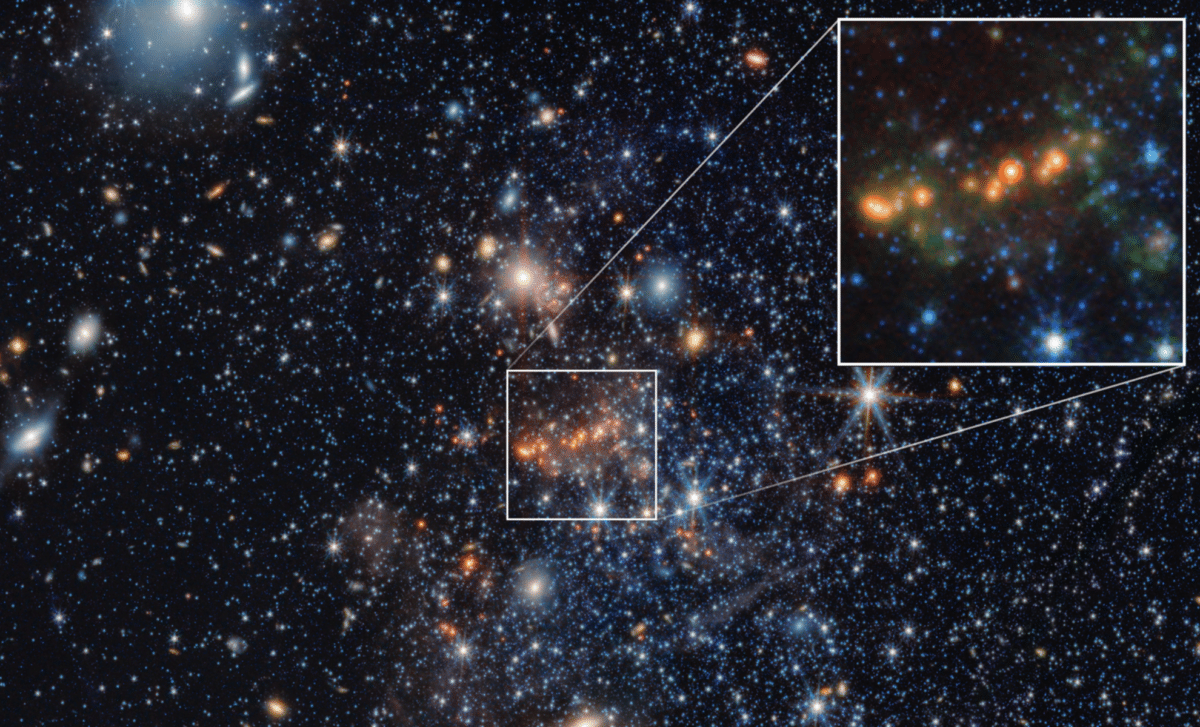
Astronomers using NASA’s James Webb Space Telescope have made a groundbreaking discovery about how dust forms in some of the earliest galaxies. The study focuses on the dwarf galaxy Sextans A, one of the most chemically primitive galaxies near the Milky Way. Despite its low metal content, Sextans A is forging complex dust, challenging previous expectations about the early universe. This discovery could reshape our understanding of how galaxies developed, offering crucial insights into the origins of planets and the building blocks of life.
New Insights into Early Universe Dust Formation
Sextans A, a small galaxy located about 4 million light-years away, holds clues to how the early universe operated long before galaxies like our own began to take shape. According to the findings, published on NASA’s official site, the galaxy’s chemical composition is relatively poor in metals, containing just 3 to 7 percent of the metal content found in our Sun. For years, scientists believed that such metal-poor environments would be unable to form significant amounts of dust. However, the James Webb Space Telescope has revealed that Sextans A is forging complex dust grains, including metallic iron and silicon carbide, despite the lack of the usual raw materials.
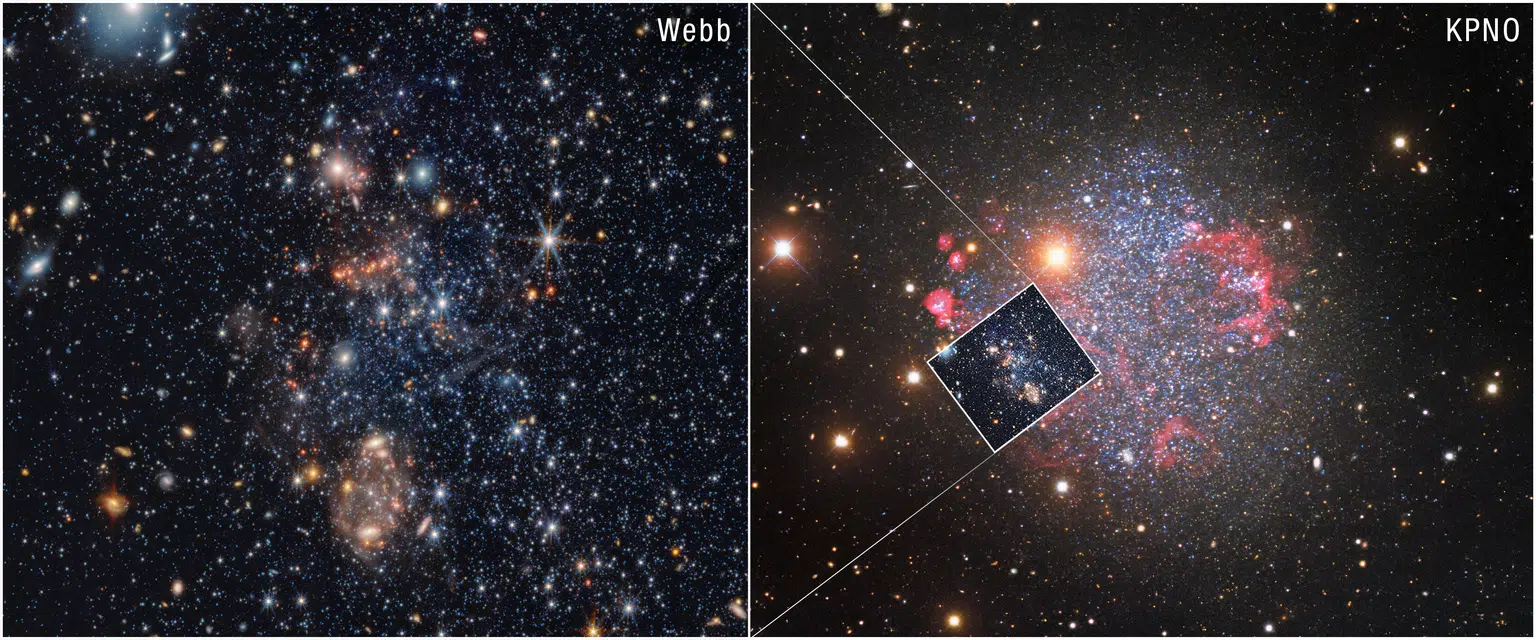 NASA’s James Webb Space Telescope’s image of a portion of the nearby Sextans A galaxy is put into context using a ground-based image from the Nicholas U. Mayall 4-meter Telescope at Kitt Peak National Observatory.
Image: STScI, NASA, ESA, CSA, KPNO, NSF’s NOIRLab, AURA, Elizabeth Tarantino (STScI), Phil Massey (Lowell Obs.), George Jacoby (NSF, AURA), Chris Smith (NSF, AURA); Image Processing: Alyssa Pagan (STScI), Travis Rector (UAA), Mahdi Zamani (NSF’s NOIRLab), Davide De Martin (NSF’s NOIRLab)
“Sextans A is giving us a blueprint for the first dusty galaxies,” said Elizabeth Tarantino, postdoctoral researcher at the Space Telescope Science Institute and lead author of one of the studies. “These results help us interpret the most distant galaxies imaged by Webb and understand what the universe was building with its earliest ingredients.”
This discovery provides an invaluable look at how the universe’s earliest galaxies might have been capable of forming dust in innovative ways, despite the absence of key ingredients like silicon and magnesium.
Uncovering Iron-Based Dust in Low-Metallicity Stars
One of the most surprising findings involves the discovery of dust made from iron, an element typically associated with higher-metallicity stars.Stars in Sextans A, which lack the chemical elements required to create typical dust, were thought to be nearly dust-free.
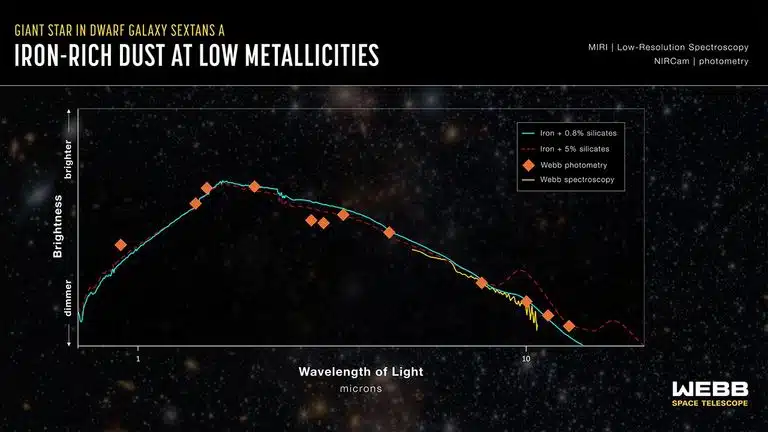 This graph shows a spectrum of an Asymptotic Giant Branch (AGB) star in the Sextans A galaxy. It compares data collected by NASA’s James Webb Space Telescope with models of mostly silicate-free dust and dust containing at least 5% silicates.
Illustration: NASA, ESA, CSA, STScI, Joseph Olmsted (STScI)
However, the Webb telescope revealed that one star, a massive asymptotic giant branch (AGB) star, was forging dust grains almost entirely out of iron. This discovery is remarkable because, under these conditions, researchers had never expected to find any dust at all.
“One of these stars is on the high-mass end of the AGB range, and stars like this usually produce silicate dust. However, at such low metallicity, we expect these stars to be nearly dust-free,” said Martha Boyer, associate astronomer at the Space Telescope Science Institute. “Instead, Webb revealed a star forging dust grains made almost entirely of iron. This is something we’ve never seen in stars that are analogs of stars in the early universe.”
This discovery suggests that even in the absence of typical dust-building elements, stars in the early universe found alternative ways to produce solid materials.
PAHs: The Building Blocks of Planets
Another key element found in Sextans A is polycyclic aromatic hydrocarbons (PAHs), which are complex carbon-based molecules. PAHs are among the smallest dust grains and can serve as indicators of star formation. The James Webb Space Telescope’s infrared images revealed that these molecules exist in small, dense clumps within the galaxy, and that they can form even in environments with extremely low metallicity.
“Webb shows that PAHs can form and survive even in the most metal-starved galaxies, but only in small, protected islands of dense gas,” said Tarantino.
These tiny islands provide the necessary conditions for PAHs to grow and survive, which were previously thought to be impossible in galaxies like Sextans A. The discovery challenges prior assumptions that PAHs couldn’t form in metal-poor galaxies and opens up new questions about the formation of carbon-based life’s building blocks in the early universe.
Dust in the Early Universe: More Complex Than Expected
These discoveries are forcing scientists to rethink their understanding of dust in the early universe. For years, astronomers have assumed that the early stages of galaxy evolution would follow predictable paths, particularly in terms of dust formation.
However, Webb’s findings suggest that the early universe was far more inventive than previously imagined. In particular, the discovery of iron-based dust and the formation of PAHs in dense gas pockets provide evidence that even galaxies with very low metal content could still form complex materials crucial to the development of planets and, potentially, life.
“Every discovery in Sextans A reminds us that the early universe was more inventive than we imagined,” said Boyer. “Clearly stars found a way to make the building blocks of planets long before galaxies like our own existed.”
These insights into the creation of dust in early galaxies will help astronomers better understand how the universe evolved and how stars, planets, and even life might have formed in such primitive environments.