
In a breathtaking new “postcard” from Mars, NASA’s Curiosity rover has captured the Martian landscape in two distinct lighting conditions. The stunning image was taken after a major software update in April, marking the rover’s final look at the “Marker Band Valley” before it moved on to new terrain.
The carefully crafted image combines two black-and-white panoramas, taken at different times of day, and color-enhanced to highlight the dramatic differences in the Martian lighting. Curiosity, which has been exploring the Red Planet’s Gale Crater since 2012, continues to send back valuable data about Mars’ geology and environment.
Revealing the Boxwork Formation
According to NASA, the two images, taken at 9:20 a.m. and 3:40 p.m. local Mars time, show the same area under dramatically different lighting conditions. The morning photo is enhanced with blue tones, while the afternoon image has yellow added. This visual contrast helps accentuate details that would otherwise be hard to discern, such as the shadows cast by distant hills and the rugged terrain of Gale Crater.
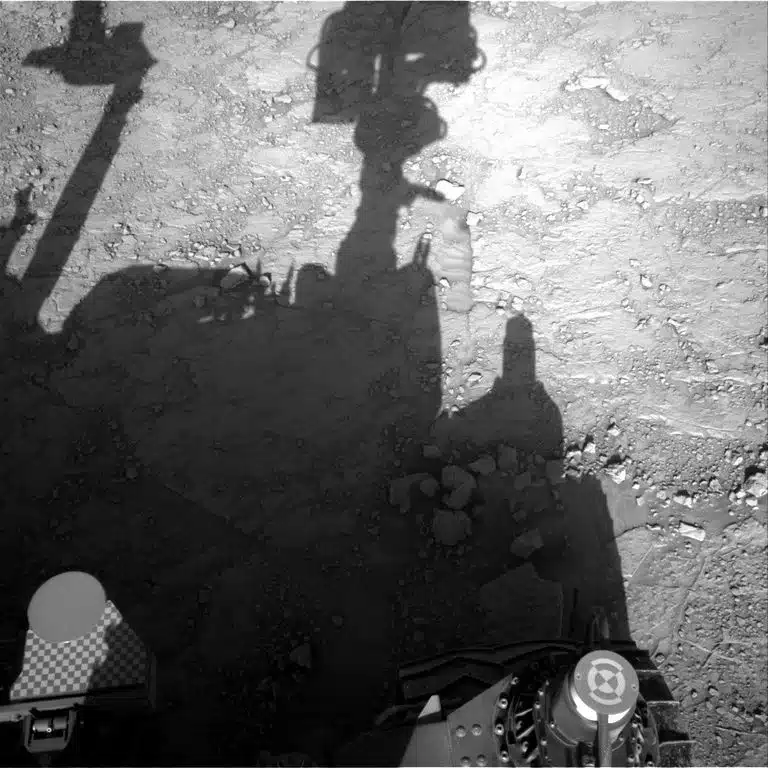 This photo shows Curiosity’s shadow looming over the unique Martian boxwork terrain. Credit: NASA/JPL-Caltech
Doug Ellison, a Curiosity engineer at NASA’s Jet Propulsion Laboratory, explained that capturing two times of day helps create sharper shadows, making the landscape appear more three-dimensional.
“Capturing two times of day provides dark shadows because the lighting is coming in from the left and the right, like you might have on a stage – but instead of stage lights, we’re relying on the Sun.” Ellison said.
Mars’ Geology Gets a Makeover
The Curiosity rover is currently near Mount Sharp, a massive mountain that rises 3 miles high within Gale Crater. As stated by the U.S. Space Agency, Curiosity’s location provides a clear view of Marker Band Valley, which is located in an area rich with sulfate minerals. These minerals are key to understanding Mars’ past, particularly the signs of an ancient lake that Curiosity has discovered in the region.
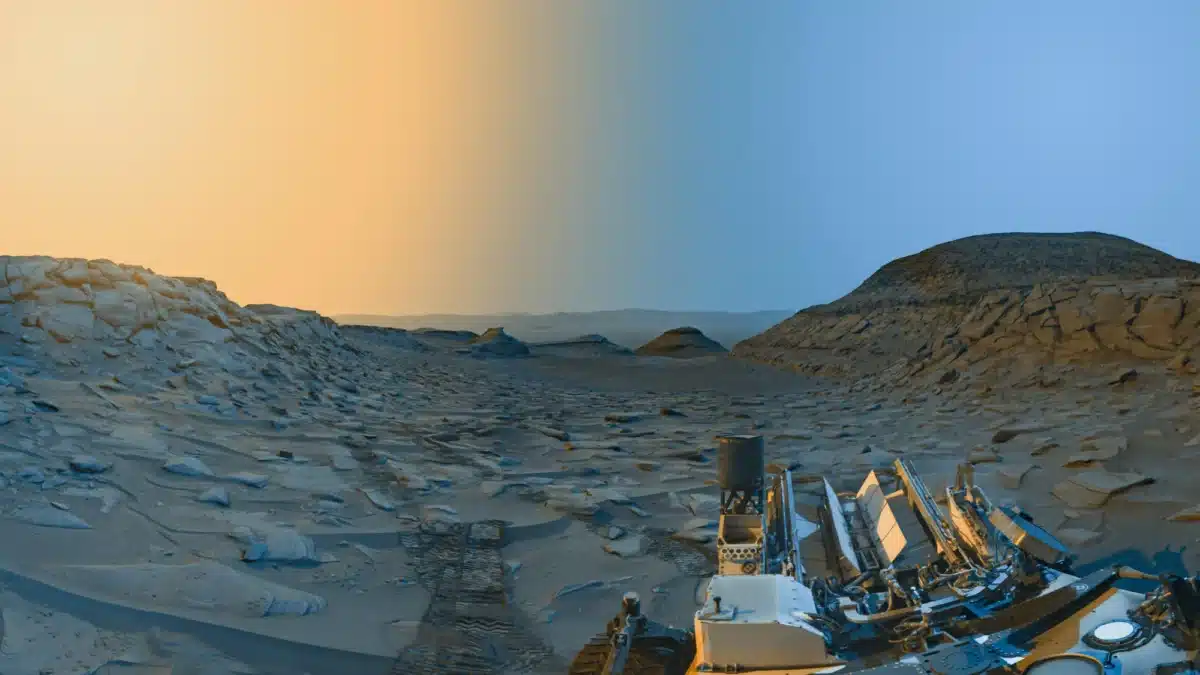 Curiosity rover captures a stunning mars ‘postcard’ showing the planet’s terrain at two different times of day. Credit: NASA/JPL-Caltech
According to Ellison, the images were taken during the winter on Mars, a period when airborne dust is at its lowest. This lack of dust makes the shadows appear sharper and more defined. He added that:
“Mars’ shadows get sharper and deeper when there’s low dust and softer when there’s lots of dust.” The crispness of these winter images provides more reliable data for ongoing studies into the planet’s environment.
The rover’s next steps will take it further into the foothills of Mount Sharp, and the data collected from these observations will help scientists prepare for the eventual human exploration of the Red Planet.