
Back to Article List
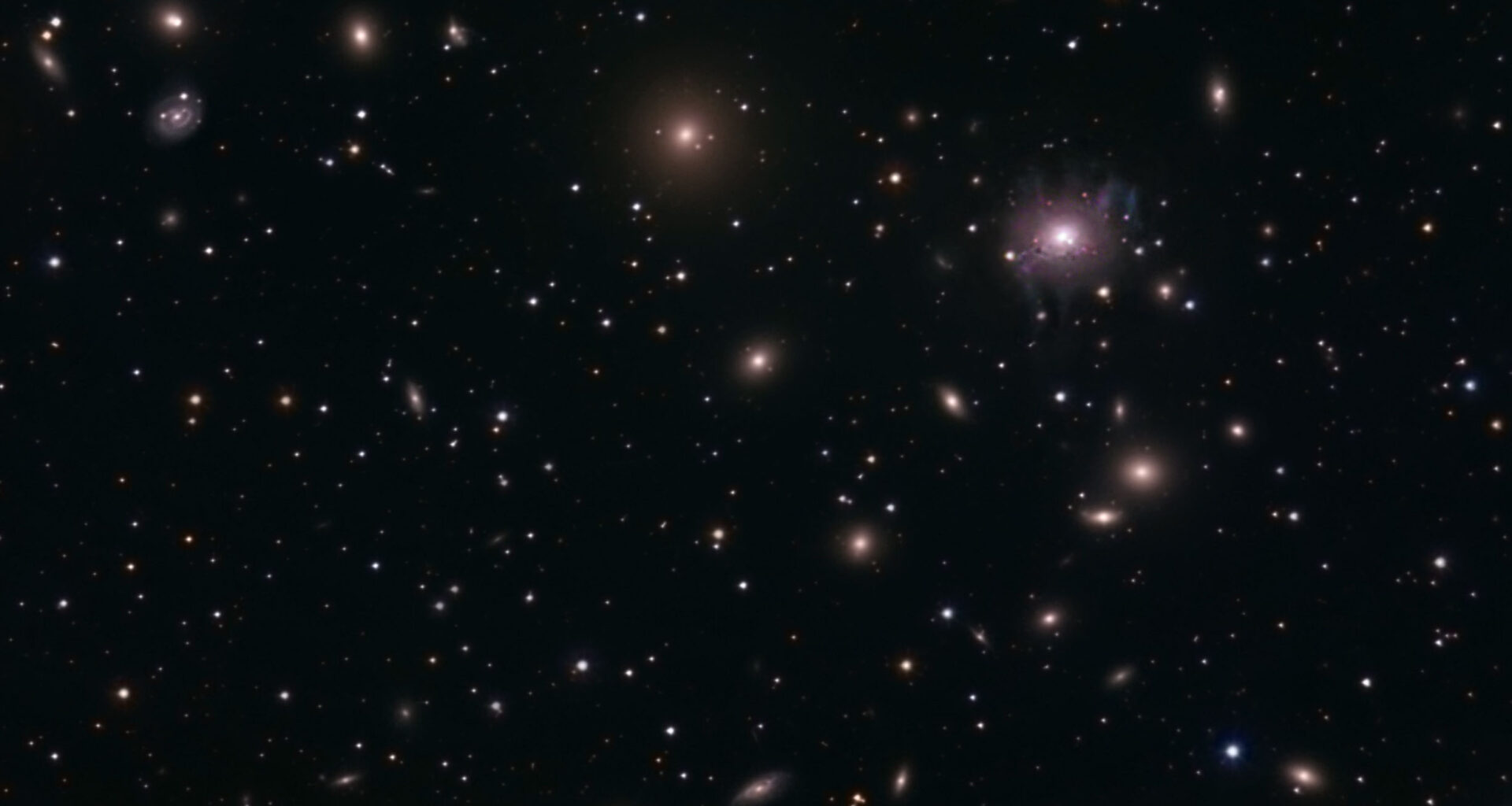
Galaxy NGC 1275 is the brightest member of the Perseus Cluster, an excellent target to try for during tonight’s dark window.

On January 8, the Jovian moon Europa and its shadow will transit Jupiter’s disk, with the event concluding by 2:37 A.M. EST.
After sunset, a favorable dark-sky window, enabled by the Moon’s absence until nearly midnight, permits observation of fainter celestial objects, particularly in the eastern constellation Perseus.
The Perseus Cluster of galaxies is a prime target, highlighted by NGC 1275 (Perseus A), an 11.7 magnitude peculiar galaxy characterized by strong radio and X-ray emissions suggesting an active supermassive black hole.
Within the Perseus Cluster, other galaxies, such as the 12th magnitude NGC 1272 located 5 arcminutes west of NGC 1275, are observable, especially with larger aperture telescopes.
Looking for a sky event this week? Check out our full Sky This Week column.
January 7: Europa transits Jupiter
January 8 opens with the icy moon Europa and its shadow transiting the disk of Jupiter. The two move across the disk from east to west until the shadow disappears from the eastern limb by 2:30 A.M. EST (early on the 8th for all but the Pacific time zone). Europa follows seven minutes later, ending its transit by 2:37 A.M. EST.
This evening, with the Moon below the horizon until nearly midnight, we can use the dark window after sunset to observe fainter objects in the evening sky.
Two hours after sunset, the constellation Perseus is high in the eastern sky. Our target tonight is a region near the star Algol (Beta [β] Persei), sometimes known as the Demon Star for its variable brightness, which swings between magnitude 2.1 and 3.4 every 2.867 days.
Center Algol in your telescope and drop some 2.2° to the lower left (east-northeast on the sky) to locate the rich Perseus Cluster of galaxies, the brightest member of which is NGC 1275. Glowing at magnitude 11.7, you’ll want as large a telescope as you can get to view this strange galaxy, also known as Perseus A. Classified as a peculiar galaxy, Perseus A is sending out strong emission that includes radio waves and X-rays — a clue to the feasting supermassive black hole in its heart. Through a telescope, this galaxy appears roughly circular, though tendrils of gas can be picked up in long-exposure astrophotos.
Many other galaxies should dot your view as well, especially in larger scopes (10 inches or more). In particular, note the slightly fainter (magnitude 12) galaxy NGC 1272, which appears just 5’ west of NGC 1275.
Sunrise: 7:22 A.M.
Sunset: 4:52 P.M.
Moonrise: 11:01 P.M.
Moonset: 10:30 A.M.
Moon Phase: Waning gibbous (65%)
*Times for sunrise, sunset, moonrise, and moonset are given in local time from 40° N 90° W. The Moon’s illumination is given at 10 P.M. local time from the same location.