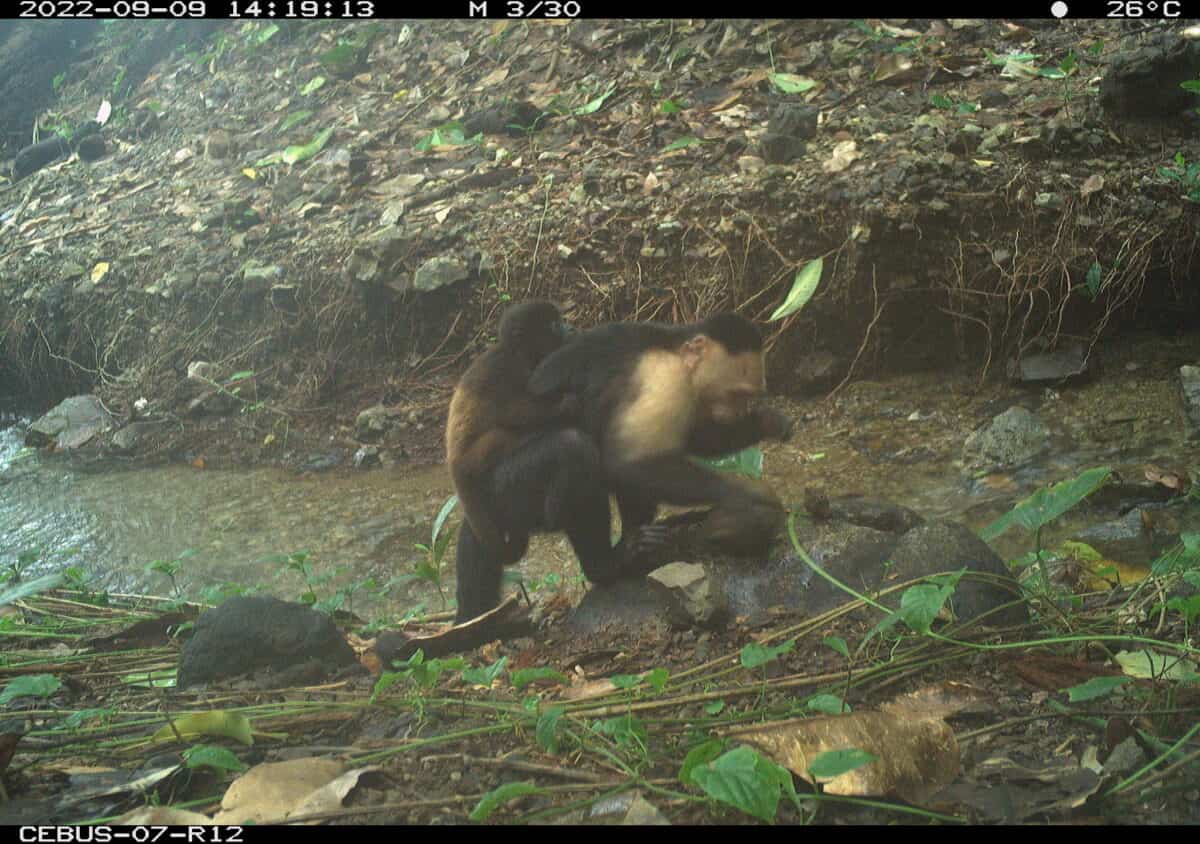
 A subadult male capuchin with a howler monkey infant. Image courtesy of Brendan Barrett/Max Planck Institute of Animal Behavior.
Every year, researchers and people out in nature capture some aspect of animal behavior that’s unusual or unexpected in some way, changing how we understand the natural world.
Here are five such examples that Mongabay reported on in 2025:
For the first time, scientists observed a “massive aggregation” of small bumblebee catfish (Rhyacoglanis paranensis) climbing up waterfalls in Brazil in November 2024. Rhyacoglanis species are considered rare and scientists don’t know much about their biology and behavior, making these observation especially valuable. Researchers say the fish were likely heading upstream to spawn.
In Canada, Indigenous Haíɫzaqv guardians and collaborating scientists set up a camera trap to see who was damaging traps they’d submerged to capture invasive European green crabs. The video showed a female wolf (Canis lupus) swimming with a trap’s rope in her mouth, pulling it to ground once ashore, then opening the trap and eating the herring bait inside. These actions suggest the wolf understood there was food inside a hidden, submerged container, researchers say. This offers a new understanding of wolf cognition, they add.
For the first time, researchers observed queens of two ant species — L. orientalis and L. umbratus — take over other ant colonies by tricking the worker ants into killing their own queen, then accepting the intruding queen as their new leader. The parasitic queen takes advantage of how ants communicate: through odors. She covertly approaches the resident queen and sprays her with what researchers suspect is formic acid, making the worker ants attack their own mother. This study is the first to document this kind of host manipulation, the researchers write, in which offspring are induced to kill “an otherwise indispensable mother.”
Using camera traps, researchers in the Peruvian Amazon captured a predator, the solitary ocelot (Leopardus pardalis), strolling alongside its prey, the common opossum (Didelphis marsupialis), several times. The researchers say the unusual partnership could be due to two possibilities: opossums may benefit from the ocelot’s hunting prowess, while the ocelot may gain from masking its scent with the opossum’s pungency. The footage shows how little we understand about rainforest dynamics.
On a remote Panamanian island, researchers captured footage of young male capuchin monkeys (Cebus imitator) stealing howler monkey (Alouatta palliata coibensis) babies for the very first time. The researchers say the observations suggest necessity isn’t always the driver of new behaviors, “especially on islands, where both need and free time are often abundant.”
This article originally appeared on Mongabay.