
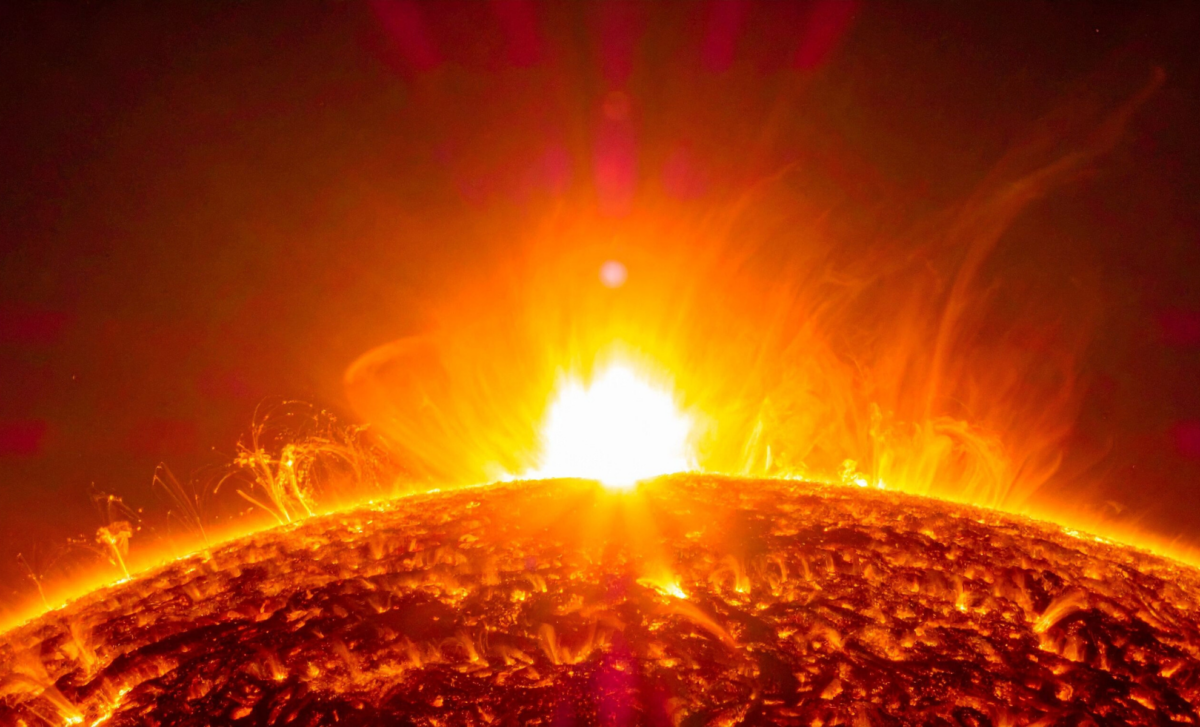
Solar physicists from NJIT’s Center for Solar-Terrestrial Research (NJIT-CSTR) have uncovered the elusive source of intense gamma rays unleashed during solar flares. These high-energy radiation signals have long puzzled scientists, but the research team has now pinpointed the source of these gamma rays to a specific population of particles in the Sun’s atmosphere. By combining gamma-ray and microwave observations from solar flare events, the team has unveiled new insights that could revolutionize our understanding of solar flare physics and improve space weather forecasting.
Unraveling the Mystery of Solar Flare Gamma Rays
For decades, scientists have been aware that solar flares generate unique gamma-ray signals, but understanding the exact source and mechanism behind these signals has been elusive. As Gregory Fleishman, the lead author of the study published in Nature Astronomy, and NJIT-CSTR research professor of physics, explains, “We knew solar flares produced a unique gamma-ray signal, but that data alone couldn’t reveal its source or how it was generated. Without that crucial information, we couldn’t fully understand the particles responsible or evaluate any potential impact on our space weather environment. By combining gamma-ray and microwave observations from a solar flare, we were finally able to solve this puzzle.”
This groundbreaking discovery was made possible by a collaboration between NASA’s Fermi Gamma-ray Space Telescope and the NJIT’s Expanded Owens Valley Solar Array (EOVSA). The team observed the solar flare event that occurred on September 10, 2017, where they identified a previously unknown class of high-energy particles, which are now recognized as the source of the gamma rays. These particles were observed to have energies in the range of several million electron volts (MeV), which is significantly higher than typical flare particles.
The Role of Bremsstrahlung in Gamma-Ray Production
A crucial component of the researchers’ findings was the identification of bremsstrahlung, a process in which high-energy electrons collide with the Sun’s plasma, emitting gamma rays. This process is responsible for the production of the intense radiation observed during solar flare events. Fleishman further elaborates on the discovery, saying,
“Unlike the typical electrons accelerated in solar flares, which usually decrease in number as their energy increases, this newly discovered population is unusual because most of these particles have very high energies, on the order of millions of electron volts, with relatively few lower-energy electrons present.”
The discovery of this high-energy particle population provides important insights into how solar flares accelerate particles to extreme energies. The process is believed to occur when magnetic energy, stored in the Sun’s corona, is released in a dramatic flare event, resulting in the rapid acceleration of charged particles. This finding could play a key role in refining solar flare models and enhancing our ability to predict space weather events that affect satellite systems and space exploration.
Analyzing Solar Flares with Advanced Observations
In their study, the NJIT team used advanced instruments to track both microwave and gamma-ray emissions from the solar flare, which allowed them to pinpoint a specific region in the Sun’s atmosphere where these high-energy particles were concentrated. This region, dubbed Region of Interest 3 (ROI 3), showed clear signs of intense particle acceleration and magnetic field decay. The combination of Fermi’s gamma-ray data and EOVSA’s microwave observations allowed the researchers to make a direct connection between the accelerated particles and the bremsstrahlung radiation that produced the gamma rays.
Fleishman also discussed how this discovery might lead to future advancements in solar physics:
“We see clear evidence that solar flares can efficiently accelerate charged particles to very high energies by releasing stored magnetic energy. These accelerated particles then evolve into the MeV-peaked population we discovered.”
Future Research and the Unanswered Questions
Although the discovery of these high-energy particles marks a major milestone in solar flare research, important questions remain. One of the biggest mysteries surrounding these particles is whether they are electrons or positrons. Fleishman notes,
“One big unknown is whether these particles are electrons or positrons. Measuring the polarization of microwave emissions from similar events could provide a definitive way to tell them apart. We expect to gain this capability soon with the EOVSA-15 upgrade.”
The EOVSA-15 project, which is currently under development, aims to enhance the solar array with 15 additional antennas and advanced ultra-wideband feeds. This upgrade will significantly improve the array’s ability to track solar flare events and provide even more precise data on the particles responsible for gamma-ray production.
The Implications of the Discovery for Space Weather Forecasting
Understanding the dynamics of solar flares and their impact on the surrounding space environment is crucial for improving space weather forecasts. The high-energy particles discovered by the NJIT team may have significant implications for satellite systems and other space-based technologies. The improved models of solar flare behavior, based on the team’s findings, could help predict space weather events with greater accuracy and reduce the risks posed by solar radiation to astronauts and spacecraft.
The study marks a turning point in solar flare research, and as Fleishman concludes, “This discovery fills critical gaps in our understanding of solar flare physics and could improve models of solar activity that ultimately enhance space weather forecasting.”