

For years, this striking arachnid remained shrouded in uncertainty. With its dramatic appearance, impressive size, and elusive habits, the Malaysian tiger tarantula has puzzled researchers and enthusiasts alike. Its story is one of scientific missteps, taxonomic confusion, and lingering mysteries.
First identified in 1891 by Swedish arachnologist Tamerlan Thorell, the species spent decades caught in a classification tangle. Two different names circulated well into modern research before scientists finally confirmed that they all referred to a single species, now officially known as Omothymus schioedtei.
A tangled scientific identity
Native to the Malay Peninsula and found across much of Southeast Asia, this tarantula has also become popular among collectors and breeders worldwide.
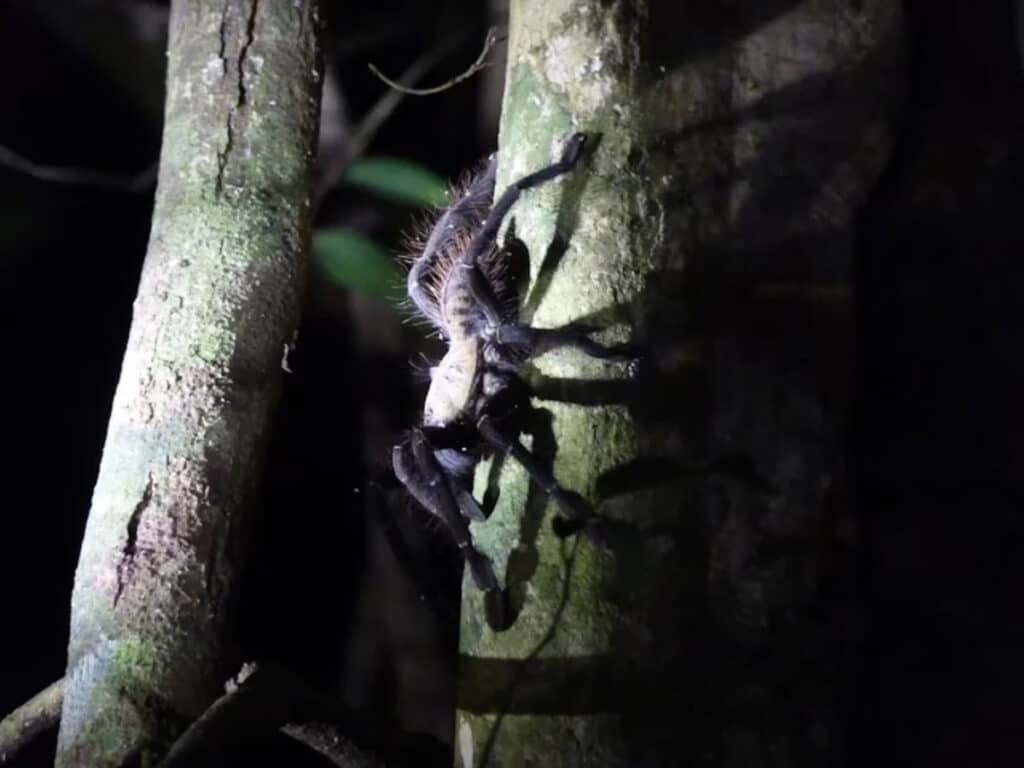
The Malayan tiger tarantula is an arboreal species from Southeast Asia with a leg span that can reach 22 centimeters. © Johannes Schuster, iNaturalist
With a leg span reaching up to 22 centimeters and a surprisingly compact body of about 4 centimeters, the Malaysian tiger tarantula ranks among the largest tarantulas on the planet. It stands alongside iconic giants like the Goliath birdeater or the massive huntsman spiders whose legs can stretch beyond 30 centimeters.
A striped giant built for the treetops
The nickname “earth tiger” comes from the dark stripes running along its body. Males and females are easy to tell apart: adult males are lighter, with beige or olive-green hues, while females remain darker and boldly striped.
Unlike many ground-dwelling spiders, Omothymus schioedtei is fully arboreal. It lives high in the trees of humid tropical forests, moving with surprising speed and showing strong defensive behavior when disturbed. Young spiders often hide beneath loose bark, while adults prefer mature trees, though some have been spotted on human-made structures like bridges.
Despite its size, much about this species remains unclear. Its discreet lifestyle and limited field observations leave gaps in our understanding of its true behavior, from hunting tactics to defense strategies.
As research continues, the Malaysian tiger tarantula reminds scientists how much there is still to learn—even about the largest creatures. Its story highlights how science evolves, correcting assumptions and revealing the hidden complexity of life in tropical forests and the broader ecosystem they support.

Cécile Breton
Journalist
Since childhood, books, photography, and travel have been part of my world. Fascinated by life, by the stars, by landscapes that tell stories without a single word, I quickly realized that I needed to express what I saw and felt.
Passionate about the world around me, I first pursued a degree in History at university, driven by my fascination with the stories of the past and the great civilizations that shaped our world. But over the years, another truth became clear: I didn’t want to spend my life in archives or research. I wanted to be out in the field, behind a camera or in front of a microphone, sharing what I learned.
So, I took a new path. I chose journalism, to learn how to tell stories differently—with rigor and clarity. I learned how to write, to interview, to edit, to capture both attention and emotion.
Giving meaning and sharing what matters
Since then, I’ve worked across different media: print, web, radio, television, and video. All of this has allowed me to bring to life topics that matter deeply to me: nature, animals, space, and the major environmental and human issues of our time.
Today, I continue my journey as a journalist at Futura. As part of the editorial team, I strive to share knowledge with curiosity, clarity, and passion. My guiding thread? To make visible what deserves to be seen, understood, and shared—and to keep my sense of wonder alive.