
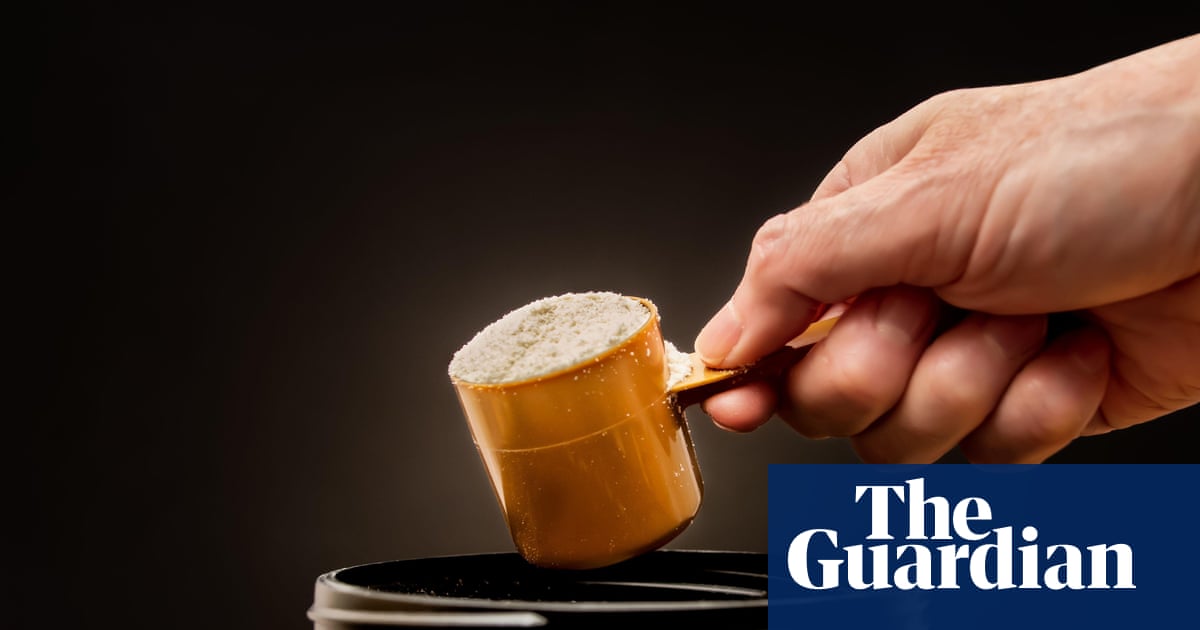
Powerlifting coach Cam Brown says more people are getting into protein supplements, even those outside the “fitness bubble”.
“Even in the shops there’s a lot more protein products there,” he said. “People have changed their viewpoints that protein powders are only for bodybuilders.”
Powerlifting coach Cam Brown says he has noticed protein supplements becoming more expensive in recent years. Photograph: Ellen Smith/The Guardian
Brown, 28, and his clients have also noticed protein supplements becoming more expensive, particularly over the last couple of years.
Supplement companies have reported a significant increase in the retail price of whey – a milk byproduct used to make protein powder – even though other dairy products have become cheaper.
Experts say the main price driver is that there is not enough whey protein being made to keep up with an increase in demand for powders and other protein-enhanced products.
Many Australian supplements companies increased the retail prices of their protein powders in the past year, and posted announcements on their websites seeking to explain why.
The local manufacturer Bulk Nutrients, regarded in the fitness industry as a more affordable brand, recently lifted its whey protein concentrate from $44 to $49 and whey protein isolate from $58 to $68.
Recent price hikes on many whey supplement products outstrip Australia’s overall inflation rate of 3.4%. Photograph: Andreas Hauslbetz/Alamy
The respective 11.36% and 17.24% price hikes far eclipse Australia’s most up-to-date overall inflation rate of 3.4%, as well as the 3.2% inflation in the price of dairy products in general recorded in the 12 months to November.
The chief executive officer of Bulk Nutrients, Jess Crowley, said the cost of whey had gone up by more than 100% in the past five years, pushing up retail prices industry-wide.
Sign up: AU Breaking News email
“There’s not enough [whey] to meet the demand for all products that want to use whey protein,” she said.
“There’s just a lot more people competing for a limited amount of stock. We’re finding these are the highest prices that we’ve ever paid.”
Crowley said the popularity of GLP-1 medications for weight loss was playing a role in the demand for protein supplements, at least anecdotally, because people wanted to take them while they were eating less.
She said because whey was a global commodity, the increasing cost of farming cattle, climate change, global economic instability and the weak Australian dollar all played a role in higher prices in addition to high demand and limited supply.
Gym culture boosts demand
Whey is one of the main proteins in milk, which is typically separated during the cheesemaking process.
The liquid byproduct can be turned into powder or used to fortify other products.
Michael Whitehead, ANZ’s executive director for agribusiness industry insights, said whey prices were more affected by the global dairy trade (GDT) than the Australian farm-gate price that dairy companies paid to access milk from local farmers.
This is because the GDT includes the international market price of cheese, which has typically been linked to the price of whey.
However, since mid-2024, whey prices have actually risen faster than cheese, according to Whitehead’s comparison of the US Department of Agriculture’s (USDA) whey 34% concentrate price index and the Oceania cheddar price.
Whitehead said the USDA whey 34% price was the closest available benchmark because it is the most widely published and consistent reference for whey, despite containing less protein than more concentrated products and in the absence of an international whey index.
From August 2024 to December 2025, the price of whey went up 52% while cheese only increased by 8%, Whitehead’s analysis found.
Pre- and post-workout protein supplements are designed to tap into the country’s booming gym culture. Photograph: Ellen Smith/The Guardian
Whitehead said the reason whey prices rose more rapidly than cheese was largely based on widespread demand for protein products.
“Consumers in Australia and so many markets, as society tries to become healthier, are thinking ‘protein, protein, protein’,” he said. “It’s just that big demand.”
In supermarkets, it’s now common to find protein-enhanced yoghurt, smoothies, muesli bars, bread, peanut butter, pancake mixes and numerous other products. There are also pre- and post-workout protein supplements, designed to tap into the country’s booming gym culture.
A global commodity
While protein powder prices are booming, the cost of other dairy products such as butter are coming down because there is more milk available on the global market, according to research by Rabobank.
Australians are consuming more protein-enhanced products even as they are drinking less milk, Rabobank found. In the last three months of 2025, drinking milk sales fell by 1.1%, while high-protein dairy continued double-digit growth.
Michael Harvey, a Rabobank senior analyst, said global commodity prices for dairy products were “coming down quite quickly” and butter had fallen by 30% since mid-2025 to its lowest level since 2023.
But he said “high-end derivatives” such as whey protein concentrate or whey protein isolate had steadily increased in price through 2025 and were now at record levels.
“Ultimately it’s just really strong demand for high protein supplements and products,” he said. “So that shorts the market.”