
The sound of bagpipes and drums could be heard early on Christmas Eve in Bethlehem this year. Scouts had gathered from all over the West Bank for the traditional Christmas parades, and their band rehearsals, which had happened multiple times a week for the past two months, were in their final stage, the rousing sounds of the pipes filtering through the air in the early morning sun. Finally, the first Scout troops started to march down the iconic Star Street, following the route of Mary and Joseph, according to the Gospel of Luke and the many nativity plays and stories told every year, down to where the Church of the Nativity now stands. The story goes that they came from Galilee to this “town of David,” Joseph walking alongside Mary, heavily pregnant, on a donkey, making their way through the streets of Bethlehem for a Roman census — and the birth of Jesus.
The streets of Bethlehem, and indeed all of Palestine, have not seen such a traditional Christmas since 2022. The air was festive, not only with the sounds of the bands, but with the excitement of the watching crowds. I was repeatedly told that this was a particularly special year, as it came after a two-year hiatus; Christmas was canceled throughout Palestine in 2023 and 2024, impossible to celebrate in light of the genocide being perpetrated in Gaza some 50 miles from Bethlehem.
There is a long tradition of canceling Christmas, going back to the early days of Christianity and the persecution of the then-Jewish sect by Romans in the first and second centuries CE. In fact, it has been a recurring trope in Christmas tales, from the misanthropic Scrooge in Charles Dickens’ “A Christmas Carol” (retold in many books and films) to the equally scornful eponymous character in Dr. Seuss’ “How the Grinch Stole Christmas.” The endless winter in Narnia that never sees Christmas is a symbol of the wickedness of the White Witch in C.S. Lewis’ “The Lion, the Witch and the Wardrobe.” But Palestine’s 21st-century cancellation of Christmas is very different from all these scenarios, both fictional and historical. It was not imposed by an external enemy but by choice, an act signaling to the world that celebration is impossible when such a violation of the message of Christmas — of peace and goodwill and a new understanding between human beings — was ongoing. And many of the factors influencing this decision have not gone away, shaping Christmas in Bethlehem this year and for years to come.
I had come to Bethlehem to spend Christmas with the De La Salle Brothers, a Catholic lay order, at Bethlehem University. I had been volunteering with them when, in a meeting, they extended the irresistible invitation, couched in suitably biblical terms. “Contrary to the sources you may have read,” started Brother Jack, “there is in fact room at the inn.” We took the opportunity to gather together in person, but more importantly, I was being given a chance to spend Christmas where it all began, over 2,000 years ago.
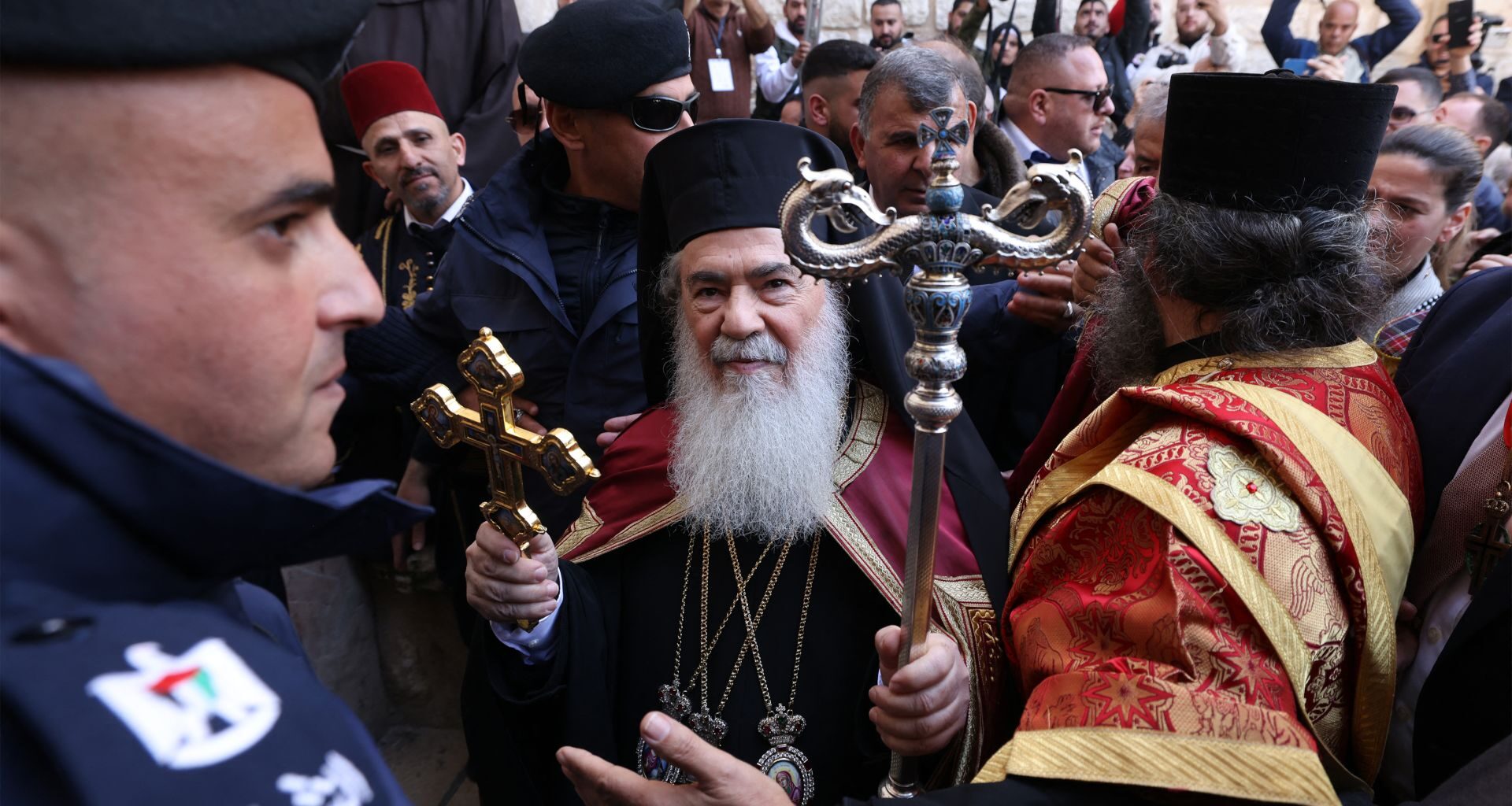
The Greek Orthodox archbishop of Gerassa, Theophanes, led a group of us through the Old City of Jerusalem, threading through the narrow souks from the Greek Patriarchate to the Church of the Holy Sepulchre. We were interrupted by many things on this short walk: the archbishop’s explanations of places and history; people kissing his hand, asking for advice or a blessing; stopping to buy icons to be blessed in the sacred spaces inside the church. When we finally arrived at the courtyard in front of the holiest sites in Christianity, we stopped to survey the surprisingly cramped and confusing building in front of us.
“One expects the central shrine of Christianity to stand out in majestic isolation,” writes the scholar of biblical studies Jerome Murphy-O’Connor in the “Oxford Archaeological Guide to the Holy Land” (2008), “but anonymous buildings cling to it like barnacles.” His criticism goes on and on. “One looks for numinous light, but it is dark and cramped.” The ear is assaulted by “warring chants,” he writes, and the visitor encounters “jealous possessiveness” between the six sects that share the sacred site: Latin Catholics, Greek Orthodox, Armenian Orthodox, Syrians, Copts and Ethiopians. This arrangement was decided in the so-called “status quo” agreement, from a decree issued by the Ottoman Sultan Osman III in 1757 that divided ownership and responsibilities across many holy sites, with further decrees specifying that any change had to be agreed by all six communities, making renovations to these places difficult to negotiate. In short, “The frailty of humanity is nowhere more apparent than here; it epitomises the human condition.”
I recognized much of this description when I read it after my own visit, but Murphy-O’Connor’s excoriation does not convey the genuine awe the site inspires — in me as much as in the many religious tourists waiting in line to visit each separate holy place inside. According to the widely accepted history of the faith, this is where Jesus was crucified and where his body was washed and then buried, in a prepared tomb nearby. The church marks each of these places, but how reliable are the locations? Neither Theophanes nor Murphy-O’Connor has a shadow of a doubt.
“The most important argument for the authenticity of the site is the consistent and uncontested tradition of the Jerusalem community,” writes the latter, “which held liturgical celebrations at the site until AD 66.” This was the year the Jewish revolt began, which led to the destruction of the city by the Romans, clearing the way to create a new city, built on a well-established pattern. As various scholars have argued, this new city was not only meant to promote a Roman identity, but was also designed to quell rising Jewish nationalism in the area.
“Actually, the Romans did us a favor in this case,” the archbishop said, looking at the church while telling this story of the suppression of Christianity in the first century after Jesus was crucified. Christians, who at that point were seen as a Jewish sect rather than a nascent new world religion, the archbishop said, made this a place of worship immediately after Christ’s death, which the Romans didn’t like — so they built a pagan temple on top, part of their redesign of the whole city.
This is well attested by both history and archaeology, with sources describing how the Roman Emperor Hadrian filled in the quarry underlying the site in front of us in 135 CE to provide a level platform for his new temple to Jupiter, flanked by a shrine dedicated to Venus. But what he likely didn’t think about was how this would indelibly mark the spot.
The local tradition certainly didn’t forget this. Two centuries later, there was a Christian emperor in power, Constantine, and a much more established structure and hierarchy to the Christian faith. The bishop of Jerusalem, Macarius I, traveled to the Council of Nicaea, the pivotal meeting to formalize early Christianity, in 325 and successfully petitioned Constantine to demolish the Roman temple to uncover the tomb of Christ. Constantine’s mother, the Empress Helena, traveled to the Holy Land on a well-documented trip, and legend has it that she discovered the very cross Jesus was crucified on — along with the tomb, likely marked with his name (as many tombs of the period were), and the site of his crucifixion, alongside the area where criminals waited for their fate.
All these places tally with the descriptions in the Gospels as well as the uninterrupted local traditions. Much of the historical evidence is still visible in the church (the quarry that was there in the first century BCE; the many tombs cut into the rock face, recorded as a common place for burial; the hill the executions were on marked by different levels inside). This all leads Murphy-O’Connor to the same conclusion as the archbishop, albeit with a little more circumspection. “Is this the site where Christ died and was buried?” he writes. “Yes, very probably.” Even the far more conservative Encyclopedia Britannica dryly admits: “No rival site is supported by any real evidence.” This site in front of us offers far more evidence than most biblical sites visited by tourists and archaeologists, but in no small part thanks to the period when Romans canceled festivities.
Helena also traveled to Bethlehem, where the Romans had attempted exactly the move they had made in Jerusalem, covering the locals’ sacred site with their own pagan temples. In 395 CE, some 70 years after Helena’s visit, St. Jerome wrote that, in the approximately 180 years between the reigns of Hadrian and Constantine, “Even my own Bethlehem … was overshadowed by a grove of Thammuz, that is of Adonis, and in the very cave where the infant Christ had uttered his earliest cry, lamentation was made for the paramour of Venus.” By the time Helena visited in 327 CE, the temple was gone and a shrine to the infant Jesus had been reinstated in the cave. Helena built a chapel over the spot — a hexagonal rotunda where worshippers could stand on a gallery looking down into the cave where the religion began.
I was lucky enough to visit the grotto, now housed in the majestic Church of the Nativity, twice this Christmas Eve. The first visit was while the parades were in full swing, meaning the grotto was empty bar our presence; the second was some 12 hours later, when the same space was packed with a crowd celebrating midnight Mass, replaced every half an hour for another service in another language. (Not knowing the schedule, I was fortunate to coincide with a Spanish Catholic service; those leaving were Sri Lankan, meaning if I’d been half an hour earlier I wouldn’t have understood much of the event.) Both times, empty and full, were full of reverence; perhaps it was a projection, but this venerated place, the heart of Christmas, seemed to contain peace. It was not a feeling that extended very far into the wider region.
Christians have had a durable presence in the Holy Land for the two millennia of the religion’s history, their numbers slowly decreasing over the first centuries of Muslim rule, then gaining a little under the Crusaders, only to shrink again as a proportion since Muslim control was reestablished. This minority has been shrinking much faster since the formation of Israel in 1948. With each war or outbreak of violence, there has been another exodus. Now there are just 40,000 Christians left in the occupied Palestinian territories, forming between 1% and 2% of the population (there are many more inside Israel, with Israeli citizenship). Most of these seemed to be in Bethlehem on this joyous-feeling Christmas Eve.
Marching with drums, brass instruments and incredible numbers of bagpipes, the Scouts ranged from around 6 years old to middle-aged Scout masters, with all ages in between represented. The uniforms, flags and music were similarly varied. Christmas carols were abundant, including “O Come All Ye Faithful” and “Angels from the Realms of Glory” (as I know them; there were only the tunes, with no singing to check the words), and “Jingle Bells” seemed to be a favorite of one band — though many military tunes were also played. I casually asked a friend, “Does anyone mind the, um, colonial overtones of these bands?” For me, it seemed relentlessly British; the bagpipes and tartan sashes were only the loudest elements — there were also spats (a short piece of cloth covering the top of the foot, the instep and ankle, last seen in British fashion many decades ago, though still seen in Scottish piping band uniforms), the international Scouts’ uniforms designed over a hundred years ago and the unmistakable army music of the imperial forces. “We don’t know it’s colonial,” came the reply. “I didn’t know any of this was British until I moved to the U.K. We think it’s our culture.”
But beneath the celebrations are constant revelations about the underlying realities of life in Palestine. I was watching from the roof of a friend’s family home and was brought coffee by someone who works for them. “Her grandson was taken from the refugee camp last night,” someone whispered. “Just 16. They don’t know where he is.” Being in Palestine means experiencing a drip feed of these stories, details added to the ever-present sights of the occupation: the vast settlements overlooking the small town, and the bridges and tunnels exclusively for the use of settlers. The Israeli-built wall cutting through Palestinian land completes the sense of apartheid.
Getting around the West Bank has been difficult for many years, involving checkpoints that are not easy to pass through for everyone, with Palestinians needing permits. Some spoke of being held up, including on Christmas Eve — even participants in the parades. My friends took me through the foot tunnel that Palestinians have to use to move through Checkpoint 300 (leading to the road to Jerusalem), rather than the road the brothers drove along by car. We shuffled through slowly, one person at a time passing through a turnstile, Israeli soldiers for the most part not visible; instead, we were controlled through the frequent cameras, with loudspeakers for instructions when necessary. The turnstile shut occasionally, locking someone in, and that day it happened to me. My friends, already through and waiting for the X-ray machine, laughed back at me. “Perfect Insta post!” one said, “Hashtag welcome to Palestine!” Those lined up behind me were solicitous, making sure I was OK, knowing it wasn’t the norm for me as it was for them. But even in this eerie, slow-moving, uncertain checkpoint, these Palestinians were considered lucky — for having a permit at all. Apparently, only a few thousand had been given for the whole population of Bethlehem.
Although the streets were thronged this Christmas, there were of course many missing: Palestinians and other nationalities who cannot enter the borders of Israel or the occupied territories, and visitors who have kept away from the area because of the perception of violence. The economy — already strangled by the limits on movement around Palestine, enforced through the security wall, checkpoints and permits — is on its knees with the lack of pilgrims.
And above all, the killing and violence of occupation and genocide go on, throughout the West Bank and Gaza, muting the joy of the returning celebrations. I visited the vice chancellor of Bethlehem University, Brother Hernán Santos, in his office, and he showed me the vase of branches on his windowsill, hung with small hearts carved out of olive wood. He told me that “they represent the children who have died (and who continue to die) unjustly in the war in Gaza.” The nativity scene was beneath, the baby Jesus looking into the thicket of hearts. Hernán unhooked one heart from his “tree” and gave it to me: “So that we never forget why we do what we do.”
The brothers told me about how they marked Christmas for the past two years. They had a tree, but instead of the usual lights and decorations, they wrote out the names of people killed in Gaza on strips of paper. Midnight Mass, essential to the Christian faith, was still held, but it was subdued, with none of the accompanying celebrations of food, drink, decorations and parties. Bethlehem itself had no Christmas lights in the streets nor a tree or nativity scene in Manger Square.
Families had small occasions for themselves, trying to keep it going for the children, but balancing this with thoughts of the starving children just an hour away. Meals were restricted to immediate family only; none of the usual street events or big neighborhood parties happened, and the decorations were not visible to the world. This is why this year felt particularly joyful — welcoming back the spirit of the festival that is all about rebirth, goodwill and peace — even though the constant threat of violence, small and large, is never far from the surface.
Become a member today to receive access to all our paywalled essays and the best of New Lines delivered to your inbox through our newsletters.