
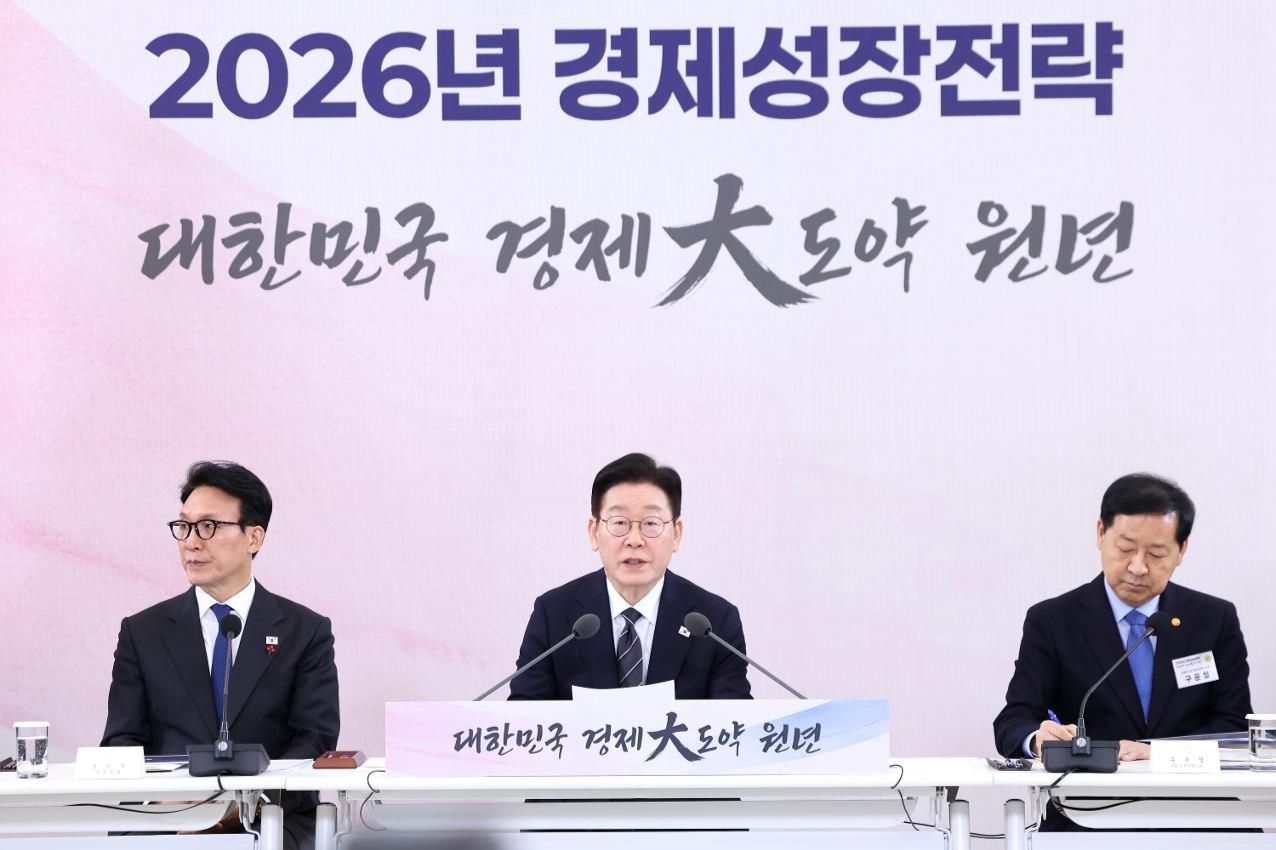
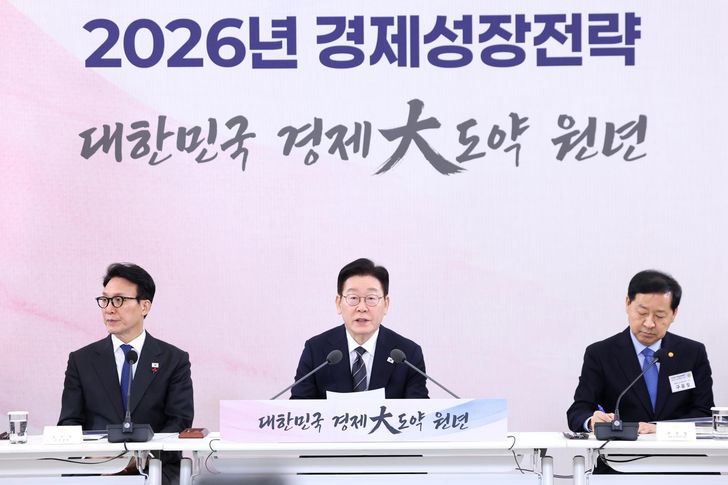
President Lee Jae Myung speaks as Prime Minister Kim Min-seok, left, and Deputy Prime Minister and Minister of Economy and Finance Koo Yun-cheol, right, listen during a government briefing on the 2026 economic growth strategy at Cheong Wa Dae, Friday. Yonhap
Korea will unveil a roadmap to internationalize its currency in the first half of 2026, aiming to strengthen economic resilience against external risks that increasingly destabilize the foreign exchange market, the government said Friday.
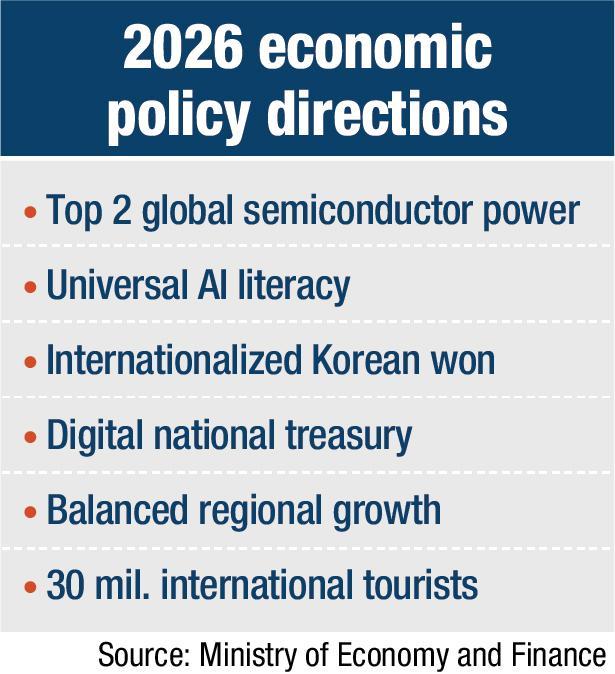
It also said it will aim to manage and execute 25 percent of the national treasury using digital currency by 2030, addressing the rise of decentralized crypto assets being explored by central governments worldwide.
These measures, jointly announced by the Ministry of Economy and Finance and other ministries, are part of the 2026 economic growth strategy designed to build on the positive momentum from President Lee Jae Myung’s first year in office.
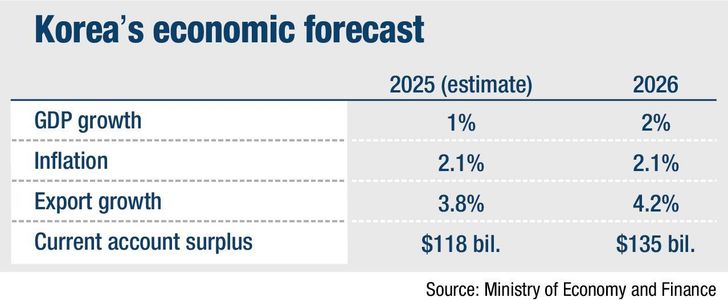
The finance ministry projected 2 percent gross domestic product (GDP) growth in 2026, marking the first time it has formally specified a growth target, up from an estimated 1 percent in 2025.
But long-term economic concerns persist, as the potential growth rate — the economy’s maximum sustainable pace — has slowed to 1 percent and could approach zero by 2040 amid unpredictable domestic and global challenges, such as artificial intelligence (AI)-driven industrial transformation and rising trade protectionism.
The president expressed hope that the 2026 strategy would serve as a catalyst for a major economic leap by 2045, the 100th anniversary of National Liberation Day.
“We must strengthen policy efforts so that the fruits of growth achieved through a great leap forward are shared by everyone, allowing all citizens to grow alongside the nation,” he said at a presidential briefing on the strategy at Cheong Wa Dae.
Deputy Prime Minister and Minister of Economy and Finance Koo Yun-cheol noted that the strategy is “designed to achieve a major breakthrough” in four key areas: aggressive macroeconomic policy, a rebound in potential growth, balanced growth to curb deepening polarization and strengthening the foundation for long-term transformation.
Regarding the local currency, First Vice Minister of Economy and Finance Lee Hyoung-il said in a separate press conference that the Korean won is “still undervalued as a volatile and heavily constrained currency despite expansion of the country’s economy.”
He said a task force will be set up to prepare a roadmap in the first half of the year, adding that the won “should be used more broadly in both cross-border trade and financial transactions.”
The roadmap will focus on reducing costs for domestic businesses, promoting won-based financial products, increasing foreign demand for won-denominated assets and enabling foreign individuals and companies to hold and use the won freely.
Progress is already being made in line with Korea’s step to join MSCI’s developed market index, according to Lee.
“Accordingly, Korea can shift away from its dollar-dependent structure, which is vulnerable to external conditions, to build a more resilient economy,” he said.
As for other financial initiatives, the government promised full-fledged support to manage and execute one-fourth of the national treasury using digital currency by 2030.
For implementation, it will launch a pilot program using digitally tokenized deposits for the electric vehicle charging infrastructure project and establish legal grounds for full-scale blockchain-based payments and settlements, both scheduled for the first half of 2026.
Additionally, preparations for a new sovereign wealth fund are underway, with initial funding of 20 trillion won ($13.79 billion), reflecting the government’s commitment to actively grow national assets.
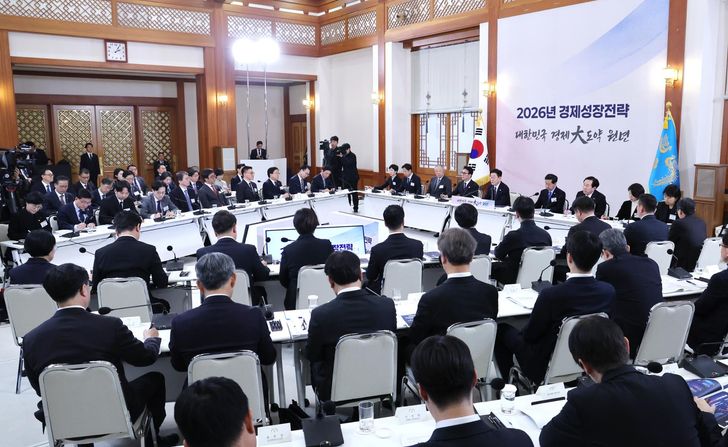
A government briefing on the 2026 economic growth strategy takes place at Cheong Wa Dae, Friday. Yonhap
Hyper-innovative AX economy
The government explained that these initiatives involve cross-industry and societal cooperation, focusing on strategic investment in national industries to build a hyper-innovative economy with AI transformation (AX) at the peak. AX refers to the integration of AI technologies into core sectors, namely robotics, automobiles, shipbuilding, home appliances, drones, plant operations and semiconductors.
As for semiconductors, the country’s top export item, the government aims to secure its position in the world’s top two semiconductor powers and will establish a presidential special committee to oversee this effort.
The committee will develop a 2027-31 roadmap in the fourth quarter of 2026.
The initiative will receive comprehensive support across fiscal policy, taxation, regulation, research and development, skills development, and other areas.
The government will also bolster efforts to nurture the defense and bio industries as new growth engines, while accelerating restructuring in petrochemicals and steel to transform them into low-carbon, high-value industries.
With the goal of nationwide AI literacy, tailored education will be offered for different groups based on age, occupation and other categories, including primary and secondary students, university students who have yet to declare a major, military personnel and small business owners.
To promote balanced regional development, infrastructure for AX, green energy and other promising industries will be nurtured across five regions outside the Seoul metropolitan area.
Moreover, the government will leverage the global appeal of Korean pop culture to attract a record 30 million international tourists this year, while developing relevant sectors such as gaming, food and beauty into strategic export industries through tailored, sector-specific measures.