
p]:text-cms-story-body-color-text clearfix”>
Near the start of “All That’s Left of You,” an elderly mother addresses the camera, her eyes melancholy but her face determined. “I’m here to tell you who is my son,” she explains. “But for you to understand, I must tell you what happened to his grandfather.”
The woman, Hanan, is played by Palestinian American writer-director Cherien Dabis, whose third feature spans more than 70 years of Palestinian history, told through the prism of one family and three generations of its men. Occasionally undone by melodramatic tendencies, “All That’s Left of You” catalogs the emotional toll that occupation visits on the oppressed. Her heartfelt film can be overly dutiful, but underneath one detects the filmmaker’s complicated feelings regarding Israel’s ongoing treatment of Palestine, wavering between defiance and empathy, despair and resilience.
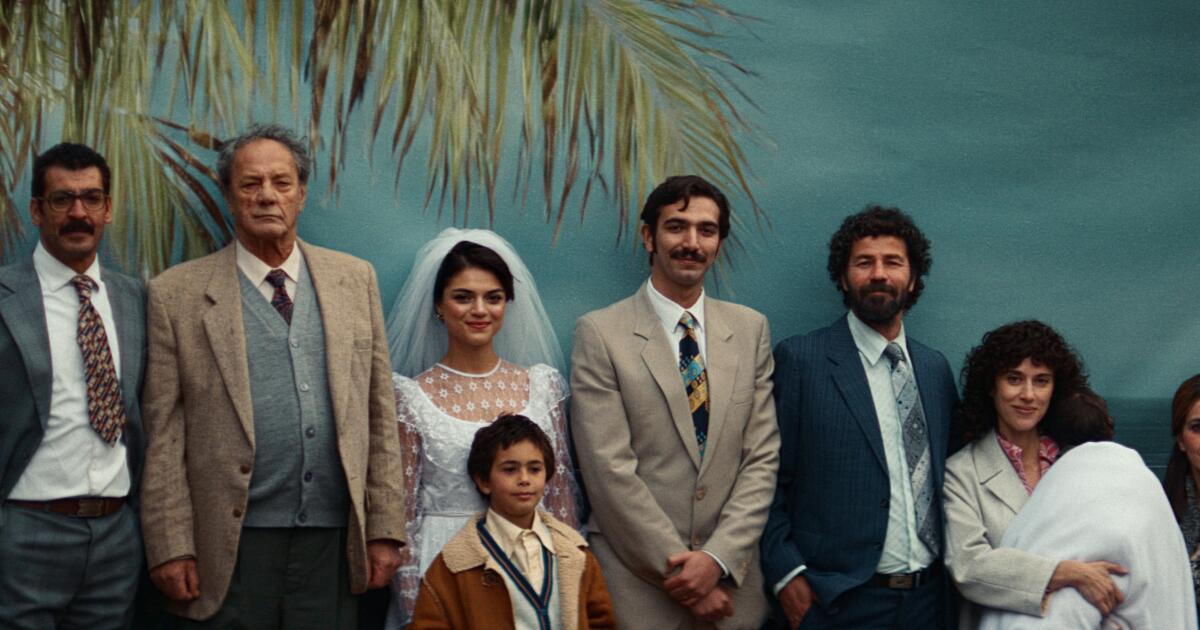
Jordan’s official entry for the international feature Oscar, “All That’s Left of You” takes the audience through four crucial periods in the lives of the Hammad family — 1948, 1978, 1988 and 2022 — traveling from one era of political unrest to the next. In 1948, Zionist forces shell Jaffa, where Sharif (Adam Bakri) resides with his wife and children, including sensitive youngster Salim (Salah Aldeen Mai). All those around Sharif are fleeing, but he refuses to leave his home, although he eventually sends the rest of the family to take shelter in nearby Nablus. Sharif stays behind, his boy Salim crying as the car drives away, separating father and son.
Sharif’s fate in the 1948 segment should not be revealed when discussing Dabis’ film, which then moves forward 30 years, with the adult Salim (Saleh Bakri) married to Hanan in the occupied West Bank. A sweet, idealistic grade-school teacher, Salim doesn’t share his aging dad’s fiery rhetoric regarding Israel. But a charged moment with his own young son Noor (Sanad Alkabarete) during an encounter with Israeli guards will forever alter their relationship — and make Noor sympathetic to his grandfather’s worldview.
That encounter plants a seed that bears bitter fruit in the 1988 chapter once teenage Noor (now played by Muhammad Abed Elrahman) finds himself in the middle of a protest that spirals out of control. As Hanan’s opening monologue suggests, the ensuing calamity has roots that stretch far back, not just to Israel’s initial takeover of Palestinian land but, also, in how the Hammads have internalized their fear and indignity.
Born in Omaha and raised in Ohio and Jordan, Dabis previously directed 2009’s “Amreeka” and 2013’s “May in the Summer,” which concerned characters navigating the chasm between their Middle Eastern heritage and their American lives. But with “All That’s Left of You,” she draws from family stories and her own childhood memories of visiting Palestine to make a film suffused with sadness and tension. And although Hanan is one of the movie’s central figures, Dabis keeps a close eye on the Hammad men, whose masculinity has been shaped (and sometimes wounded) by their people’s inability to be free.
It has been more than a decade since Dabis’ last feature, but in the interim she’s become an in-demand television director on shows such as “Ramy,” “Ozark” and “Only Murders in the Building.” Unfortunately, the polished, tasteful “All That’s Left of You” can suffer from an excessive earnestness, the writer-director letting the worthiness of her purpose smother a potentially fraught, fascinating exploration of how subsequent generations take up (or reject) their parents’ grievances.
But when the storytelling gets too stately, her cast brings the necessary shading. The child roles possess a charming innocence that too quickly will be shattered — Alkabarete’s transformation from cherubic to sullen is especially crushing — while the adults gracefully play worn-down individuals coping with different degrees of emotional duress. Each new segment of “All That’s Left of You” is its own self-contained drama, but they build on one another, the past’s invisible weight bearing down on children who cannot fully comprehend the sorrow that came before, but have grown up knowing nothing else.
The horrors of the 1988 chapter open the door for a plot development that risks coming across as manipulative. Hanan’s stark face at the beginning of “All That’s Left of You” readies the audience for tears by the final reel, but Dabis’ narrative twist pushes the film into a movie-ish unreality that conveniently ties a bow on the script’s pondering of the value of choosing love over hate. But even here, her sincerity overcomes her weakness for sentimental flourishes, including Amine Bouhafa’s treacly score.
Other recent films about Palestine have rippled with justifiable outrage, but “All That’s Left of You” leads with bittersweet resignation and even a modest hope for a better tomorrow. The film ends where it begins, in Jaffa. The characters no longer recognize home, but despite all they have lost, perhaps they can find a few things worth holding onto.
‘All That’s Left of You’
In Arabic and English, with subtitles
Not rated
Running time: 2 hours, 25 minutes
Playing: At Laemmle Royal