
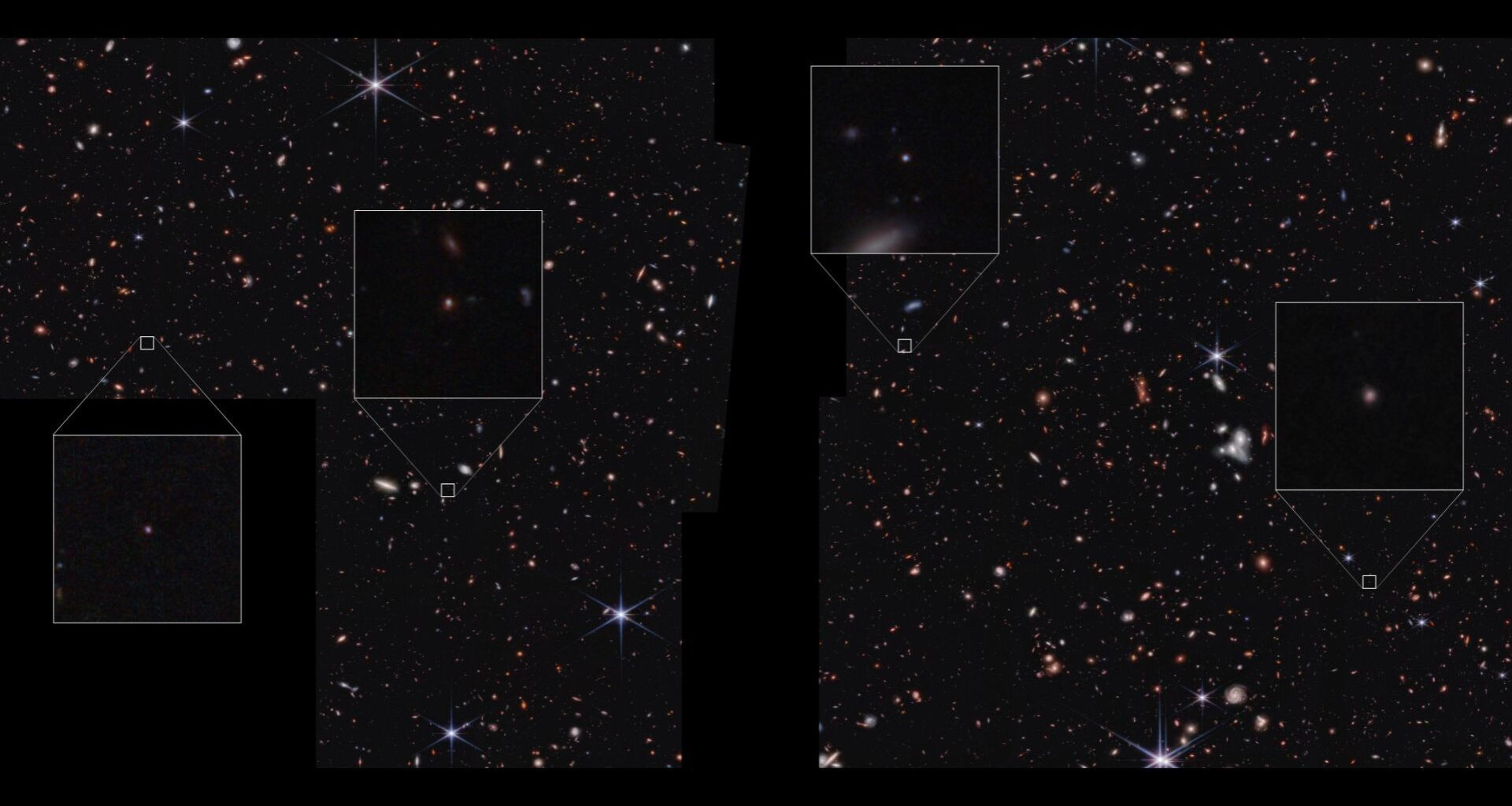
Strange cosmic objects spotted by NASA’s James Webb Space Telescope (JWST) are presently puzzling astronomers. The odd observations show features of both stars and galaxies, leading to researchers referring to them as “platypuses” after the animal with a mishmash of parts. The features may provide hints to how galaxies formed billions of years ago, in the early life of the universe.
At first glance, the newfound objects look like stars, small points of light in the JWST data. Scientists found that further observation revealed more galaxy-like features, however. “If you look at any of the features separately, just putting them together makes a platypus look so odd,” said Haojing Yan, an astronomer at the University of Missouri. “Our objects are exactly like that.”
You may like
Close but not quite
Soon after JWST saw first light in 2021, it began to reveal a number of unusual objects of unknown origin. Inspired by these discoveries, Yan and two of his students began to explore other compact sources in a quest to determine if any strange objects had escaped notice.
The researchers examined approximately 2,000 objects, visually examining each one in search of oddities.. That left nine peculiar, small objects that were slightly larger than a single point of light in the data. Usually, such compact objects are classified as point sources, and most tend to be stars. But on further examination, the researchers realized that the objects were larger and more diffuse than a point source, leading them to classify the objects as “point-like”.
“It’s very close to a point source, but not exactly,” Yan said.
Instead of the broad emission lines linked to stars, however, the researchers found narrow lines indicative of the active star formation usually found in galaxies. They turned their eyes toward quasars, quasi-stellar objects powered by the supermassive black holes in galactic centers. Quasars — a type of active galactic Nuclei (AGNs) — are classified by the light they emit.
But while the newfound objects bear a strong resemblance to known classifications of quasars, they don’t quite fit. For one thing, they are dimmer than expected. Their spectral fingerprint is also narrower than even narrow-line quasars.
“Our objects are not quasars,” Yan said.
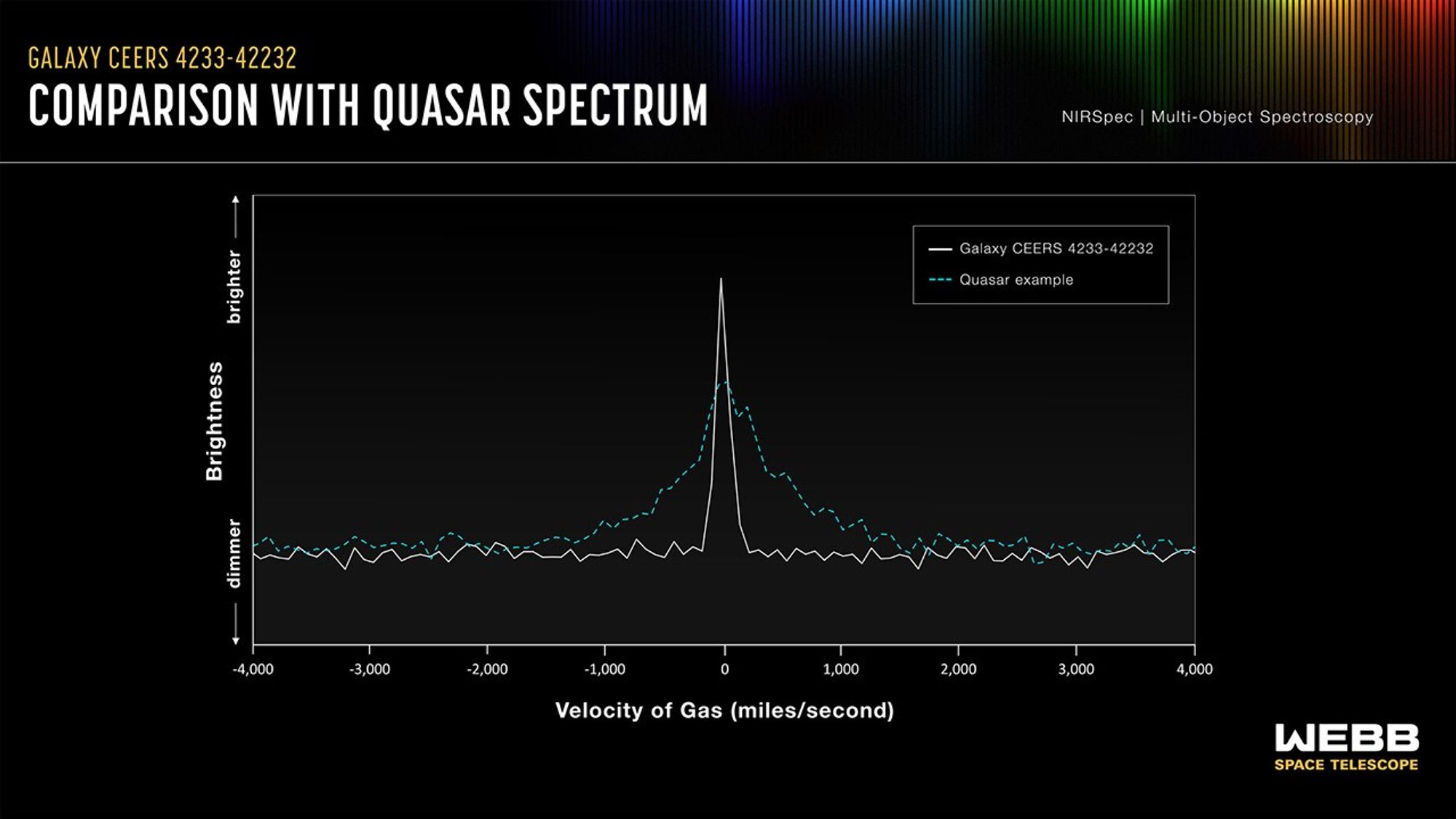
This graphic illustrates the pronounced narrow peak of the spectra that caught researchers’ attention in a small sample of galaxies, represented here by galaxy CEERS 4233-42232. Typically, distant point-like light sources are quasars, but quasar spectra have a much broader shape. (Image credit: NASA, ESA, CSA, Joseph Olmsted (STScI))
That doesn’t preclude them from being a different form of AGN, however. Yan said they could be a class of objects known as narrow-line AGN. However, known narrow-line AGNs tend to show up as point sources rather than point-like.
You may like
“If our objects end up within the narrow-line AGN [classification], they must be of a new kind,” Yan said.
Another possibility is that the unusual objects are star-forming galaxies. Although all galaxies form stars, star-forming galaxies do so at an accelerated rate. They also produce narrow emission lines, “like duckbills are normally seen in ducks,” Bangzheng Sun, also of the University of Missouri, said at the news conference.
If the objects are star-forming galaxies, Sun said, they must be young — no more than 200 million years old. “They are still in their infancy,” he said.
Additionally, if the strange specks are galaxies, their slightly expanded size is hard to understand. “These galaxies must be sitting there, forming stars from the inside out,” Sun said. “This is a process we have not seen before.”
The inside-out process may be happening in multiple galaxies, Yan told Space.com. But while most stellar production induces violent, chaotic motion, “our objects would imply that such processes in them could be happening in a very peaceful way (as opposed to the usual merging process) so that their point-like appearance remains intact,” Yan said by email.
The researchers think they have identified a population of these new objects, but whether they are a new form of AGN or odd young galaxies remains a question. They hope to find more examples in future observations with JWST.
“These nine objects are special,” Yan said. “They are our platypuses.”