
Throughout the cycles of protests that have rattled Iran over the years, a common limitation has been the lack of a credible, structured opposition inside or outside the Islamic republic.
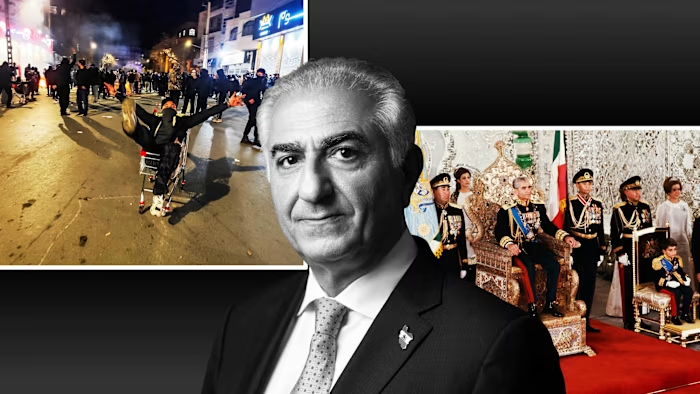
But one constant, Reza Pahlavi, the exiled son of the last Shah, is once more positioning himself as the would-be leader of those pushing for regime change as Iran struggles to contain the biggest wave of unrest in several years.
And, analysts say, this time there are anecdotal hints that support for the exiled prince may be rising, if only because disillusioned Iranians see few other options.
“With significant investment and rebranding, the former crown prince’s image and odds have improved, putting him in a top position among opposition figures in the diaspora,” said Ali Vaez, an Iran expert at Crisis Group. “Internally, too, desperation among some Iranians for a redeemer has revived nostalgia about another [Shah] rescuing the country from ruin, as his grandfather did in the 1920s.”
 The coronation of Mohammad Reza Pahlavi in 1967. Queen Farah Pahlavi is seated on his right and Crown Prince Reza Pahlavi on his left © Rolls Press/Popperfoto/Getty Images
Analysts caution that the true extent of his popularity is unknown, with no signs of nationwide support. Many in large cities such as Tehran who oppose the regime also resent the idea of a return to the past and instead advocate for a democratically elected republican government.
For years, Pahlavi — who promotes himself as a “transitional leader” but lacks an organised political structure — has been derided as being distanced from the republic and dependent on a splattering of monarchists inside and outside Iran.
But with the republic at its most vulnerable in decades, as it grapples with a confluence of increasing external and domestic pressures, analysts say he and his supporters can stoke the flames of fury.
On Thursday, videos posted on social media showed huge crowds taking to the streets of Tehran and other cities in what appeared to indicate that the 12-day protests, which erupted over economic grievances, were intensifying. There was a near complete internet blackout on Thursday night and on Friday, cutting the Islamic republic off from the outside world.
The apparent uptick in the demonstrations came after Pahlavi this week issued what he described as his “first call to action,” using social media to call on the protesters to begin chanting in unison at “precisely” 8pm on Thursday and Friday evenings.
Ellie Geranmayeh at the European Council on Foreign Relations, said: “People would have come out no matter what, but from what I’ve seen there was a spike in turnout last night with some protesters chanting his name.”
She said that given the internet blackout, it was “very difficult to assess the crowd numbers that showed up specifically for Pahlavi”.
But she added that Pahlavi was helping to galvanise support on the ground, backed by overseas Iranian television networks that Tehran considers opposition channels but are watched inside the republic.
 Videos posted on social media showed huge crowds taking to the streets of Tehran to protest © UGC/AFP/Getty Images
“Combined with the economic desperation, some are concluding that Pahlavi is better than other options,” Geranmayeh said. “But Iran is a country of 90mn people, and while Pahlavi has gained momentum, many civil society actors inside Iran continue to press for homegrown democratic change.”
Under the Islamic regime, no organised internal opposition has been able to mobilise. Authorities sniffed out any hint of organised dissent, jailing activists, critics and former regime loyalists who had turned against the system.
Regime supporters have long dismissed Pahlavi, while myriad competing voices in the large and vocal Iranian diaspora diluted his impact. But today he is by far the most prominent figure, analysts say.
Based in the US, Pahlavi has for years watched developments in Iran from afar, waiting to pounce when the regime that ousted his father in the 1979 Islamic revolution faces an eruption of social arrest, or more recently, conflict.
His profile rose during the last eruption of mass protests, known as the Women, Life, Freedom movement, in 2022. As that uprising spread across the country, he met American lawmakers and toured European capitals in am attempt to drum up support.
Last year, he pinned his hopes on Israel’s 12-day war on the Islamic republic providing his opening. He repeatedly called on Iranians to rise up against their leaders even as the nation rallied around the flag, telling the FT it was “the first time in all these years that we see the playing field being more even for an opportunity for change”.
But on each occasion, the regime, while bruised, stood firm. And Pahlavi, who has not stepped foot in the republic since 1978 when he left, aged 17, to study in America, returned to the margins of Iranian politics.
This time, however, Iranians say that anecdotally his name does appear to be more prominently chanted by those taking to the streets as the protests have spread to provincial cities and towns.
Alongside anti-regime slogans such as “death to the dictator” — a reference to the 86-year-old supreme leader Ayatollah Ali Khamenei — some have also chanted “Long live the Shah” and “Pahlavi will come back”.
 Iran’s supreme leader Ayatollah Ali Khamenei on Friday accused protesters of acting on behalf of US President Donald Trump © Khamenei.ir/AFP/Getty Images
Support for Pahlavi appears to have been strongest in western and southern provinces such as Lorestan, Ilam and Fars, where the local communities have traditionally backed the Pahlavi dynasty.
The Islamic regime has long worried about foreign interference and a US or Israeli push for regime change. Khamenei on Friday accused protesters of acting on behalf of US President Donald Trump, who has repeatedly warned that Washington will come to the rescue of demonstrators if the regime cracks down on them.
Tehran will also be aware that its regional enemy, Israel, which dramatically revealed the depth of its intelligence penetration in the republic during its June war, may seek to exploit the situation.
The threat of renewed Israeli strikes has hung over the republic since June, exacerbating the sense of angst and uncertainty.
Pahlavi’s relationship with Israel — he met Prime Minister Benjamin Netanyahu twice during a visit to Israel in 2023 — could work against him, analysts say.
Trump so far appears unconvinced about Pahlavi. When asked in an interview broadcast on Thursday if he would meet the exiled royal, the US president said he seemed “like a nice person” but added: “I’m not sure that it would be appropriate at this point to do that as president.”
“I think that we should let everybody go out there, and we see who emerges,” Trump said.
Vali Nasr, a former US official who is a professor at the Johns Hopkins School of Advanced International Studies, said Pahlavi could play an important role to push the narrative of the protests “away from just protesting over inflation and bread and butter issues in the direction of an alternative to the Islamic republic”.
But, Nasr added, “I don’t think [Pahlavi] is in a position to play a role should the regime fall, because he has no grounding there”.
He cited the differences with the 1979 revolution, whose leader Ruhollah Khomeini had a broad network inside Iran.
“First I don’t think the regime is falling in the way people outside think. Even if it becomes a really, really big crisis, what I would expect is an action within the regime, a kind of military coup,” Nasr added. “I just don’t see the Revolutionary Guards disappearing.”
He and others said there were also lessons for Pahlavi from Trump’s extraordinary military operation to capture Venezuelan President Nicolás Maduro this month.
The US’s raid served as a warning to Iran to take Trump’s threats seriously. But his decision not to support the Venezuelan opposition or push for elections, and instead leave the Bolivarian regime in place, at least for now, was also a cautionary tale to Pahlavi, analysts said.
“What happened in Venezuela suggested that at least within the White House they are more realistic than we assume,” Nasr said.
The most organised opposition is the Mujahedin-e Khalq (MEK), an exiled group that enjoys support in the US from Iran hawks such as veteran Republican John Bolton.
During the 1980s, it backed Iraq in its war with Iran, and the Islamic regime often accuses it of stoking protests and instability and collaborating with Israel. Analysts say the militant movement, often described as a cult, is loathed and feared in Iran, where it is accused of killing officials and civilians.
“The government is in a really awkward position,” said Mehrzad Boroujerdi, a professor at Missouri University of Science and Technology. “I cannot think of another moment in time when they have been weaker economically, weaker regionally, weaker military, with a supreme leader so paralysed.”
He believes, however, there is “paralysis of both the state, but also the opposition”.
“Right now, even though [Pahlavi] is the most recognised name among opposition figures, unfortunately he’s not doing anything consequential in bringing that opposition together,” Boroujerdi said. “The divisions and the cleavages that exist within the opposition are as deep as ever.”