
Pizza, pasta and pigging out — for many of us, Italian food equals indulgence. We think la dolce vita means stuffing our faces with cheese and meat-laden dough or creamy, calorie-dense bowls of spaghetti, washed down with a pint of Aperol spritz and finished, naturally, with tiramisu.
But this is not how Italians really eat — certainly not in my family. Traditional Italian cooking sits at the heart of the Mediterranean diet. Said to be one of the healthiest ways of eating in the world, it is predominantly built on plants, healthy fats such as extra virgin olive oil, and small amounts of meat and fish. Pizza and pasta exist, of course, but they’re only part of a bigger, more nuanced picture.
“Italy has so much more to offer than pizza and pasta,” says chef Gennaro Contaldo, a mentor to Jamie Oliver and the author of Verdure. “Humble vegetables, for example, play a huge part — they are not an afterthought or just eaten as side dishes but often the hero of the plate.”
The chef Theo Randall agrees. “Italian cuisine is made up of 20 regions, each with its own collection of recipes, many of which are not just delicious but naturally healthy and balanced.”
He adds: “Since introducing regional menus at my restaurant, Theo Randall Cucina Italiana, and writing recipes for my cookbooks, I’ve discovered countless dishes from across Italy that have a real lightness and simplicity. They’re easy to prepare and very good for you. Extra virgin olive oil, for example, has well-documented health benefits and is far better than cooking with butter, which is much higher in saturated fat.
“Simply dressed fish and vegetables with lemon juice and olive oil make a delicious meal that’s light, good for digestion and supportive of heart health. Cooking Italian food is a wonderful way to eat yourself into a healthier lifestyle.”
That certainly tallies with my own Italian upbringing. My nonna’s cooking ranged far beyond the stereotypes and always prioritised balance, variety and flavour: sweet, slow-cooked peperonata; chicken thighs gently stewed in tomatoes until they collapsed at the touch of a fork; and her famous salads, which somehow managed to convince children that they liked lettuce. Coming from the coast, my Sardinian grandfather favoured seafood — anchovies, octopus and marinated mussels — which I ate beside him as a child as he taught me how to count to ten in Italian. We ate a lot of pasta, but never without vegetables and a source of protein. To this day I feel deprived if someone serves me just pasta and nothing else.
In January, when we’re craving food that feels restorative rather than heavy, real Italian cooking is worth returning to: simple, tasty and nourishing dishes that leave you feeling energised, not in a food-induced stupor. Now that’s la dolce vita.
• Read restaurant reviews and recipes from our food experts
Gennaro Contaldo’s aubergine parmigiana
“This is the traditional aubergine parmigiana my family have been making for decades,” says Contaldo. “It takes a little time to prepare, but it is so well worth it. You can make it in advance and reheat when required. Although parmigiana was always a side dish when I was growing up, I now make it as a main, served with a green or mixed salad, for a delicious meal.”
Serves 6
Ingredients
500g aubergines
A little flour — for dusting
4 eggs, lightly beaten with a little salt
Sunflower or vegetable oil, for frying
A handful of basil leaves
65g grated parmesan
1 mozzarella ball, torn
For the tomato sauce
2 tbsp extra virgin olive oil
½ onion, finely chopped
1 small garlic clove
2 tins of chopped tomatoes (or the equivalent amount of passata)
Method
1. Thinly slice the aubergines lengthways. Place the slices on a dish and sprinkle with salt. Cover with baking parchment, place a weight on top (a few tins on a board will do) and leave for 30 min. This will draw out excess moisture from the aubergines.
2. Meanwhile, prepare the tomato sauce. Heat the olive oil in a pan, then gently sweat the onion and garlic over a medium heat for a couple of minutes until softened. Stir in the tomatoes, about half a tin of water and a little salt to taste. Simmer over a medium-low heat for about 25 min.
3. Preheat the oven to 180C fan/gas 6. Lay a clean tea towel on a work surface and arrange the aubergine slices on top. Cover with another clean tea towel and pat dry thoroughly, ensuring the slices are completely dry.
4. Dust the aubergine slices lightly in flour, shaking off any excess, then dip them into the beaten egg. Heat enough oil in a large pan to shallow-fry. Fry the aubergine slices for a couple of minutes on each side until golden. Drain on kitchen paper and pat dry to remove as much excess oil as possible.
5. Spoon a little tomato sauce into the base of an ovenproof dish. Add a layer of aubergines, scatter over some basil leaves, sprinkle with parmesan, then add some mozzarella and season with black pepper. Continue layering in this way until all the ingredients are used, finishing with tomato sauce and grated parmesan.
6. Cover with foil and bake for 20 min. Remove the foil and return to the oven for a further 20 min, until the top is golden brown. Remove from the oven and leave to rest for 5-10 min before slicing and serving.
• We’re living la dolce vita! What is it really like?
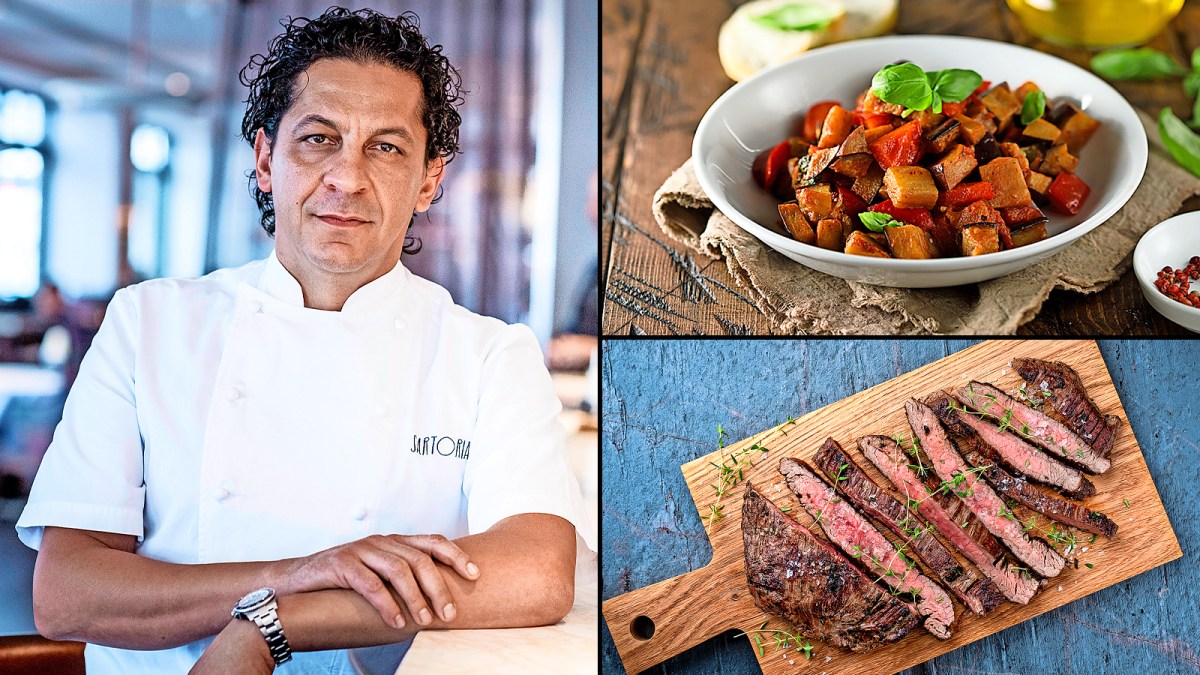
Francesco Mazzei’s caponata
This sweet-and-sour Sicilian classic can be thought of as a warm salad, packed full of plants and wonderfully moreish thanks to that agrodolce (sweet and sour) sauce. At his new restaurant, Mezzogiorno, Mazzei celebrates this vegetable-rich southern Italian dish, as opposed to the richer, creamier cuisine of the north.
Serves 4
Ingredients
3 aubergines
Vegetable oil, for deep-frying
1½ sticks celery, chopped
1½ large onions, chopped
2 tbsp extra virgin olive oil
80g tomato purée
1 tbsp capers, rinsed
10 green olives, pitted and halved
1 tbsp pine nuts
1 tbsp raisins
½ tbsp sugar
80ml red wine vinegar
3 tbsp almonds, toasted and crushed
Bread, to serve
Method
1. Cut the aubergines into 3cm cubes and transfer them to a bowl of cold salted water for 30 min. Meanwhile, heat a deep-fryer or a deep pan of oil to 190C (if you don’t have a thermometer, the oil will be hot enough when a breadcrumb dropped into it turns golden within a few seconds).
2. Drain the aubergine cubes and pat dry with kitchen paper. Deep-fry in the hot vegetable oil until golden and cooked through (5-7 min), then transfer to a plate lined with kitchen paper to drain off any excess oil.
3. Blanch the chopped celery in salted boiling water for 2-3 min then set aside, reserving the cooking water.
4. Place the onions in a saucepan and cover with half a glass of water (about 100ml). Cook until the water has evaporated, then add the extra virgin olive oil and sauté the onions for a minute or two. Add the tomato purée, capers, olives, pine nuts, raisins and the blanched celery, along with a little of its reserved cooking water. Cook for 5 min.
5. Add the fried aubergine cubes and mix gently. Dissolve the sugar in the vinegar, and add it to the caponata. Cook for 2 min over a medium-high heat. Remove from the heat and allow to cool.
6. Serve at room temperature, sprinkled with the crushed toasted almonds and some warm bread.
• The rules of Italian cooking you should never break (and those you can)
Theo Randall’s grilled beef tagliata with pan-charred vegetables
For a protein-packed dinner or lunch this steak recipe with lots of delicious charred veggies will hit the spot.
Serves 4
Ingredients
2 red peppers, halved lengthways
2 medium aubergines, cut into 2cm-thick rounds, then halved
2 medium courgettes, cut into 1cm-thick rounds on a slight angle
300g asparagus, tough ends removed
300g tenderstem broccoli, tough ends removed
5 tbsp good olive oil
Juice of 1 lemon
8 basil leaves
2 × 300g sirloin steaks, fat left on, at room temperature
1 red chilli, seeds removed and finely chopped
3 tbsp chopped flat-leaf parsley
1 garlic clove, peeled and crushed with sea salt to a paste
2 tbsp aged balsamic vinegar
Method
1. Heat a large non-stick frying pan over a high heat. Place the peppers cut-side down in one of the hot pans and cook until the skins are well charred, about 15 min. Transfer to a bowl, cover with clingfilm and leave to steam.
2. Wipe the pan clean, then add the aubergine slices. Cover with a lid and cook for 4 min. Turn the slices over and cook for a further 4 min. Check they are cooked through by inserting a fork — it should slide in easily. If not, cook for a further 2 min. Remove from the pan and set aside. Heat another large non-stick frying pan for which you have a lid over a high heat.
3. Wipe the pan again and arrange the courgette slices evenly in the pan. Cook for 4 min on one side, then turn and cook for another 4 min. Remove from the pan and set aside.
4. While the courgettes are cooking, use the second pan to cook the asparagus and tenderstem broccoli. Add 2 tablespoons of water, cover with a lid and cook for 4 min. Shake the pan to turn the vegetables, then cook for a further 4 min. Remove and set aside to cool slightly.
5. Remove the peppers from the bowl. Using a serrated knife, scrape away the charred skin, then turn them over and remove any seeds. Cut the flesh into 1cm strips and set aside.
6. Place all the cooked vegetables in a large bowl. Add 3 tablespoons of olive oil, the juice of half the lemon, the torn basil leaves and season with salt and pepper. Set aside.
7. Heat a very hot griddle pan or one of the frying pans. Hold the sirloin steaks fat-side down to render the fat, about 2 min. Lay the steaks flat in the pan and cook for 2 min on one side, then turn and cook for a further 2 min. Remove from the pan and rest on a warm plate for 4 min.
8. Mix the chilli, parsley, garlic and balsamic vinegar together in a small bowl with 2 tablespoons of olive oil to make a sauce. Taste for seasoning.
9. Trim the fat and sinew from the rested steaks, then slice the beef thinly against the grain, keeping all the resting juices. Place the beef and juices in a bowl and toss with half the sauce.
10. Arrange the vegetables on a large serving platter, top with the sliced beef, then spoon over the remaining sauce. Serve in the centre of the table.