
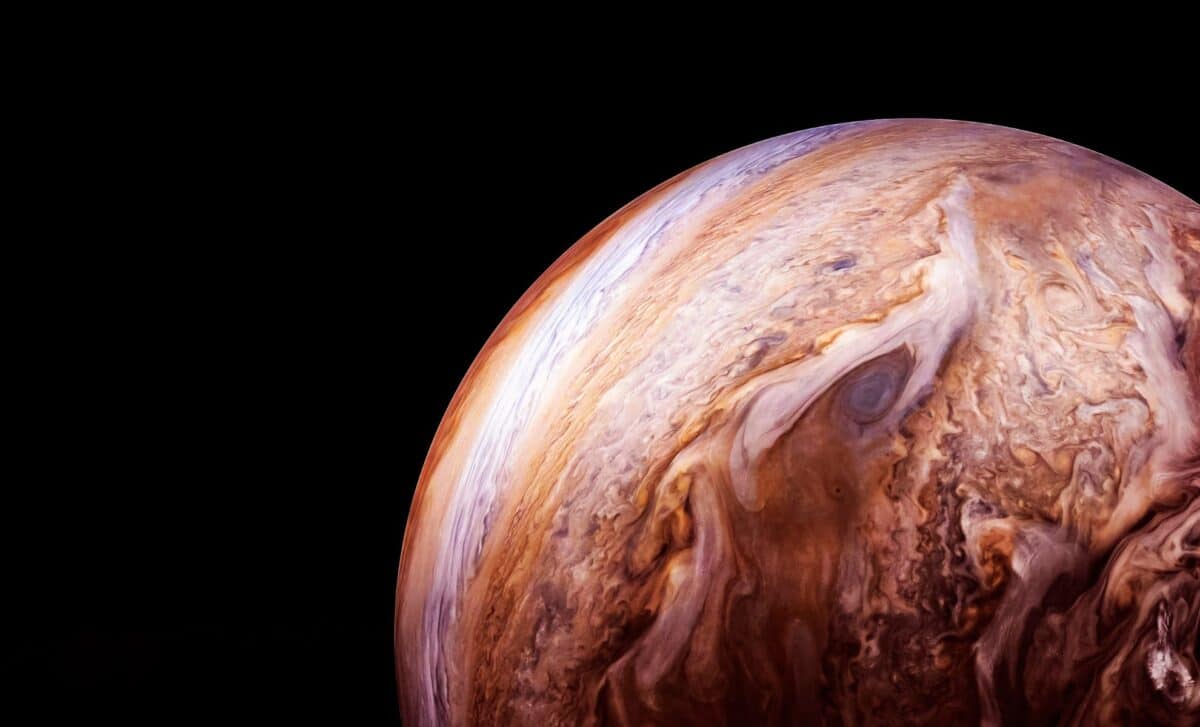
Jupiter’s Great Red Spot, a storm that has captivated scientists for centuries, has shrunk to the smallest size ever recorded. Recent observations from NASA’s Hubble Space Telescope reveal that the iconic storm, once large enough to fit Earth inside, is now dramatically smaller than it has been in recorded history.
The Great Red Spot has been visible from Earth for more than 350 years. While scientists have long noted the storm’s gradual shrinking, the latest measurements show an unprecedented acceleration in its size reduction.
Shrinking to a New Low
The Great Red Spot, known for its massive size and distinctive reddish color, has now shrunk to a diameter of 10,250 miles, the smallest measurement ever recorded. According to data from NASA’s Hubble Space Telescope, this storm was once as large as 25,500 miles across, with earlier observations, including those made during NASA’s Voyager missions in 1979, measuring the stormat 14,500 miles.
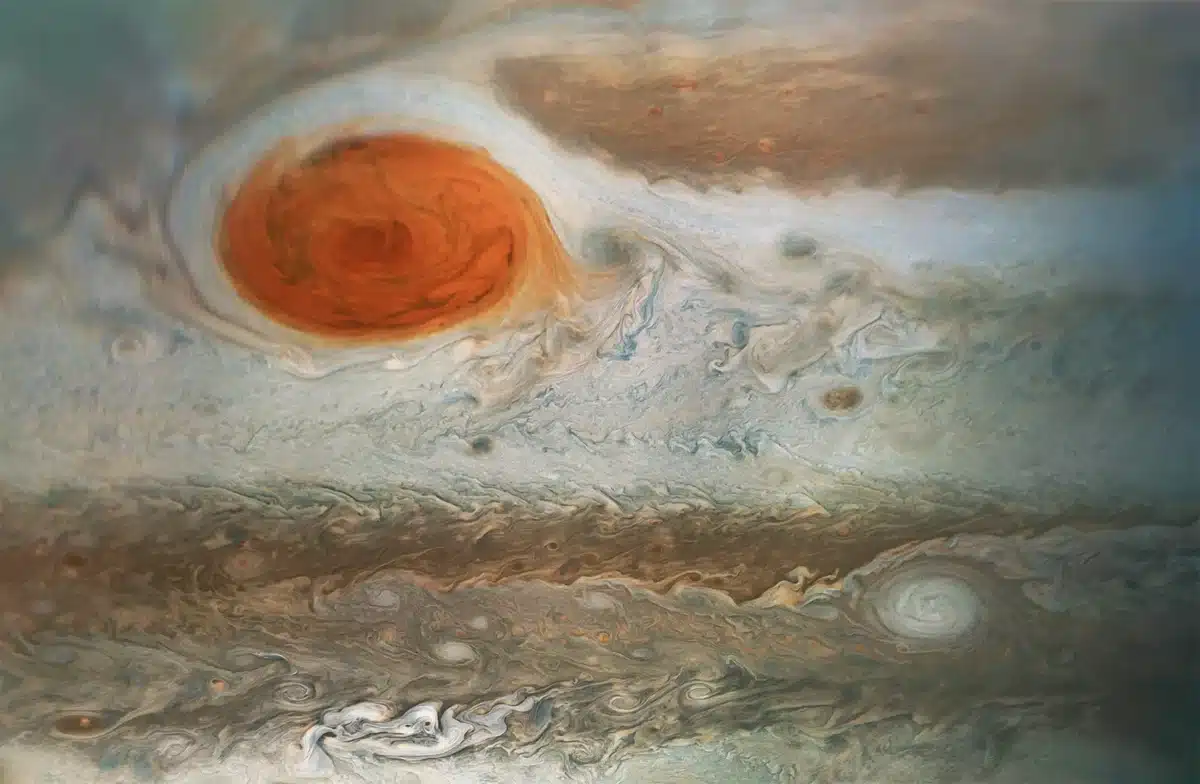 Jupiter’s Great Red Spot. Credit: NASA/JPL-Caltech/SwRI/MSSS/Gerald Eichstädt/Seán Doran
The most recent shrinkage rate, first noticed in 2012, shows the storm is reducing in size by approximately 580 miles every year.
Despite its dramatic shrinkage, the storm is still enormous when compared to Earth. Yet, its rapid contraction in recent years has surprised many researchers.
“In our new observations it is apparent that very small eddies are feeding into the storm,” said Amy Simon of NASA’s Goddard Space Flight Center.
What’s Changing Inside!
Over the years, the storm’s shape has shifted from an oval to a more circular form. This transformation is part of the broader changes taking place within Jupiter’s atmosphere, and researchers are paying close attention to these developments.
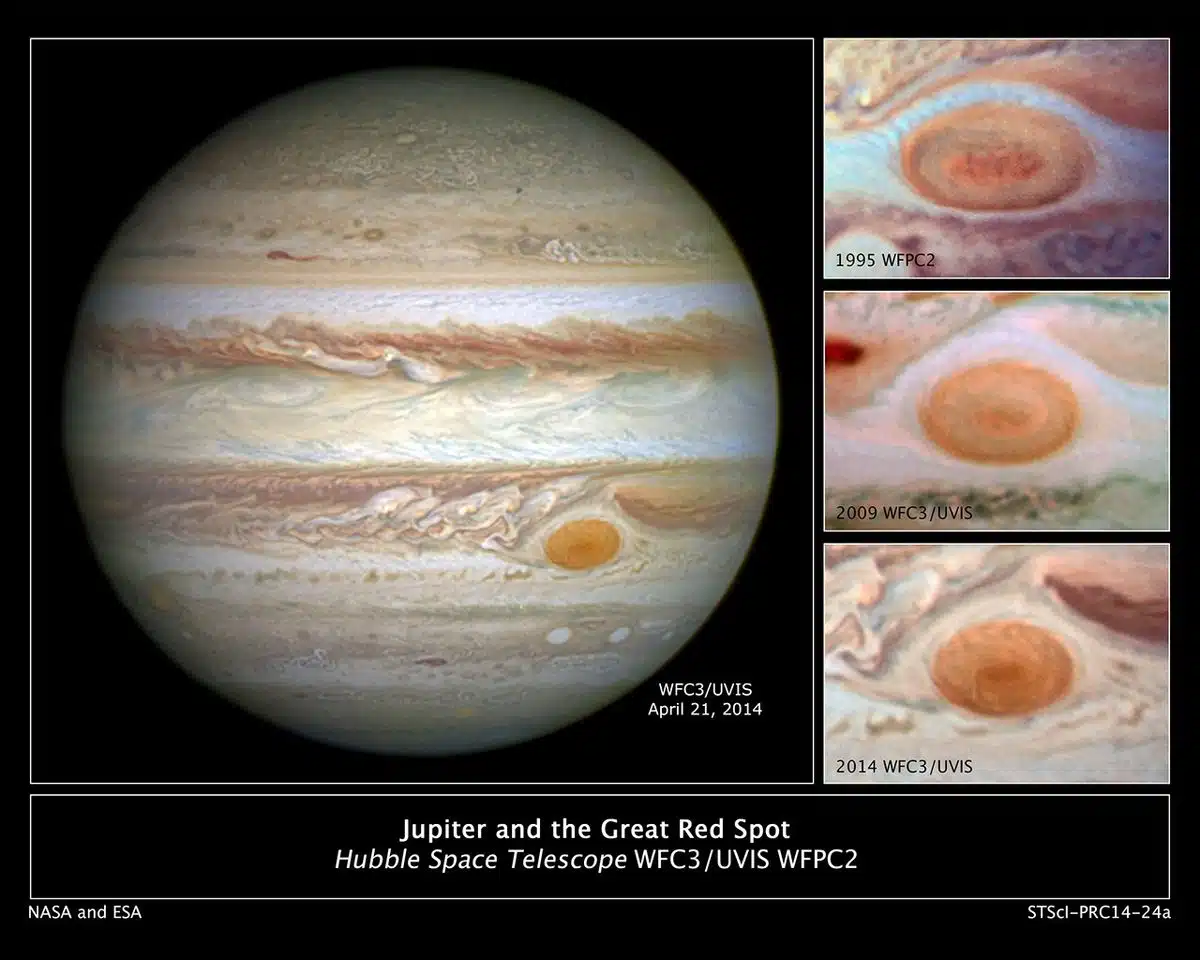 A stunning comparison of Jupiter’s Great Red Spot over nearly two decades, captured by the Hubble Space Telescope. Credit: NASA/ESA
Simon and her team believe that small atmospheric eddies, or whirlpools, may be affecting the storm’s internal dynamics. These eddies could be feeding into the Great Red Spot, altering the energy and momentum that drives the storm’s vast circulations. According to Simon:
“We hypothesized that these may be responsible for the accelerated change by altering the internal dynamics and energy of the Great Red Spot.”
The Mystery Unfolds
While the shrinking of the Great Red Spot is well-documented, the cause remains unclear. Scientists have speculated that various factors, such as changes in Jupiter’s atmospheric conditions or shifts in the storm’s internal structure, could be contributing to its reduction in size. However, no definitive explanation has emerged.
This is a beautiful timelapse video made of Europa and IO passing over Jupiter’s Great Red Spot using hundreds of images from Cassini!
📷: NASA/JPL pic.twitter.com/gDOnqavVsD
— Shining Science (@ShiningScience) July 3, 2025
Recent observations, particularly those from the Hubble Space Telescope, have provided a wealth of data to study the storm’s evolution. By closely monitoring the dynamics of the storm, scientists hope to uncover the reasons behind the recent acceleration in its shrinking.