
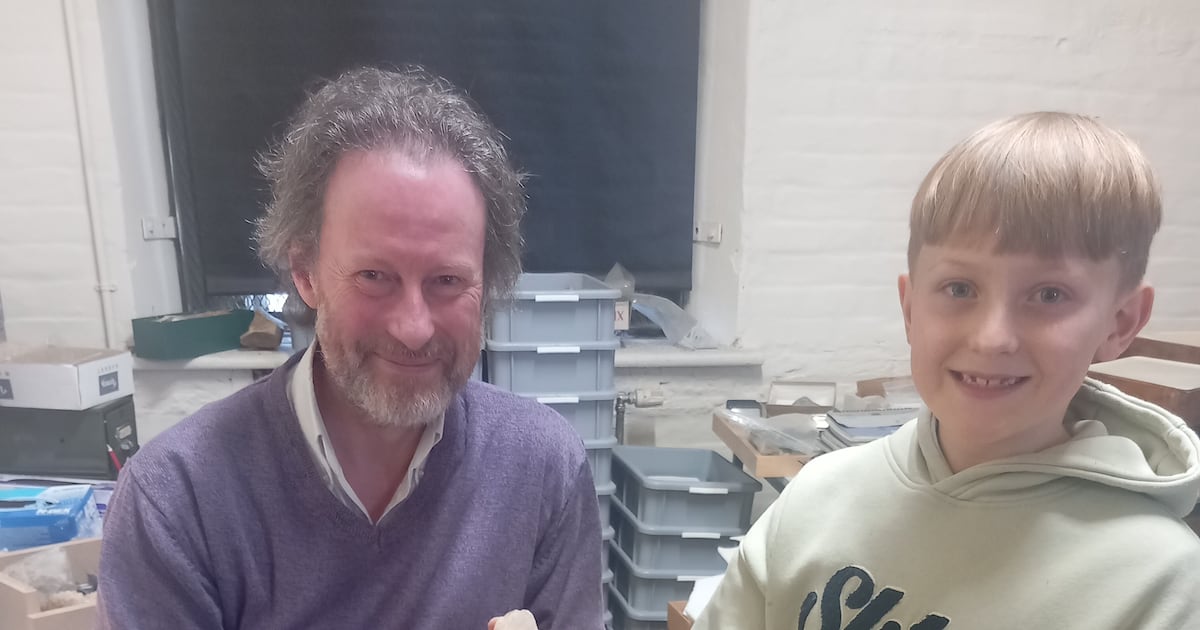
Around lunchtime on March 1st, 2024, Patrick Roycroft, geology curator at the National Museum of Ireland, was given a piece of mineral, about the size of a Creme Egg, by a seven-year-old boy called Ben O’Driscoll. Just a few weeks earlier, in mid-February, Ben had returned home after soccer practice one Saturday morning and had decided to explore a field near his home in Rockforest East, near Mallow in Co Cork.
He knew from his grandfather’s stories that something unusual might lie beneath the fields and he was encouraged to go searching. That day, as he ran out to a freshly ploughed field, Ben spotted something in the mud. When he showed his mother, Melanie, what he’d found, she sensed he’d struck it lucky. She got in touch with Roycroft, packed the family into the car and drove up to Dublin through the snow, with the small, pearly stone in tow to find out more.
Roycroft knew exactly what he was looking for. Within seconds, he realised what he had in his palm was genuine: a true cotterite, one of the rarest forms of quartz in the world. It had a very characteristic optical effect – a silvery lustre – which is not seen in any other quartz. What Ben had found was the first discovery of cotterite in 150 years.
To label cotterite as “rare” – implying it exists in small numbers, but might still turn up somewhere, some time again – is almost misleading. There are about three dozen known authentic cotterite specimens, which are held by museums in Cork, Dublin, London and even the Smithsonian in Washington. They were all found within a few months of each other and derive from a single horizontal vein of calcite, quartz and ferruginous mud cut through carboniferous limestone in Rockforest. It was formed in a single geological event under conditions so specific that, as far as scientists know, they have never been repeated anywhere else in the world since.
At the heart of this story is Roycroft, who has been central to piecing together how cotterite forms, meticulously deciphering clues to uncover the mineral’s little-known ancient past. But he’s also paid attention to the recent human side of the story and the people who discovered cotterite in the first place. This tale has one character: a woman called Grace Elizabeth Cotter, who grew up in Knuttery, a townland near Rockforest in Cork.
She made the first find in 1875 in the Rockforest estate, which was then owned by her uncle. Curious and clever enough not to ignore what she discovered, Cotter passed it on to a local geology enthusiast in Mallow, who then got it into the hands of Robert Harkness, a scientist. Within a few years, Harkness had introduced it to the Mineralogical Society of Great Britain and Ireland, naming it cotterite in Grace’s honour.
Minerals are atoms fitted together in a repeated pattern. In a regular quartz, each silicon atom bonds to four oxygen atoms, forming a regular, transparent 3D structure. This looks like a pyramid with a triangular base. The solid crystal has a smooth, glassy surface that reflects light evenly, making the quartz shine like a newly cleaned window.
So why is it that cotterite, although a quartz, has a pearlescent finish? As the crystal grows, cotterite develops in extremely thin layers, each about 10 microns thick (in contrast, a strand of human hair is 50-100 microns). As they grow, they develop gossamer-thin cracks that produce a frosting effect, scattering light in silver waves. The effect is ethereal, giving cotterite a distinctive sheen. These minuscule differences in how the atoms stack together have produced a natural variant that looks completely different. It’s a quartz from Cork that doesn’t behave like quartz at all.
Cotterite grew in Cork because Rockforest offered a precise set of conditions: the fluids, temperatures, pressures and chemistry which, at that moment, conspired to create something extraordinarily unique. Only there, only then, did this alchemy produce a crystal that looks so different.
The exact location of the geological treasure that formed within the locally-worked quarry, which could have been the size of half a room in a house, in Rockforest, is no longer known with certainty. Harkness noted that it appeared beneath a thin layer of reddish clay in an area that covered just 6sq m, but by 1878, the clay and the conditions that produced it had vanished.
But the mineral itself continues to intrigue geologists like Roycroft. Why does the quartz grow in such layered sheets? What role did the red iron-rich mud play in its formation? What were the exact growth conditions that produced this mineral? In essence: how did cotterite come about?
As Roycroft writes in the latest issue of the Irish Naturalists’ Journal, the 2024 specimen will forever be called the ‘Ben O’Driscoll Cotterite’. It is a fitting reward for young Ben’s curiosity and enthusiasm that February morning.
In many ways, cotterite is as much a story about attention – paying it and following it, just as Grace, Ben, and Patrick Roycroft did, and the intense interest it offers us – as it is about chemistry and geology. These rare gems, hidden away in the smallest pockets of Ireland, are waiting for us to notice them.