
(SOUNDBITE OF ARCHIVED RECORDING)
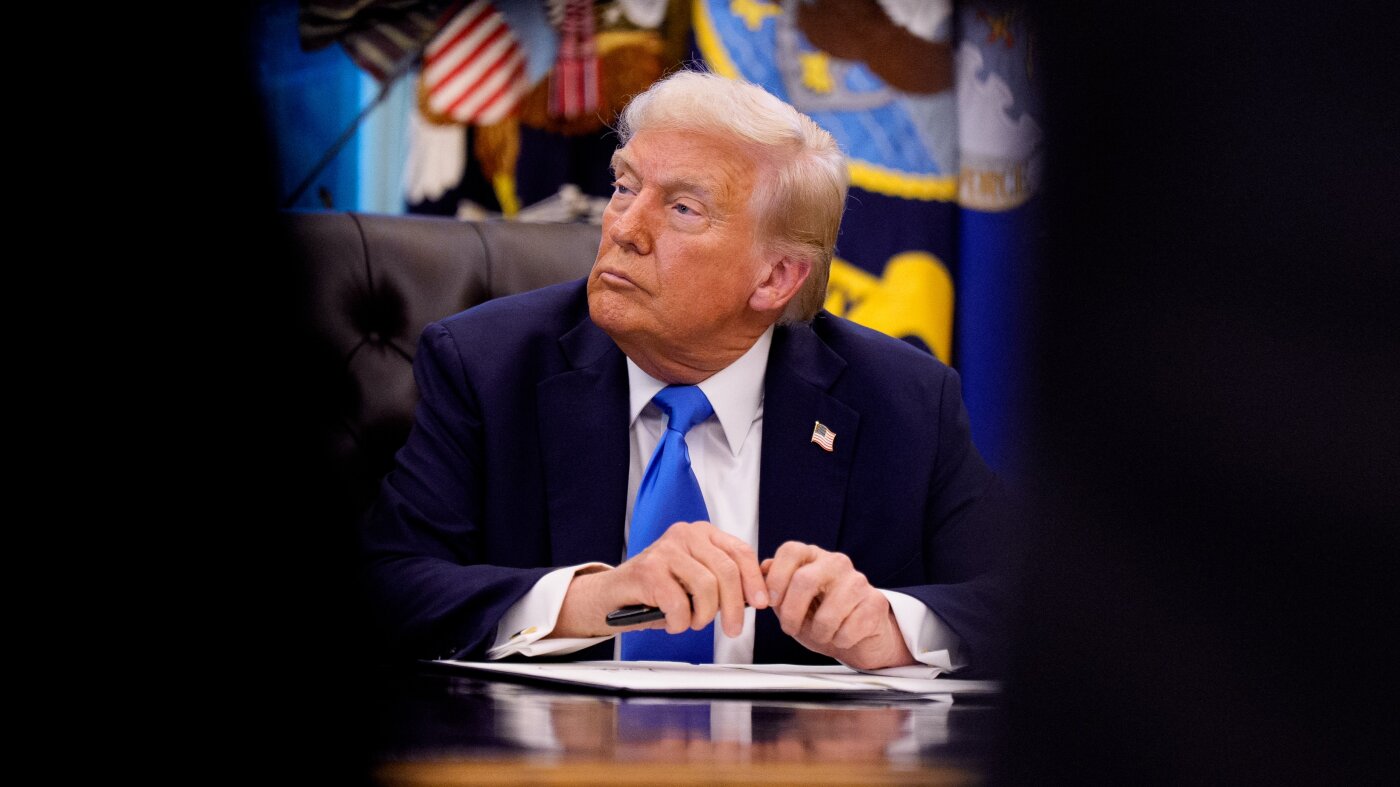
PRESIDENT DONALD TRUMP: The most important difference between our plan and that of our opponent is that our plan will put America first.
MARY LOUISE KELLY, HOST:
When Donald Trump first ran for president in 2016, he promised a focus on domestic issues.
(SOUNDBITE OF ARCHIVED RECORDING)
TRUMP: Americanism, not globalism, will be our credo.
KELLY: He offered a vision for American foreign policy, and he vowed to keep the U.S. out of global conflicts.
(SOUNDBITE OF ARCHIVED RECORDING)
TRUMP: We must abandon the failed policy of nation building and regime change.
KELLY: But in his second administration, a shift. Trump has ousted Venezuelan President Nicolás Maduro…
(SOUNDBITE OF ARCHIVED RECORDING)
TRUMP: We are going to run the country until such time as we can do a safe, proper and judicious transition.
KELLY: …Threatened Iran for its suppression of recent protests…
(SOUNDBITE OF ARCHIVED RECORDING)
TRUMP: If they start killing people like they have in the past, I think they’re going to get hit very hard by the United States.
KELLY: …Talked about annexing Greenland.
(SOUNDBITE OF ARCHIVED RECORDING)
TRUMP: We need Greenland from a national security situation. It’s so strategic.
KELLY: Trump has launched military strikes on terror targets in Yemen, Syria, Nigeria, while threatening to annex Canada, retake the Panama Canal and more.
STEWART PATRICK: There’s no question that in his second term, Donald Trump is entirely unbound, and he’s eager to throw America’s weight around in the world.
KELLY: Stewart Patrick is a specialist on world order and international cooperation at the Carnegie Endowment for International Peace. He says Trump is waving aside rules-based international order in his effort to ensure U.S. dominance, and that’s worrying Americans. According to a new NPR/Ipsos poll, nearly half of Americans say Washington should stay out of other countries’ affairs. And while the poll also finds that Americans want the U.S. to be a moral leader in the world, far fewer actually think it is.
(SOUNDBITE OF MUSIC)
KELLY: CONSIDER THIS – in his second term, Trump’s foreign policy is dramatically reshaping the global geopolitical landscape. So how are people reacting inside the U.S. and beyond?
(SOUNDBITE OF MUSIC)
KELLY: From NPR, I’m Mary Louise Kelly.
(SOUNDBITE OF MUSIC)
KELLY: It’s CONSIDER THIS FROM NPR. President Trump raised eyebrows when he told The New York Times there was only one thing that could stop him on the global stage.
(SOUNDBITE OF ARCHIVED RECORDING)
TRUMP: Yeah, there’s one thing – my own morality, my own mind.
KELLY: So what do Americans think about the moral standing of the United States? Well, a new NPR/Ipsos poll released today finds Americans still want the U.S. to be a moral leader in the world, but far fewer think it actually is. To make sense of what that means and hear what else Americans told us in this poll, I am joined by NPR senior political editor and correspondent Domenico Montanaro. Hi there.
DOMENICO MONTANARO, BYLINE: Hey. Great to be with you.
KELLY: And senior international affairs correspondent Jackie Northam. Hey, Jackie.
JACKIE NORTHAM, BYLINE: Hi, Mary Louise.
KELLY: Domenico, just walk us through key findings of this poll. What did we learn?
MONTANARO: Well, the survey, we should say, was conducted before the U.S. military action in Venezuela, but it is more about Americans’ broader sentiment on foreign policy, and it shows some really notable shifts from a similar survey conducted nearly a decade ago. On the question of moral leadership, like you were talking about, 61% say the U.S. should be the world’s moral leader, but only 39% think that it actually is. And that’s down sharply from 60% in 2017.
One more point. There’s a seeming contradiction that stood out to me among Republicans’ thinking about Venezuela here. Two-thirds of them say that the U.S. should not hesitate to use military force, but 56% say that the U.S. should stay out of the affairs of other countries. So it’s a warning sign for Trump going forward on Venezuela. His party’s rank and file are seemingly fine with military action, might not be OK with running the country long term.
KELLY: Wow. Some really interesting shifts from a decade ago. OK, that’s how Americans view this moment. Jackie, what about everyone else? How is the world looking at, say, America’s involvement in Venezuela?
NORTHAM: Well, I talked to a number of analysts in the U.K., France and in India, just to get a sense of how the Venezuela operation was being viewed. And, you know, there was muted reactions from a lot of governments in part because leaders don’t want to annoy Trump. But people in many countries are very worried, not only about the disrespect for international law, but more broadly is, where does this stop? Trump is talking about acquiring Greenland, even by force, threatening Cuba, Colombia, Mexico. I spoke with Sylvie Kauffmann, and she’s a foreign affairs columnist at Le Monde in Paris. And she said that’s a real concern for people.
SYLVIE KAUFFMANN: There’s quite a lot of emotion about this. When you hear people on the radio, they are worried about what is next. You know, can they really invade Greenland? What will happen? What should we do? Are we going to send troops there?
NORTHAM: And of course, Mary Louise, allies are wondering if relations with the U.S. – you know, alliances such as NATO – will hold up if something does happen in Greenland.
KELLY: Say more about that, Jackie. Beyond Greenland, beyond Venezuela, how allies are trying to navigate relations with the U.S.
NORTHAM: It’s a real challenge. It has – throughout, you know, this first term. It seems if a country does something Trump doesn’t like, he’ll retaliate, like with increased tariffs or sanctions. I spoke with Pratap Mehta, and he’s a senior fellow at the Centre for Policy Research in Delhi. And he says at the beginning of Trump’s second term, a lot of leaders thought this action was simply transactional. He’s after resources or money. But Mehta says, a year on, they see there’s something else driving Trump’s actions.
PRATAP MEHTA: It’s actually quite remarkable how much he seems to believe that part of the problem with America’s relations with the world is that America had actually not exercised its power correctly. Quite extraordinary, and I think the rest of the world is beginning to see that.
NORTHAM: And that’s led to a real erosion of trust in the U.S., Mehta says. You know, in fact, two of the people I talked with used the term enemy.
MONTANARO: Yeah, it’s really remarkable to hear, you know, people using the term enemy. You know, domestically, half say that the U.S. has lost influence worldwide in this survey, while 57% say China, who’s also seen as the leader in technological development, has gained it.
KELLY: Domenico, on that, do we know how much is specific to President Trump, how much this reflects things being viewed through the partisan lens in this very partisan moment?
MONTANARO: Yeah, really a lot. I mean, when you look inside those numbers, almost three-quarters of Democrats and 6 in 10 independents think the U.S. has lost influence around the world, compared to just a quarter of Republicans who think so, too. Just like with so many things in U.S. society, things are viewed through this lens of Trump, whether it’s the economy or here, we’re talking about foreign policy. And we see that show up in this survey on everything from military intervention, American moral standing, whether the U.S. should give humanitarian aid to other countries, whether the U.S. should prioritize democracy and human rights, or, thinking about Venezuela again, whether foreign policy should focus on enriching America and Americans.
KELLY: Yeah. Stay with what you just raised about democracy and human rights and whether American foreign policy should focus on prioritizing that versus enriching Americans. What does the survey say?
MONTANARO: Well, on whether foreign policy should focus on enriching the country, two-thirds of Republicans say it should, compared to just 29% of Democrats and less than half of independents who said that. Promoting democracy and human rights are more of a priority, again, for Democrats now, and that’s something Trump seems to have shifted quite a bit from the way the GOP used to talk about international intervention.
KELLY: Yeah.
MONTANARO: You know, it’s not that long ago that Republicans were talking about the need for the U.S. to spread democracy and counter communism, to tout freedoms and voting. But in this survey, only 16% of Republicans say that those things should be the priorities compared to a majority of Democrats. Instead, it’s way more transactional for Republicans.
KELLY: Just fascinating. OK, so big picture question. I’ll throw it to both of you. How should we think about where U.S. foreign policy may go from here? Domenico, you first.
MONTANARO: It seems very much in flux. You know, we’ve seen Trump upend the post-World War II world order. He’s moving towards something that is more about regional and hemispheric strength, an idea that really dates back to colonialism. And he’s been able to convince his base that this is the way to go, in part because Americans don’t care as much about foreign policy compared to, say, the economy as a voting issue. This survey, for example, found 61% say that they follow domestic politics at least fairly closely, compared to just 43% who say the same of international affairs. So after events like Venezuela, the messaging to a domestic audience is so key because certainly Trump’s base is convincible.
KELLY: And Jackie?
NORTHAM: Trump certainly is embracing force to advance U.S. national security interests and likely feels pretty confident after what appears to be a successful military operation in Venezuela. But, you know, I spoke with Michael Cox, and he’s a professor of international relations at the London School of Economics. And he says Trump could be too confident.
MICHAEL COX: There’s a danger now, it seems to me, of the classical overreach, of hubris, to use the old fantastic Greek word. And that’s not going to do anybody any good. It therefore becomes a rather dangerous moment.
NORTHAM: You know, Mary Louise, Cox says none of Trump’s ambitions are given. You know, there are many things, including domestic problems, that could undermine Trump’s actions.
KELLY: NPR’s Jackie Northam and Domenico Montanaro. Thanks to you both.
MONTANARO: You’re welcome.
NORTHAM: Thank you very much.
KELLY: And for more on NPR’s coverage of the changing world order, you can put world reordering in your search engine.
This episode was produced by Kai McNamee, with audio engineering by Ted Mebane. It was edited by Vincent Ni, Nick Spicer and Sarah Handel. Our executive producer is Sami Yenigun. And a thank you to our CONSIDER THIS+ listeners, who support the work of NPR journalists and help keep public radio strong. Supporters also hear every episode without messages from sponsors and unlock bonus episodes of CONSIDER THIS. You can learn more at plus.npr.org.
(SOUNDBITE OF MUSIC)
KELLY: It’s CONSIDER THIS FROM NPR. I’m Mary Louise Kelly.
Copyright © 2026 NPR. All rights reserved. Visit our website terms of use and permissions pages at www.npr.org for further information.
Accuracy and availability of NPR transcripts may vary. Transcript text may be revised to correct errors or match updates to audio. Audio on npr.org may be edited after its original broadcast or publication. The authoritative record of NPR’s programming is the audio record.