
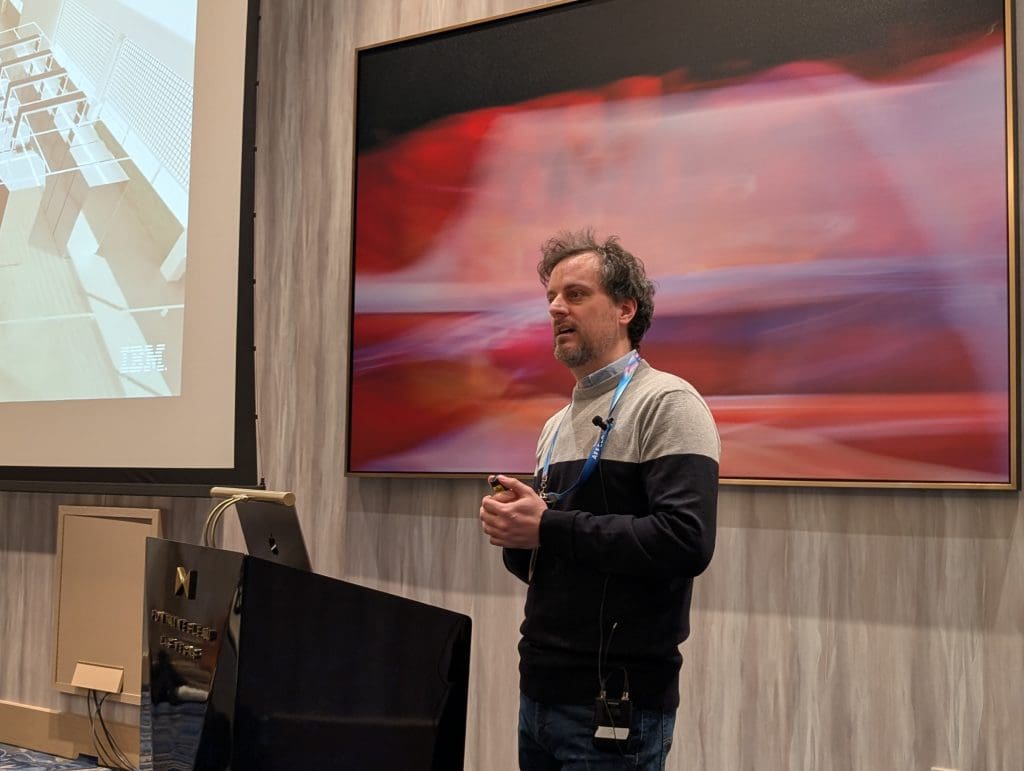
Standing room only as IBM’s Borja Peropadre lays out the roadmap to quantum advantage, and why 2026 could be the inflection point
IBM expects “strong claims of quantum advantage” to emerge this year. That was the headline message from Borja Peropadre, who leads a team of algorithm engineers at IBM Quantum, speaking to a packed room at the Fontainebleau’s CES Foundry in Las Vegas.
Peropadre was direct about IBM’s mission: “Our mission at IBM is to bring useful quantum computing to the world.” He outlined a roadmap first published in 2019, since extended to 2033, noting that “year over year, we’ve been delivering in that vision and in this roadmap.”
The presentation centred on three milestones. The first, “quantum utility,” was achieved in 2023. The second, quantum advantage, is expected this year. The third, fault-tolerant quantum computing with error correction, is targeted for 2029.
Peropadre referenced a prediction made by Jay Gambetta, then vice president of IBM Quantum and now Director of IBM Research, at Supercomputing 2024: “My prediction is quantum advantage is going to happen in the next two years. But only if HPC and quantum communities work together.” Peropadre added: “So we are entering into that year now.”
The case for 2026
IBM’s confidence stems from a 2023 paper that, as Peropadre put it, “created a lot of excitement and a lot of confusion.” The paper demonstrated that a noisy quantum computer using 127 qubits and almost 3,000 two-qubit gates produced accurate expectation values “beyond the capabilities of brute force classical computation.”
Peropadre illustrated the significance with a thought experiment. “Imagine that I give you these ten white boxes. Each of them is a computing machine.” Nine were state-of-the-art classical simulators using approximate algorithms. One was a quantum computer. The outcome: “The quantum computer is the one that is basically on the average of all these things.”
That might sound underwhelming, but Peropadre explained the implications: “There are problems out there where we don’t have brute force exact classical algorithms. And quantum computers can help today to bring solutions or provide solutions where approximate methods really struggle.”
IBM has defined two criteria for quantum advantage. The first is “quantum separation,” which Peropadre described as “this provable separation or this provable outperformance in efficiency, time to solution, accuracy, or quality.” The second is validation: “If I have a quantum computer that produces a faster outcome than a classical computer, but I don’t have brute force or exact classical algorithms that can verify or can tell me that this result is accurate, how can I believe that the quantum computer is doing the right thing? This is what we mean by validation. We need to make sure that the output is rigorously validated.”
IBM has identified three families of problems where noisy quantum computers can produce verifiable results. The first is “observable estimation,” covering dynamics in materials and chemistry. The second is “variational problems,” such as computing the ground state or minimum energy of molecules. Peropadre explained: “If you get an energy that is lower than the best classical method, we know that there will be quantum advantage there.” The third category is “classically verifiable” problems, like Shor’s algorithm for factoring: “If you want to know if that solution is right, you just need to multiply the two smaller numbers and see if the number that you have is right or not.”
IBM is already running experiments across these categories. Using “mirror circuits,” which Peropadre described as circuits that are “easy for us to verify” because “we do one operation on the contrary, so basically it does nothing,” IBM tested two independent quantum computers: IBM Boston and IBM Pittsburgh, both running Heron chips. “We got the same result. This is giving us the feeling that we are getting strong confirmation that we are approaching to compute problems that are beyond what classical computers can produce.”
On variational problems, quantum computers are “starting to outperform the best classical methods that have been the legacy methods in quantum chemistry over the years.” Peropadre called this “another direction where we see potential for quantum computers to outperform classical methods in 2026.”
But he was candid about the competition: “A few days before we were going to present these results, we came ourselves with a classical method that was much better than the quantum computer. I don’t think this is something… this is the nature of science. This is what’s going to happen in the next few years. We’re going to see this feedback loop of quantum basically trying to outperform classical but classical trying to outperform quantum.”
He added a significant qualifier: “We don’t think there’s going to be a strong claim or a final goal post that says quantum advantage has been achieved on this. I think it’s super healthy from a scientific standpoint that we keep working with the classical community and that we keep seeing this evolution of classical and quantum algorithms together.”
To track this competition, IBM and partners including Algorithmiq, the Flatiron Institute, and BlueQubit have created open-source “advantage trackers.” Peropadre explained: “You can go online, you can check it’s open source, and you can basically follow kind of the race between classical and quantum computers.” Researchers post their institution, method, circuit details, qubit and gate counts, and results. “We really expect and we really hope that this gets a lot of traction this year. Everybody joins, everybody puts their results.”
The hardware pipeline
Peropadre walked through the progression of IBM’s quantum processors, using the number of two-qubit gates as the key metric for circuit complexity.
“In 2016, when we put the first quantum computer on the cloud, we had a quantum complexity of three two-qubit gates. Fast forward to 2023, when we did this utility paper, we get almost to 3,000 gates. Last year, we already achieved 5,000 two-qubit gates.”
The roadmap projects continued growth: “By the end of this year, we’re going to have 7,500 two-qubit gates, and we’ll go up to 100 million gates by 2029, and a billion gates by 2033.”
The utility results were achieved on the Heron processor, which has a “heavy-hex topology.” IBM has since released Nighthawk, a 120-qubit chip with a square lattice design. “This chip is able to produce up to 30% more complex quantum circuits than the ones that I described,” Peropadre said. “We expect that this is going to be like our flagship for achieving quantum advantage this year.”
Nighthawk is available to IBM premium clients and partners in the IBM Quantum Network. Peropadre showed a chart comparing IBM’s fleet to competitors including Rigetti, QuEra, Quantinuum, IQM, and IonQ, noting that “all of IBM quantum computers, the entire fleet, is well into what we call the utility region.”
Error correction, which Peropadre described as necessary for “a very robust quantum computer,” is targeted for 2029. Until then, IBM relies on error mitigation techniques. “For the most part, running GPUs and CPUs. So you already start seeing that picture of quantum is not working in isolation. It has to work orchestrated with classical computing resources.”
What remains uncertain
Hardware alone will not deliver quantum advantage. “We need to do algorithm discovery,” Peropadre said. “We need to find more algorithms that really apply to different applications.”
He cited the variational quantum eigensolver, discovered around 2014, as an example: “That was a real disruption in the field, and everybody started working in variational algorithms. The progress over the years has been slow but steady.”
But the real breakthroughs come from new algorithms entirely. “The thing that is really disruptive is the discovery of new algorithms. Something that really changed the game in chemistry was finding new algorithms, like the SQD algorithms, sampling-based quantum diagonalisation algorithms, that brought the number of qubits from around 30 to 80.”
The lesson, Peropadre argued, is that access drives discovery: “Many of the algorithms that have been discovered, even in the past, it’s been when scientists had access to computers. So now these are machines that people, the community have access to. People need to start trying their quantum algorithms in these machines.”
IBM has identified four application domains: Hamiltonian simulation (covering “chemistry or material science or how quantum systems evolve”), optimisation (“from optimising portfolios in finance” to protein folding, which involves “a massive exponential number of possibilities that a protein has to fold over itself”), machine learning, and differential equations (“the behaviour of aeroplanes in certain turbulent landscapes”).
Specific applications Peropadre highlighted included pharmaceuticals (“how small molecules have a direct link to a pocket in a target”) and battery development (“lithium ion, very fundamental molecules and chemical reactions”).
IBM’s Quantum Network has over 100 active test cases with partners including RIKEN, Oak Ridge National Laboratory, and Boeing. “We are very aware that quantum advantage is not going to come through IBM alone,” Peropadre said. “We need our partners and the experts in these different verticals to come and tell us where we need to look for it.”